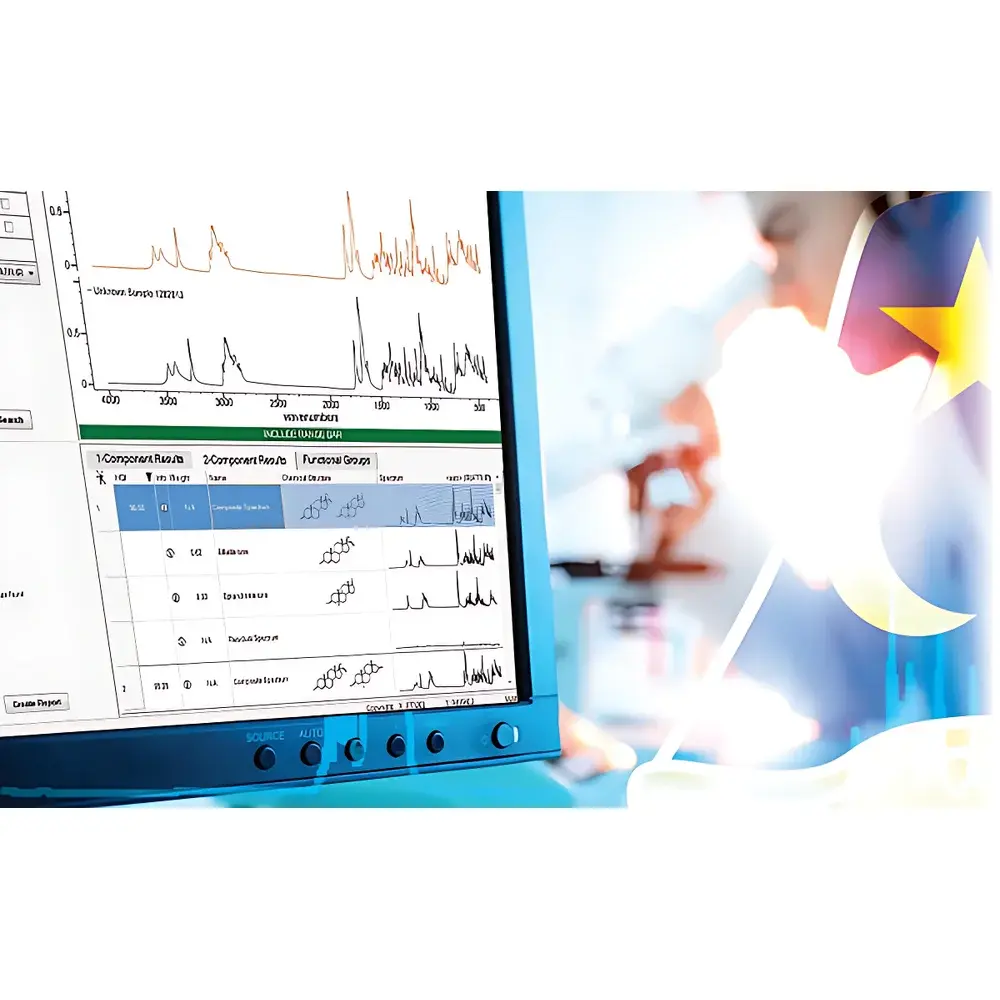
Wiley KnowItAll Raman Spectral Library
| Brand | Wiley |
|---|---|
| Origin | USA |
| Vendor Type | Authorized Distributor |
| Origin Category | Imported |
| Model | Raman Database |
| Price Range | USD 2,800 – 7,200 (based on subscription tier and bundling) |
Overview
The Wiley KnowItAll Raman Spectral Library is a rigorously curated, subscription-based spectral reference resource engineered for analytical laboratories requiring high-confidence compound identification via Raman spectroscopy. Built upon the foundational Sadtler spectral collection—acquired and continuously expanded by John Wiley & Sons—the library delivers over 25,000 experimentally acquired, instrument-validated Raman spectra spanning organic molecules, inorganic compounds, polymers, pharmaceuticals, pigments, minerals, forensic standards, and advanced materials. Each spectrum is accompanied by rich, structured metadata—including CAS Registry Numbers, molecular formulas, IUPAC names, physical state, crystalline form (where applicable), sample preparation method, excitation wavelength, and instrument configuration—enabling precise spectral matching and contextual interpretation. Unlike generic spectral repositories, this library adheres to ASTM E1421–22 and ISO/IEC 17025-aligned curation protocols: all spectra undergo multi-stage validation, including baseline correction verification, peak assignment cross-checking against quantum-chemical calculations (where available), and consistency screening across replicate acquisitions. The library is not a standalone instrument but an integral component of a validated spectral identification workflow compliant with FDA 21 CFR Part 11 and GLP/GMP documentation requirements.
Key Features
- Access to 26 domain-specific Raman databases—including Sadtler Pharmaceutical Series (Parts 1–3), Sadtler Inorganics, Sadtler Polymers & Monomers (Basic Sets 1 & 2), Sadtler Pigments & Dyes, Sadtler Nutraceuticals, HORIBA Forensic and Mineral collections, Sigma-Aldrich Raman Library, and semiconductor-grade material spectra.
- Comprehensive metadata fields: CAS RN, molecular weight, melting point, solubility, functional group annotations, and spectral acquisition parameters (e.g., 532 nm / 785 nm excitation, grating resolution, detector type).
- Integrated search functionality supporting substructure, similarity, and peak-matching algorithms with adjustable tolerance thresholds (±0.5 cm⁻¹ to ±5 cm⁻¹).
- Native compatibility with KnowItAll ID Expert (included) and KnowItAll Analytical Edition (optional upgrade) for automated mixture deconvolution, spectral subtraction, and multivariate analysis (PCA, PLS-DA).
- Direct import support for raw spectral files from major Raman platforms—including Thermo Fisher DXR, Renishaw inVia, Horiba LabRAM, Bruker SENTERRA, and Ocean Insight systems—via standardized .spa, .csv, .jdx, and .txt formats.
Sample Compatibility & Compliance
The library supports identification of solid, liquid, and powdered samples analyzed under common Raman configurations: backscattering geometry, confocal microscopy, macro-probe, and fiber-optic coupling. It is routinely employed in regulated environments where traceability and audit readiness are mandatory—such as pharmaceutical QC labs (USP , ICH Q5E), forensic evidence units (SWGDAM guidelines), and environmental testing facilities (EPA Method 8000D). All spectral entries include provenance documentation: original acquisition date, laboratory source, instrument serial number (where disclosed), and reviewer sign-off logs—ensuring full compliance with ALCOA+ principles (Attributable, Legible, Contemporaneous, Original, Accurate, Complete, Consistent, Enduring, Available).
Software & Data Management
Subscriptions include perpetual access to KnowItAll ID Expert software, which provides secure, role-based user authentication, electronic signature capture, and full audit trail generation per FDA 21 CFR Part 11. Optional KnowItAll Analytical Edition extends capabilities with spectral library fusion (Raman + FTIR co-search), quantitative calibration curve builder, and batch processing for high-throughput screening. Data export is supported in PDF (with embedded spectral images and metadata), CSV (peak table), and XML (for LIMS integration). Backups are managed via encrypted local storage or optional cloud sync (AWS-hosted, HIPAA- and GDPR-compliant infrastructure).
Applications
- Pharmaceutical: Excipient identification, counterfeit drug detection, polymorph screening, and stability-indicating assay development.
- Materials Science: Polymer degradation analysis, carbon allotrope characterization (graphene, CNTs), catalyst composition verification.
- Forensics: Illicit substance profiling, paint chip layer analysis, explosive residue differentiation.
- Environmental: Microplastic identification in water/sediment matrices, mineralogical mapping of soil contaminants.
- Food & Cosmetics: Adulterant detection (e.g., melamine in dairy), pigment authenticity verification, preservative quantification.
- Aerospace & Automotive: Coating integrity assessment, thermal barrier material phase confirmation, composite resin cure monitoring.
FAQ
Is the library compatible with non-Wiley spectral software?
Yes—spectra can be exported in JCAMP-DX (.jdx) format, enabling import into third-party platforms such as OMNIC, GRAMS/AI, or custom Python/R-based analysis pipelines.
How frequently is the database updated?
New spectra are added quarterly; major version releases (v.x.0) occur annually, incorporating peer-reviewed submissions, regulatory reference standards, and collaborative data from NIST and USP working groups.
Can multiple users access the same subscription concurrently?
Concurrent access is licensed per named user or per concurrent seat—flexible deployment models (network floating license, single-user node-locked) are available upon request.
Does the library include reference spectra for biological macromolecules?
Yes—selected proteins, nucleic acids, and polysaccharides are included in the BioMaterials and Pharmaceutical modules, with emphasis on secondary structure markers (e.g., amide I band profiles at 1600–1700 cm⁻¹).
What validation documentation accompanies each spectral record?
Each entry includes a digital certificate of spectral authenticity, listing instrument calibration status, signal-to-noise ratio (>100:1 typical), and spectral resolution (≤2 cm⁻¹ FWHM for standard acquisitions).
Related Products