
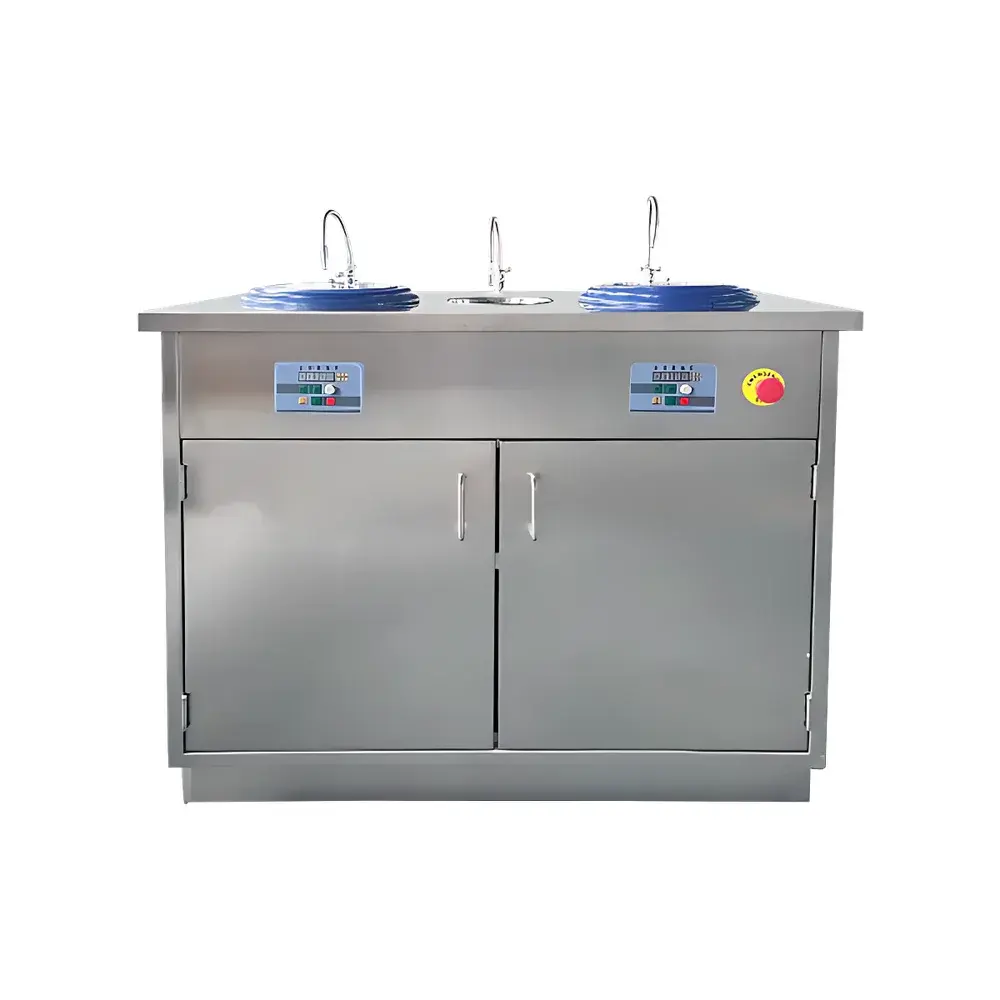
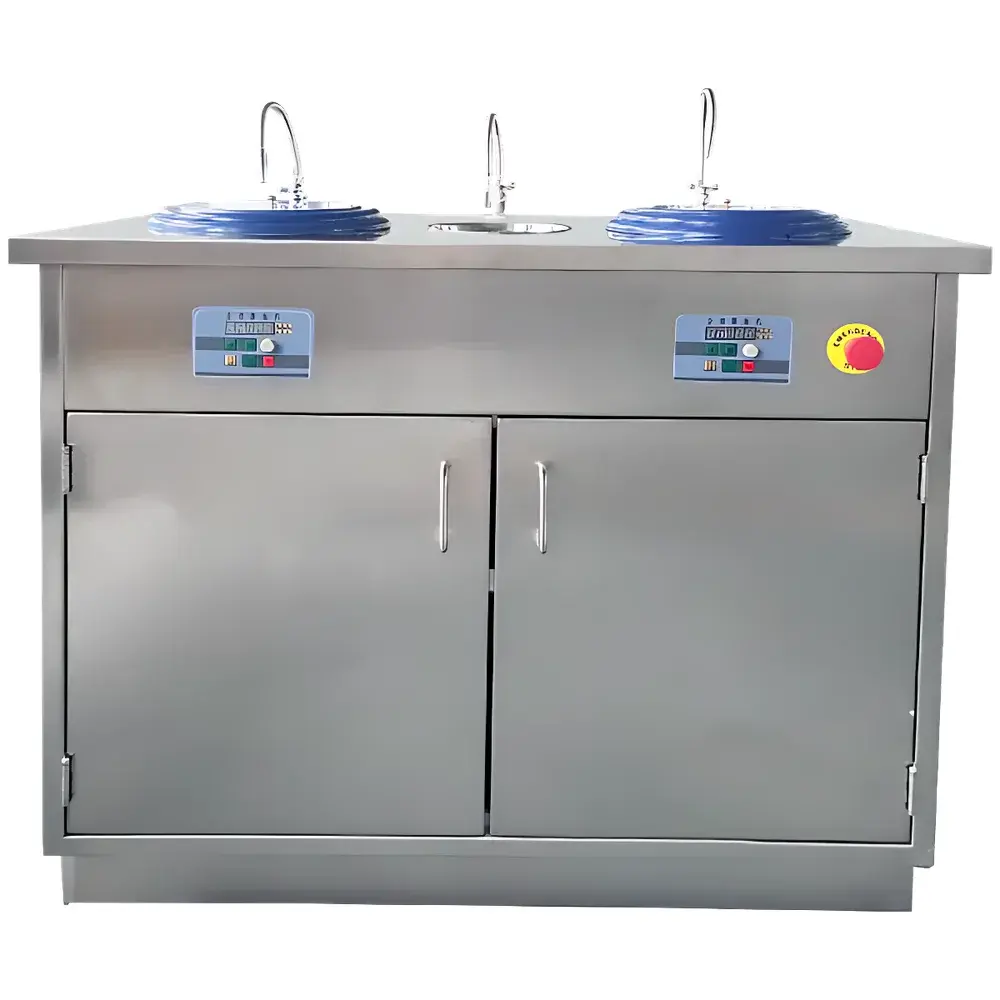
YANRUN MP-2A Dual-Station Metallographic Grinding and Polishing System
| Brand | YANRUN |
|---|---|
| Origin | Shanghai, China |
| Manufacturer Type | Direct Manufacturer |
| Country of Origin | China |
| Model | MP-2A |
| Speed Control | Infinitely Variable (50–1500 rpm) + Preset Fixed-Speed Modes |
| Platen Diameter | 230 mm (optional: 200 mm, 250 mm, 300 mm) |
| Number of Platens | 2 |
| Dimensions (L×W×D) | 1100 × 600 × 850 mm |
| Power Supply | 220 V AC |
| Motor Power | 550–750 W per station |
| Control Architecture | Independent Dual-Channel Servo Control |
| Rotation Direction | Bidirectional (Forward/Reverse) |
| Integrated Rinse Station | Adjustable Multi-Axis Spray Nozzle |
| Enclosure Material | Stainless Steel Floor-Standing Cabinet |
Overview
The YANRUN MP-2A is a dual-station, floor-standing metallographic grinding and polishing system engineered for precision sample preparation in metallurgical, materials science, and quality assurance laboratories. It operates on the fundamental principle of controlled mechanical abrasion—using sequential abrasive media (silicon carbide papers, diamond suspensions, and colloidal silica slurries) applied under calibrated pressure and rotational motion—to produce artifact-free, planar surfaces suitable for optical microscopy, scanning electron microscopy (SEM), and microhardness testing. Its robust stainless-steel cabinet architecture ensures long-term dimensional stability and corrosion resistance in high-humidity or chemical-intensive lab environments. Designed for reproducible surface finish generation, the MP-2A supports standardized workflows aligned with ASTM E3, ISO 14487, and EN 10365—key international protocols governing metallographic specimen preparation.
Key Features
- Dual independent platen stations with fully decoupled servo-driven motors—enabling simultaneous yet separate control of speed, direction, and runtime for each disc.
- Infinitely variable speed range (50–1500 rpm) complemented by factory-preset fixed-speed modes optimized for coarse grinding, fine grinding, and final polishing stages.
- Bidirectional rotation capability (forward/reverse) to minimize directional scratch patterns and enhance uniformity across heterogeneous or anisotropic samples.
- Adjustable multi-axis spray nozzle integrated into a dedicated rinse station—providing targeted, low-turbulence water delivery during operation to suppress heat buildup and remove debris without disturbing abrasive distribution.
- Stainless-steel structural frame with reinforced base plate and vibration-dampening feet—reducing transmission of operational harmonics to adjacent instrumentation.
- Ergonomic height-adjustable work surface and front-access service panel—facilitating routine maintenance, consumable replacement, and alignment verification per ISO/IEC 17025 calibration requirements.
Sample Compatibility & Compliance
The MP-2A accommodates a broad spectrum of conductive and non-conductive solid specimens—including ferrous and non-ferrous metals (e.g., steel, aluminum, titanium alloys), sintered ceramics, cemented carbides, geological thin sections, and composite laminates. Its modular platen design supports interchangeable diameters (200 mm, 230 mm, 250 mm, and 300 mm), enabling adaptation to both standard ASTM E3 mounting puck dimensions and custom-sized mounts. All electrical components comply with IEC 61000-6-3 (EMC emission standards) and IEC 61000-6-2 (immunity). Mechanical safety conforms to EN 60204-1, including emergency stop circuitry, interlocked guard covers, and automatic motor cutoff upon lid opening. The system is compatible with GLP-compliant documentation practices when paired with external logbook systems or LIMS integration via RS-232 or USB virtual COM port.
Software & Data Management
While the MP-2A operates via hardware-based dual-channel digital control (no embedded OS or touchscreen), it delivers full traceability through analog/digital signal outputs. Each station provides isolated 0–10 V analog tachometer feedback and discrete TTL-level status signals (running, stopped, fault) for integration into centralized lab automation platforms. Optional data acquisition modules enable timestamped logging of rotational speed, runtime, and direction changes—supporting audit-ready records required under FDA 21 CFR Part 11 when used in regulated QC/QA environments. Firmware updates are performed via USB interface using manufacturer-provided configuration utilities validated per ISO/IEC 17025 clause 5.9.
Applications
- Metallurgical research labs preparing specimens for grain size analysis (ASTM E112), inclusion rating (ASTM E45), and phase quantification (ISO 13097).
- Automotive and aerospace manufacturing QA departments conducting root-cause failure analysis of fatigue cracks, intergranular corrosion, or heat-affected zone (HAZ) characterization.
- Academic teaching laboratories supporting undergraduate and graduate coursework in materials engineering, where repeatable, hands-on sample prep reinforces theoretical concepts in deformation mechanisms and phase transformations.
- Ceramic and hardmetal R&D facilities requiring scratch-free surfaces for subsequent nanoindentation or EBSD pattern indexing.
- Third-party testing laboratories accredited to ISO/IEC 17025—leveraging the MP-2A’s mechanical consistency and documented repeatability to meet stringent uncertainty budgeting requirements.
FAQ
Is the MP-2A compliant with ISO/IEC 17025 requirements for accredited testing laboratories?
Yes—the system’s mechanical reproducibility, independent dual-channel control, and analog output interfaces support documented method validation and equipment qualification per ISO/IEC 17025 Clause 6.4.1.
Can the MP-2A be integrated into a laboratory information management system (LIMS)?
Yes—via optional serial or USB-to-serial adapter modules that provide machine-state telemetry and accept external start/stop commands.
What platen sizes are supported out-of-the-box, and how is diameter change performed?
Standard configuration includes 230 mm platens; alternate diameters (200 mm, 250 mm, 300 mm) are field-replaceable using M8 fasteners and require recalibration of torque compensation parameters.
Does the system include built-in calibration traceability?
No—calibration of rotational speed and time functions must be performed externally using NIST-traceable tachometers and timers as part of the lab’s metrology program.
What maintenance intervals are recommended for optimal performance?
Platen bearing inspection every 1,000 operating hours; drive belt tension verification quarterly; and full lubrication of gearboxes annually per the manufacturer’s technical manual (Revision 3.2, 2023).



