
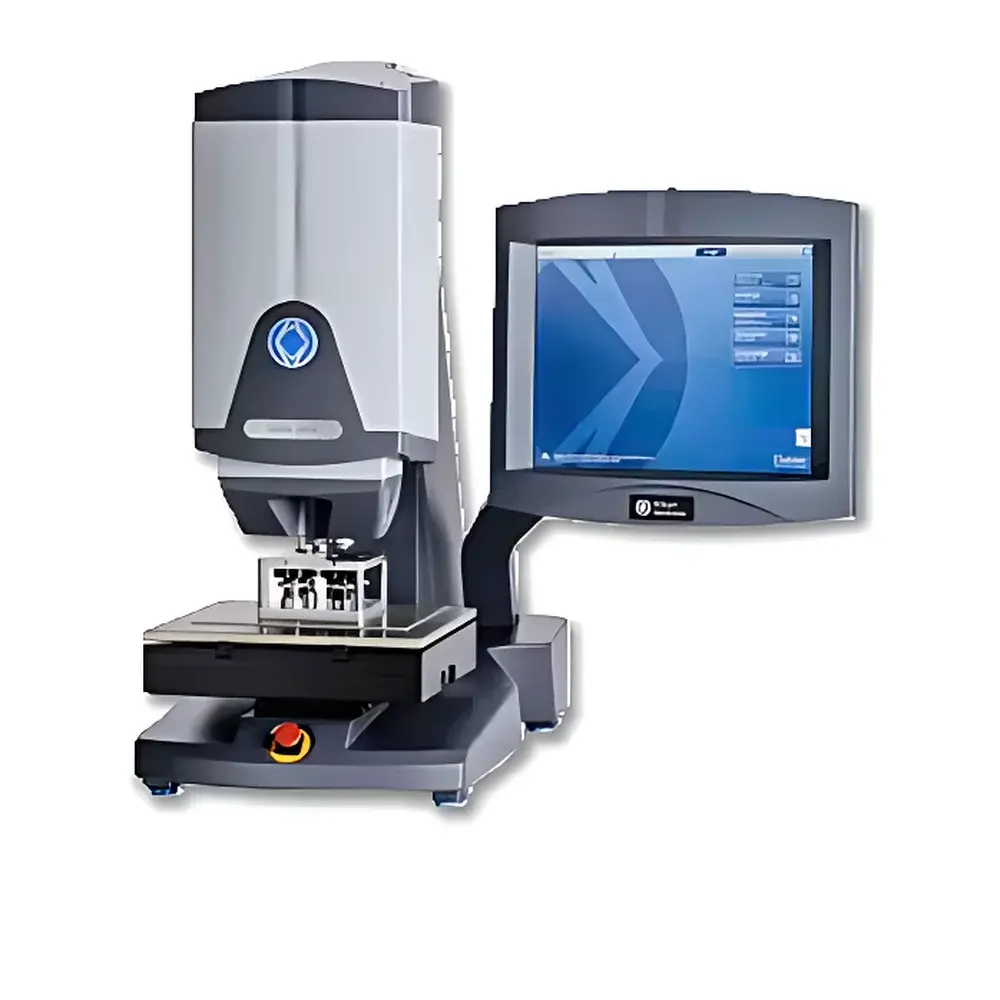
Wilson® VH3100 Automated Vickers/Knoop Hardness Tester
| Brand | Wilson Hardness |
|---|---|
| Origin | USA |
| Manufacturer | Wilson Hardness (A Buehler Company) |
| Type | Imported Instrument |
| Model | VH3100 |
| Instrument Category | Vickers Hardness Tester |
| Test Force Range | 50 gf to 10 kgf |
| Force Accuracy | ±1.5% below 200 gf, ±1% above 200 gf |
| Loading Method | Load Cell-Based Closed-Loop Control |
| Dwell Time | 1–999 s |
| Standards Compliance | ASTM E384, ASTM E92, ISO 6507-1, ISO 9385, ISO 4546 |
| Optical Magnification | 30×–2000× with Digital Zoom |
| Objective Working Distance | Long Working Distance (LWD) |
| XY Stage | High-Precision Motorized Stage (100 × 100 mm Travel) |
| Illumination | Adjustable LED |
| Humidity Range | 10–90% RH (non-condensing) |
| Power Supply | 100–240 VAC, 50/60 Hz |
| Weight | 37.5 kg (82.7 lbs, excluding monitor) |
Overview
The Wilson® VH3100 Automated Vickers/Knoop Hardness Tester is a fully integrated, sensor-driven microhardness testing system engineered for precision, repeatability, and operational robustness in industrial quality control and R&D laboratories. It operates on the principle of static indentation hardness measurement: a diamond pyramid indenter (Vickers) or rhombic-based pyramid (Knoop) is loaded onto a polished sample surface under controlled force, held for a defined dwell time, and the resulting impression is optically measured to calculate hardness values in HV (Vickers) or HK (Knoop) units. The system employs closed-loop load cell feedback for real-time force regulation—ensuring traceable, metrologically sound indentation across its full 50 gf–10 kgf test force range. Designed and manufactured in the USA by Wilson Hardness (a Buehler company), the VH3100 meets stringent international standards including ASTM E384 (for microhardness), ASTM E92 (for macrohardness), ISO 6507-1 (Vickers), ISO 9385 (Knoop), and ISO 4546 (instrument verification). Its cast aluminum structural frame provides mechanical stability and thermal inertia, minimizing drift during extended testing sequences in non-climate-controlled environments.
Key Features
- Full-range test force capability from 50 gf to 10 kgf—covering micro-, small-load, and macro-hardness applications without hardware reconfiguration.
- Patented collision avoidance system that actively monitors Z-axis position and halts descent when proximity to the sample or stage exceeds safe thresholds—preventing costly damage to indenters, objectives, or specimens.
- Motorized long-working-distance (LWD) optical system with digital zoom (30×–2000× magnification), enabling high-resolution imaging of shallow Knoop impressions and deep Vickers indentations across heterogeneous surfaces.
- High-precision, large-travel (100 × 100 mm) XY motorized stage with sub-micron repeatability—optimized for multi-point hardness mapping, case depth profiling (CHD), and serial testing of batched samples.
- Integrated LED illumination with adjustable brightness, contrast, and coaxial/diffuse lighting modes—enhancing edge detection for automated image analysis on reflective, matte, or coated surfaces.
- Rugged cast-aluminum chassis rated for continuous operation in production-floor environments—resistant to vibration, dust ingress, and ambient temperature fluctuations.
Sample Compatibility & Compliance
The VH3100 accommodates diverse specimen geometries—from thin foils (≥25 µm) and IC wafers to large forged components (up to 200 mm in height and 300 mm in width). Its open-stage architecture supports custom fixturing for irregular parts, weldments, and layered structures such as clad metals, PVD/CVD coatings, and thermal spray deposits. All hardness calculations adhere to ASTM E384’s calibration and uncertainty requirements for microindentation, including correction for diagonal length measurement error and indentation size effect (ISE). The instrument’s software enforces GLP-compliant workflows: audit trails record operator ID, timestamp, test parameters, raw image files, and manual overrides. Data integrity is further ensured via 21 CFR Part 11–ready user authentication (three-tier password hierarchy), electronic signatures, and immutable data archiving in encrypted SQLite databases.
Software & Data Management
Controlled via an intuitive 12.1″ capacitive touchscreen interface, the VH3100’s proprietary software suite delivers end-to-end automation—from autofocus and auto-illumination to indentation, image capture, diagonal measurement, hardness calculation, and statistical reporting. Key modules include CHD (Case Hardness Depth) profile generation with ISO 2639-compliant gradient interpolation; scatter plots with trendline regression; automated outlier rejection based on user-defined sigma thresholds; and one-click export to Excel (.xlsx) or PDF with embedded metadata (test standard, operator, equipment ID, calibration certificate traceability). Virtual joystick control enables precise manual navigation without physical handwheels. All measurement images are stored with EXIF tags (magnification, force, dwell time, objective ID) and support post-acquisition reanalysis—including recalibration against NIST-traceable reference blocks and batch-level statistical process control (SPC) charting.
Applications
- Heat treatment validation: carburized case depth, nitrided layer uniformity, tempering response in alloy steels and tool steels.
- Thin-film and coating evaluation: TiN, DLC, Al₂O₃, and electroplated layers on substrates ranging from silicon wafers to aerospace-grade titanium alloys.
- Microstructural characterization: grain boundary hardening, precipitate dispersion analysis, and phase-specific hardness in duplex stainless steels or nickel-based superalloys.
- Failure analysis: hardness gradients across weld HAZs, interfacial debonding in laminates, and embrittlement assessment in hydrogen-charged components.
- Quality assurance in medical device manufacturing: hardness mapping of stainless steel surgical blades, cobalt-chromium stent struts, and ceramic hip joint articulating surfaces.
FAQ
Does the VH3100 support both Vickers and Knoop hardness scales within a single test sequence?
Yes—the instrument automatically selects the appropriate indenter geometry and applies standardized calculation algorithms per ASTM E384 and ISO 9385, allowing concurrent HV and HK reporting on the same sample region.
Is external calibration required before each test run?
No—built-in force calibration verification using certified reference weights and optical scale validation against NIST-traceable stage encoders ensures compliance between scheduled maintenance intervals (recommended annually).
Can the system integrate with existing LIMS or MES platforms?
Yes—via configurable OPC UA or TCP/IP protocols, the VH3100 exports structured JSON or CSV datasets containing full test metadata, enabling bidirectional communication with enterprise systems for automated report ingestion and SPC dashboarding.
What is the minimum sample thickness recommended for reliable Knoop testing at 10 gf?
For Knoop testing, minimum thickness should be ≥10× the indentation depth; at 10 gf on typical hardened steel, this corresponds to ≥20 µm—verified via cross-sectional SEM correlation in application notes.
How does the collision protection system respond during rapid stage movement?
The system continuously monitors Z-position relative to the current focal plane and stage Z-coordinate; if predicted clearance falls below 50 µm during programmed motion, drive commands are suspended and an audible alert is triggered until manual confirmation.



