
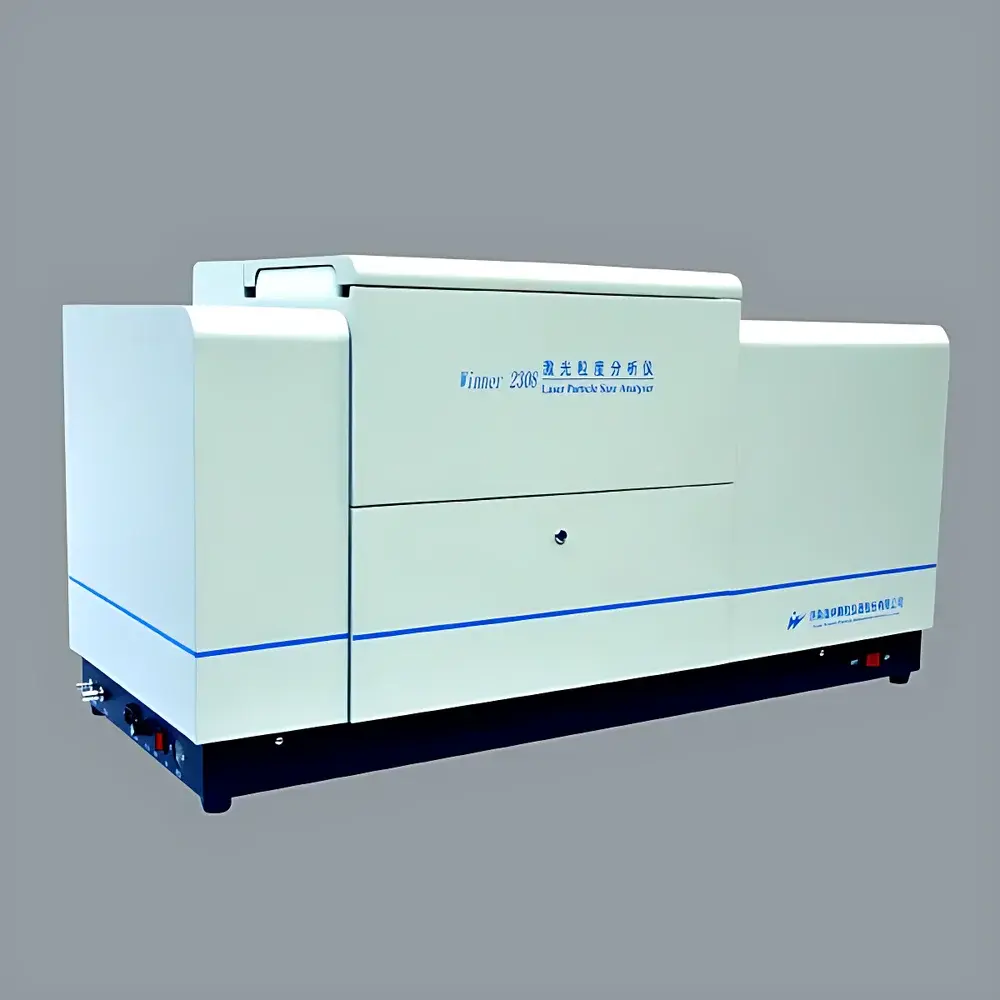
Winner 2308 Intelligent Dry/Wet Integrated Laser Particle Size Analyzer
| Brand | Jinan Winner |
|---|---|
| Origin | Shandong, China |
| Manufacturer Type | Direct Manufacturer |
| Regional Classification | Domestic (China) |
| Model | Winner 2308 |
| Price Range | USD 21,000–28,000 (FOB Qingdao) |
| Dispersion Method | Dry & Wet Dispersion |
| Instrument Type | Laboratory Laser Diffraction Particle Size Analyzer |
| Measurement Range | Dry Mode: 1–2000 µm |
| Wet Mode | 0.01–2000 µm |
| Repeatability | <1% RSD (D50 of NIST-traceable standard reference material) |
| Measurement Time | 10–120 s |
Overview
The Winner 2308 Intelligent Dry/Wet Integrated Laser Particle Size Analyzer is a dual-mode laboratory instrument engineered for high-precision particle size distribution (PSD) analysis using laser diffraction principles. It implements convergent-beam Fourier transform optical design—compliant with ISO 13320:2009 and GB/T 19077–2016—to eliminate aperture-limited angular detection constraints. The system integrates two orthogonal laser sources: a primary red semiconductor laser (λ = 639 nm, P > 2 mW) and a secondary blue auxiliary laser (λ = 405 nm, P > 2 mW), enabling extended angular detection from 0.0155° to 164°. This dual-spectrum configuration ensures robust signal capture across the full dynamic range, particularly critical for resolving submicron populations in wet dispersions and coarse aggregates in dry aerosols. Unlike conventional modular setups requiring manual reconfiguration, the Winner 2308 features an all-in-one optical and fluidic architecture that maintains optical alignment integrity during mode switching—eliminating drift-induced bias associated with external dispersion units or repeated realignment.
Key Features
- Integrated dry/wet dispersion platform with one-button mode switching—no hardware disassembly or recalibration required between measurement protocols.
- Patented internal wet dispersion module (CN ZL.2010 1 0533181.6): combines ultrasonic dispersion (40 kHz, 60 W, adjustable duration), magnetic stirring (0–3000 rpm), peristaltic circulation (3.6 L/min, 29 W), and automated drainage in a single sealed flow cell (550 mL capacity).
- Self-aligning optical system (CN ZL.2013 2 0835882.4): three-axis motorized stage with hybrid stepper motors achieving ≤1 µm positional resolution; continuously monitors and corrects beam centering in real time during operation.
- Unconstrained distribution fitting algorithm: applies non-parametric inverse Abel transformation without assuming log-normal or Rosin-Rammler distributions—preserving bimodality, skewness, and tail behavior inherent in raw scattering data.
- Dual detection geometry: forward-scatter and wide-angle side/back-scatter detectors mounted on separate focal planes enable simultaneous coverage of fine (0.01 µm) and coarse (2000 µm) fractions without interpolation artifacts.
Sample Compatibility & Compliance
The Winner 2308 accommodates diverse particulate systems—including aqueous suspensions, organic solvent-based colloids, emulsions, dry powders, and agglomerated nanomaterials—without cross-contamination risk due to physically segregated dry and wet fluid paths. Its wet module meets ISO 21501-4 requirements for suspension stability monitoring, while dry dispersion adheres to ASTM D7927–19 guidelines for powder aerosolization consistency. All firmware and data handling routines support audit-ready operation: timestamped metadata, user-access logs, and immutable raw intensity files (.DAT) are generated per measurement. The system supports optional GLP/GMP-compliant workflow modules—including electronic signatures, 21 CFR Part 11–aligned audit trails, and IQ/OQ documentation templates—for regulated environments in pharmaceutical development and QC labs.
Software & Data Management
Jinan Winner’s proprietary WinPAS v5.2 software provides fully automated acquisition, real-time Mie theory-based inversion, and multi-parameter reporting (D10/D50/D90, span, specific surface area, volume/mass/surface distributions). Raw scattering patterns are stored in vendor-neutral HDF5 format with embedded calibration coefficients and environmental parameters (temperature, humidity, refractive index). Batch processing supports up to 999 sequential measurements with customizable pass/fail thresholds against SOP-defined control limits. Export options include CSV, XML, PDF reports with embedded spectral plots, and direct integration with LIMS via OPC UA or RESTful API. Software validation packages—including installation qualification (IQ), operational qualification (OQ), and performance qualification (PQ) test scripts—are available upon request.
Applications
This analyzer serves as a primary PSD characterization tool across industries where particle morphology directly impacts functional performance: catalyst formulation (pore accessibility), battery electrode slurries (coating uniformity), inhalable drug powders (aerodynamic diameter), ceramic green bodies (sintering density), food emulsions (shelf-life stability), and abrasive grit grading (cutting efficiency). In academic research, it supports fundamental studies in colloidal science, crystallization kinetics, and nanoparticle aggregation dynamics—particularly where comparative dry vs. wet behavior reveals hydration shell effects or dispersion-induced fragmentation. Its broad dynamic range eliminates the need for complementary techniques (e.g., sedimentation or electron microscopy) in routine quality screening.
FAQ
Does the Winner 2308 require external compressed air for dry dispersion?
No—it uses an integrated vacuum-assisted venturi disperser with adjustable suction pressure (0.05–0.3 MPa), eliminating dependency on facility air lines.
Can the same sample cell be used for both dry and wet modes?
No—dry and wet modules employ dedicated, non-interchangeable optical cells to prevent residue carryover and maintain contamination-free baseline stability.
Is Mie theory calculation mandatory, or can Fraunhofer approximation be selected?
Both models are available; users may select based on particle refractive index uncertainty or computational speed requirements—default is Mie with user-input n & k values.
What is the minimum sample mass required for dry mode analysis?
Typical dry testing consumes 0.1–5 g depending on bulk density and desired statistical confidence; automated mass dosing is not included but compatible with third-party gravimetric feeders.
How often does the optical alignment system require maintenance or recalibration?
The motorized alignment mechanism is designed for ≥50,000 cycles without degradation; annual verification using NIST-traceable alignment standards is recommended per ISO/IEC 17025.
Related Products



