
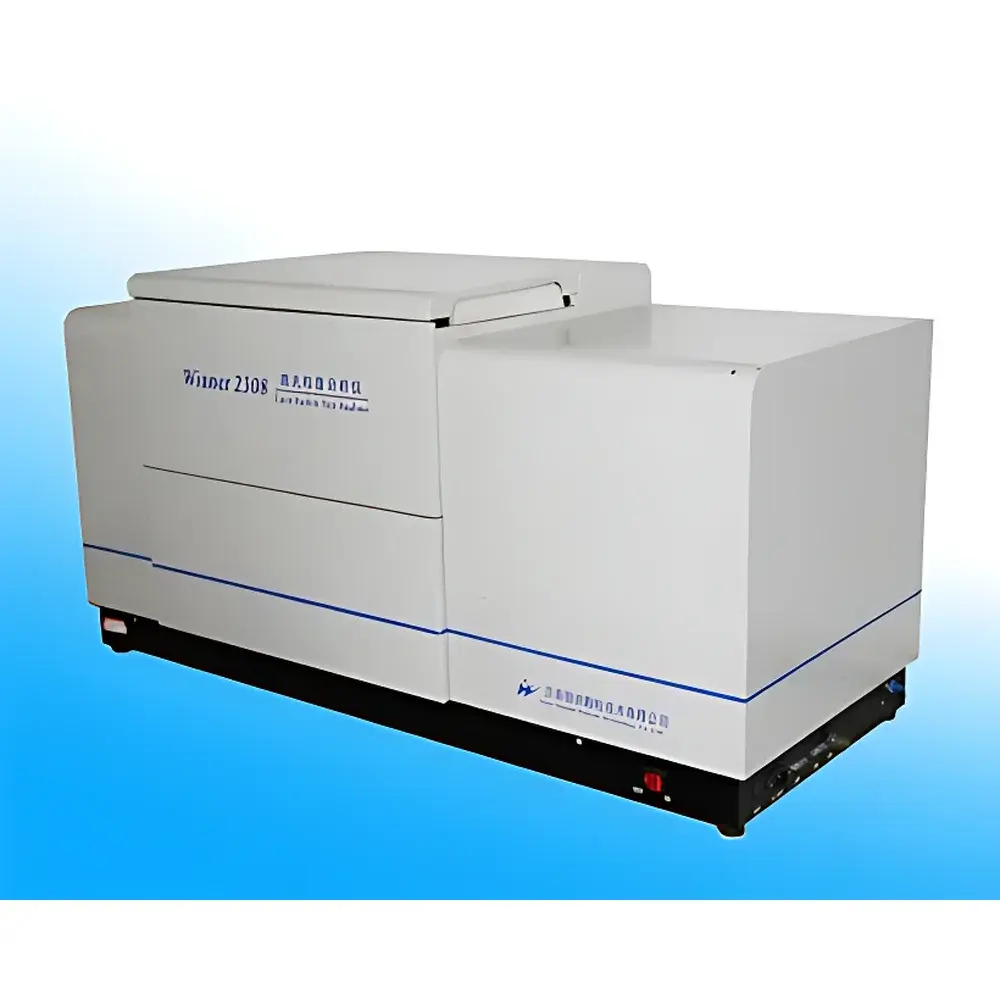
Winner2308 Dry/Wet Integrated Laser Diffraction Particle Size Analyzer
| Brand | Jinan Winner |
|---|---|
| Origin | Shandong, China |
| Manufacturer Type | Direct Manufacturer |
| Origin Category | Domestic (China) |
| Model | 2308 |
| Price Range | USD 21,000 – 28,000 |
| Dispersion Method | Dry & Wet Dispersion |
| Instrument Type | Laboratory Laser Diffraction Analyzer |
| Measurement Range | Wet: 0.01–2000 µm |
| Dry | 0.1–200 µm |
| Repeatability | Wet: <0.5% |
| Dry | <1% |
| Measurement Time | Wet: <2 min per run |
| Dry | <1 min per run |
Overview
The Winner2308 Dry/Wet Integrated Laser Diffraction Particle Size Analyzer is a high-precision laboratory instrument engineered for reliable, traceable particle size distribution (PSD) analysis across an exceptionally broad dynamic range. It operates on the principle of laser diffraction—measuring angular intensity patterns of scattered light generated when a collimated laser beam interacts with particles suspended in liquid or dispersed in air. The system employs a convergent-beam Fourier transform optical configuration, eliminating aperture-induced truncation errors and enabling full angular detection from 0.0155° to 164°. Dual-laser orthogonal illumination (639 nm red + 405 nm blue) enhances sensitivity to submicron particles while maintaining robust signal integrity for coarse fractions up to 2000 µm. Designed for dual-mode operation, the instrument integrates fully self-contained wet and dry dispersion modules into a single platform, eliminating cross-contamination risks and mechanical misalignment associated with external dispersers.
Key Features
- Dry/wet dual-mode operation with one-button switching—no hardware reconfiguration required between measurement modes.
- Patented integrated wet dispersion system (ZL.2010 1 0533181.6) featuring combined ultrasonication (40 kHz, 60 W), programmable stirring (0–3000 rpm), and high-flow circulation (3.6 L/min, 29 W)—optimized to suppress sedimentation of coarse particles (>100 µm) during analysis.
- Automated 3D optical alignment system (ZL.2013 2 0835882.4) driven by precision four-phase hybrid stepper motors, achieving micron-level positional resolution to maintain consistent laser beam–detector geometry over extended operational cycles.
- Unconstrained free-fitting algorithm—distribution reconstruction without pre-assumed mathematical models (e.g., log-normal or Rosin-Rammler), preserving true multimodal characteristics and minimizing bias in heterogeneous samples.
- Dual focal plane optical design supporting simultaneous detection of forward-scattered and wide-angle scattered light, extending measurable range to 2000 µm under wet conditions and ensuring compliance with ISO 13320:2009 requirements for coarse particle reporting.
Sample Compatibility & Compliance
The Winner2308 accommodates diverse sample types: aqueous suspensions (e.g., colloidal silica, pharmaceutical emulsions), organic dispersions (e.g., polymer latexes in toluene), and dry powders (e.g., metal oxides, ceramic precursors, battery cathode materials). Its sealed dry dispersion module minimizes operator exposure and enables inert-gas purging for oxygen-sensitive or electrostatic-prone materials. The system complies with GB/T 19077–2016 and ISO 13320:2009 for laser diffraction methodology validation. Traceability is supported through NIST-traceable reference standards (e.g., NIST SRM 1963, SRM 2800), and data integrity meets GLP/GMP-aligned documentation practices—including audit trail logging for parameter changes, calibration events, and user actions.
Software & Data Management
Control and analysis are executed via proprietary Windows-based software compliant with FDA 21 CFR Part 11 requirements for electronic records and signatures. The interface supports method templates, automated SOP execution, batch reporting (PDF/CSV/XLSX), and statistical comparison across multiple runs or instruments. Raw scattering data is stored in HDF5 format, enabling post-acquisition reprocessing with updated optical models or refractive index inputs. All calibration parameters—including laser power monitoring, detector gain adjustment, and background subtraction profiles—are version-controlled and exportable for third-party verification.
Applications
The Winner2308 serves critical quality control and R&D functions across regulated and industrial sectors. In pharmaceutical manufacturing, it verifies granule uniformity prior to tableting and monitors nanoparticle drug carrier stability. In advanced materials development, it characterizes primary particle size of LiFePO₄ cathodes, SiO₂ aerogel precursors, and quantum dot suspensions. For construction chemistry, it quantifies cement fineness and fly ash particle morphology. Applications also extend to food science (starch granule swelling behavior), agrochemical formulation (wettable powder dissolution kinetics), and environmental monitoring (sediment grain size classification per ASTM D422).
FAQ
What regulatory standards does the Winner2308 comply with?
It conforms to ISO 13320:2009, GB/T 19077–2016, and supports validation protocols aligned with USP <429> and ASTM E2927.
Can the instrument measure nanoparticles below 100 nm in wet mode?
Yes—the 405 nm auxiliary laser and optimized low-angle detection enable reliable quantification down to 0.01 µm (10 nm) in stable colloidal systems with appropriate refractive index input.
Is dry dispersion suitable for heat-sensitive or fragile particles?
The pneumatic dispersion system uses low-shear airflow and adjustable pressure settings to minimize attrition; optional temperature-controlled feed hoppers are available for thermal management.
How is data security and user accountability maintained?
Role-based access control, electronic signature capture, and immutable audit trails meet 21 CFR Part 11 requirements for regulated laboratories.
Does the system support method transfer between wet and dry modes for the same material?
Yes—comparative analysis tools allow side-by-side D10/D50/D90 overlays, residual error mapping, and statistical equivalence testing (e.g., t-test, ANOVA) to assess measurement consistency across dispersion states.



