
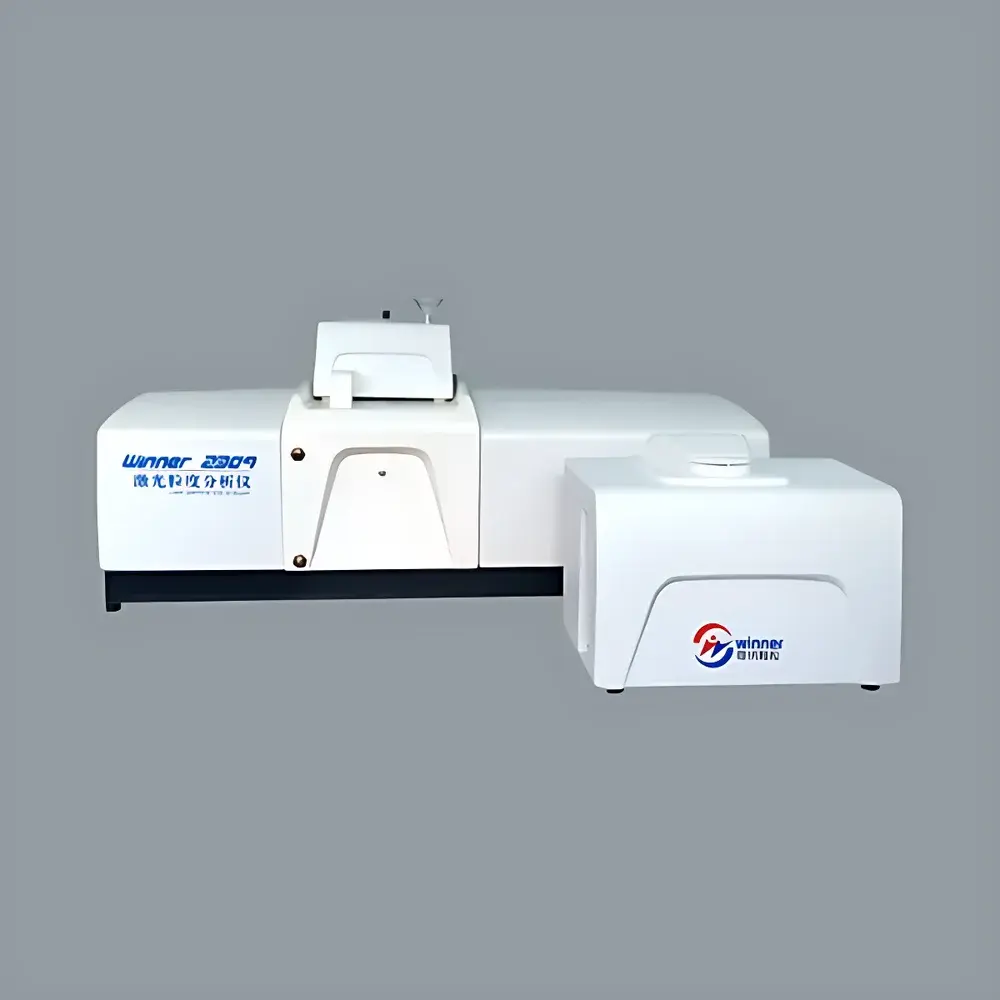
Winner2309 Automated Dry/Wet Laser Particle Size Analyzer
| Brand | Jinan Winner |
|---|---|
| Origin | Shandong, China |
| Manufacturer Type | Direct Manufacturer |
| Product Type | Laboratory Laser Particle Size Analyzer |
| Dispersion Method | Dry & Wet Dispersion |
| Measurement Range | Wet: 0.01–2000 µm |
| Dry | 0.1–2000 µm |
| Repeatability | < 1% (D50 of NIST-traceable standard samples) |
| Measurement Time | < 120 s per run |
| Compliance | GB/T 19077–2016, ISO 13320:2009 |
| Laser Sources | Primary He–Ne λ = 639 nm, P > 2 mW |
| Optical Alignment | Fully Automatic 3D Motorized Centering System (Patent ZL201320835882.4) |
| Detection Angle | 0.0155°–164° |
| Channel Count | 116 |
| Sample Handling | Integrated Ultrasonic Dispersion, Stirring, Circulation (wet) |
| Dimensions (Host) | 1200 × 410 × 560 mm |
| Weight | 62 kg (host) + 15 kg (wet dispersion unit) |
Overview
The Winner2309 Automated Dry/Wet Laser Particle Size Analyzer is a laboratory-grade instrument engineered for high-precision, reproducible particle size distribution (PSD) analysis across diverse sample states—both liquid-dispersed suspensions and dry powders. It operates on the principle of laser diffraction, applying Mie scattering theory and Fraunhofer approximation to convert angular intensity patterns of scattered light into volumetric particle size distributions. Its dual-laser orthogonal optical architecture—featuring a primary red laser (639 nm) and auxiliary blue semiconductor laser (405 nm)—enables extended angular detection (0.0155°–164°) and enhanced sensitivity to submicron and nanoscale particles via simultaneous forward, side, and backward scattering capture. The system adheres strictly to ISO 13320:2009 and GB/T 19077–2016 standards for diffraction-based particle sizing, ensuring metrological traceability and regulatory acceptability in quality control and R&D environments.
Key Features
- Modular dry/wet dispersion units—physically decoupled from the optical bench—to minimize cross-contamination and simplify maintenance.
- Patented fully automatic 3D optical alignment system (ZL201320835882.4), driven by high-resolution four-phase hybrid stepper motors with micron-level positional accuracy, guaranteeing consistent beam centering across thousands of measurements.
- Dual-spectrum detection architecture with imported Fourier transform lens assembly, supporting full-range measurement from 0.01 µm (wet) or 0.1 µm (dry) up to 2000 µm without manual lens swapping or aperture adjustment.
- Unconstrained distribution fitting algorithm—free from pre-assumed log-normal or Rosin-Rammler functions—preserves true multimodal and skewed PSD profiles without mathematical bias.
- Integrated wet dispersion module featuring programmable ultrasonication, mechanical stirring, peristaltic circulation, and temperature-stabilized sample cell; dry module employs controlled air-jet dispersion with adjustable pressure and flow rate.
Sample Compatibility & Compliance
The Winner2309 accommodates a broad spectrum of particulate materials: aqueous and non-aqueous suspensions (e.g., colloidal silica, polymer emulsions, pharmaceutical nanosuspensions), dry free-flowing powders (e.g., catalysts, battery cathode materials, ceramic precursors), and cohesive or electrostatically charged agglomerates requiring gentle deagglomeration. Its dispersion flexibility supports method development aligned with ASTM D4294, USP <429>, and ICH Q5A guidelines for particulate characterization in regulated biopharmaceutical and advanced material workflows. Data integrity meets GLP/GMP expectations through audit-trail-capable software logging, user access control, and electronic signature support compliant with FDA 21 CFR Part 11 requirements when deployed with validated configurations.
Software & Data Management
The embedded Windows-based analysis software provides intuitive, workflow-driven operation: one-click “Auto Test” initiates dispersion, measurement, and report generation without manual intervention. Raw scattering data are stored in vendor-neutral binary format (.wps), exportable to CSV, Excel, or XML for third-party statistical analysis. Batch processing supports comparative analysis across multiple runs, with overlay plots, statistical summaries (D10/D50/D90, span, relative width), and customizable pass/fail thresholds based on specification limits. All calibration events, alignment logs, and user actions are timestamped and archived—enabling full traceability during internal audits or regulatory inspections.
Applications
This analyzer serves critical roles in QC laboratories and applied research settings across multiple sectors: monitoring granulation consistency in oral solid dosage forms (pharma); quantifying primary particle size and agglomerate stability in Li-ion battery cathode slurries (energy storage); characterizing pigment dispersion homogeneity in coatings and inks (chemicals); evaluating fracture morphology and milling efficiency in cementitious systems (construction); and assessing aerosol generation fidelity in fire suppressant powders (safety engineering). Its dual-mode capability eliminates the need for separate dry-only or wet-only instruments—reducing capital expenditure and footprint while maintaining method equivalence across sample preparation protocols.
FAQ
Does the Winner2309 require external calibration standards for routine operation?
No—factory calibration using NIST-traceable polystyrene latex standards is performed prior to shipment; users may optionally verify alignment and sensitivity using supplied reference materials at defined intervals per internal SOP.
Can the instrument measure samples that sediment rapidly in liquid media?
Yes—the integrated high-power recirculation pump (flow rate adjustable up to 4000 mL/min) and optimized flow cell geometry ensure homogeneous suspension during measurement, even for dense or high-viscosity dispersions.
Is dry dispersion suitable for heat-sensitive or electrostatic-prone materials?
Yes—the air-jet dispersion module uses low-pressure, laminar airflow (< 0.2 MPa) with optional inert gas purging, minimizing thermal degradation and static buildup; optional grounded sample chamber and anti-static tubing are available.
How is data security ensured during multi-user lab deployment?
Role-based access control (administrator/operator/analyst), encrypted local database storage, and configurable audit trail retention policies comply with ISO/IEC 17025 and FDA 21 CFR Part 11 requirements for regulated environments.
What maintenance is required for long-term optical performance?
Annual verification of laser power output and detector linearity is recommended; optical windows and flow cell surfaces should be cleaned after each sample series using solvent-rinsed lint-free wipes—no optical realignment is needed due to the active motorized centering system.



