
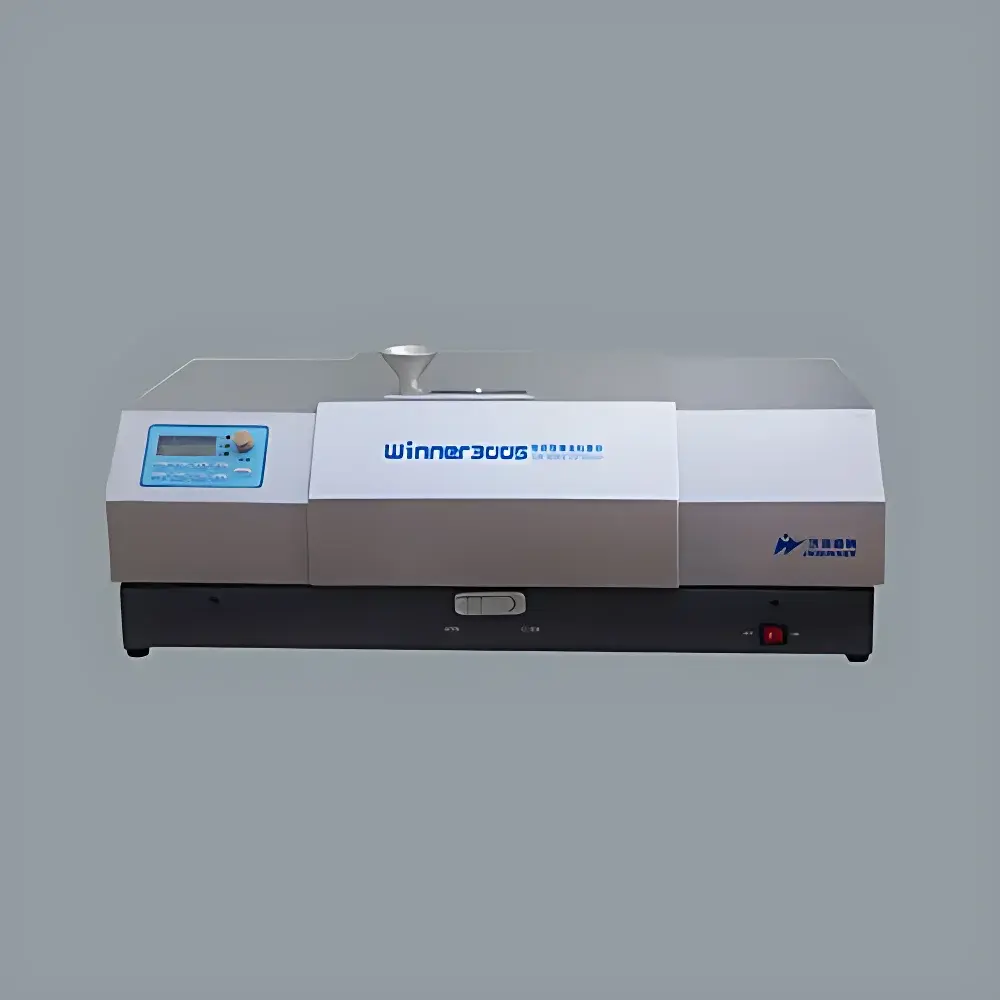
Winner3005 Automated Laser Particle Size Analyzer by Jinan Winner
| Brand | Jinan Winner |
|---|---|
| Origin | Shandong, China |
| Manufacturer Type | Direct Manufacturer |
| Regional Origin | Domestic (China) |
| Model | 3005 |
| Pricing Range | USD 0–14,500 (FOB) |
| Dispersion Method | Dry Dispersion |
| Instrument Type | Laboratory-Grade Laser Particle Size Analyzer |
| Measurement Range | 0.1–500 µm |
| Repeatability | <1% RSD |
| Measurement Duration | 10–120 s |
Overview
The Winner3005 Automated Laser Particle Size Analyzer is a laboratory-grade instrument engineered for high-precision particle size distribution (PSD) analysis of dry powders using the principle of laser diffraction. Based on Mie scattering theory and validated inverse algorithms, the system quantifies angular intensity distributions of light scattered by particles suspended in an air stream. Its optical design incorporates a dual-detector architecture—comprising a central main detector and a large-angle auxiliary detector—to capture forward- and backward-scattered light across a broad angular range. This configuration ensures comprehensive signal coverage from submicron to coarse particles (0.1–500 µm), enabling robust resolution of multimodal distributions without reliance on pre-assumed shape models.
Key Features
- Dual-Mode Operation Architecture: Supports both fully automated one-click measurement via PC-based software and manual mode through front-panel controls—providing operational flexibility for routine QC labs and method development environments.
- Turbulent Flow Dispersion System: Implements patented turbulent dispersion technology (CN Patent No. ZL.2007 2 0018648.7) combined with normal shock wave shear forces to de-agglomerate dry powders without mechanical grinding or liquid media. Critical dispersion components—including nozzles and venturis—are fabricated from wear-resistant ceramic to maintain long-term calibration stability and minimize maintenance intervals.
- Optimized Optical Detection: Employs a high-sensitivity photodiode array with extended angular coverage (up to 150°), allowing accurate detection of fine particles (100 µm) via forward scatter—eliminating the need for multiple lens configurations.
- Real-Time Data Acquisition & Processing: Captures >10,000 data points per measurement cycle at ≥10 kHz sampling rate. The embedded analysis engine applies non-negative least-squares (NNLS) unconstrained fitting to raw scattering patterns, yielding volume-based PSD without bias toward log-normal assumptions.
- Robust Environmental Integration: Designed for stable operation under standard laboratory conditions (20–25°C, 30–70% RH). Integrated air pressure and temperature sensors enable real-time refractive index correction during acquisition.
Sample Compatibility & Compliance
The Winner3005 is optimized for free-flowing, non-fibrous dry powders with bulk densities between 0.2–3.5 g/cm³ and moisture content <0.5 wt%. It accommodates materials commonly processed in pharmaceutical solid-dose manufacturing (e.g., lactose, microcrystalline cellulose), battery cathode precursors (LiCoO₂, NMC), ceramic powders (Al₂O₃, ZrO₂), catalyst supports, pigments, and construction additives. The system meets essential requirements for ISO 13320:2020 (laser diffraction particle sizing), ASTM E2918-22 (standard guide for reporting particle size analysis), and supports GLP-compliant workflows through audit-trail-enabled software logging. While not inherently 21 CFR Part 11 compliant out-of-the-box, its data export architecture (CSV, TXT, XML) facilitates integration into validated LIMS or ELN platforms requiring electronic signature and change control.
Software & Data Management
The proprietary WinPAS v4.2 software provides intuitive instrument control, real-time scatter pattern visualization, and standardized reporting per ISO/IEC 17025 guidelines. Key functions include batch measurement scheduling, SOP-driven method templates, statistical comparison of up to 12 datasets, and customizable report generation (PDF/HTML) with embedded metadata (operator ID, timestamp, environmental logs, instrument serial number). Raw scattering data and fitted PSDs are stored in vendor-neutral formats to ensure long-term accessibility beyond software lifecycle. All processing steps—including background subtraction, noise filtering, and optical model selection—are fully traceable and reversible.
Applications
This analyzer serves as a primary characterization tool in quality control laboratories across regulated and industrial sectors. In pharmaceutical development, it verifies granule uniformity prior to tableting and monitors milled API particle size for dissolution performance. In advanced materials R&D, it tracks sintering-induced agglomeration in metal and ceramic powders, evaluates coating homogeneity in pigment dispersions, and validates narrow-distribution requirements for lithium-ion battery electrode slurries. Process engineers use its rapid turnaround (≤120 s/test) to monitor mill output consistency, while formulation scientists rely on its repeatability (<1% RSD) for DOE-based optimization of dry blending parameters.
FAQ
What sample preparation is required for dry powder analysis?
No solvent, surfactant, or sonication is needed. Samples must be oven-dried (<60°C), cooled to ambient temperature, and loaded directly into the vibratory feeder hopper. Typical mass per run: 0.1–2.0 g depending on material density and desired signal-to-noise ratio.
Can the system measure cohesive or electrostatically charged powders?
Yes—via adjustable dispersion air pressure (0.1–0.6 MPa) and programmable vibration frequency (0–50 Hz), which mitigate bridging and wall adhesion. Optional ionizer module (accessory) suppresses static buildup during feeding.
Is calibration traceable to NIST standards?
The optical path is factory-calibrated using NIST-traceable polystyrene latex (PSL) standards (10 µm and 100 µm). Users may perform periodic verification with certified reference materials; calibration certificates are issued per ISO/IEC 17025-accredited procedures upon request.
Does the software support multi-language interfaces?
English and Chinese GUIs are included. Additional language packs (German, Japanese, Korean) are available upon license activation.
What maintenance intervals are recommended?
Optical windows require cleaning every 200 measurements; ceramic dispersion components show negligible wear after 10,000+ cycles. Annual recalibration and alignment verification are advised for GMP environments.



