
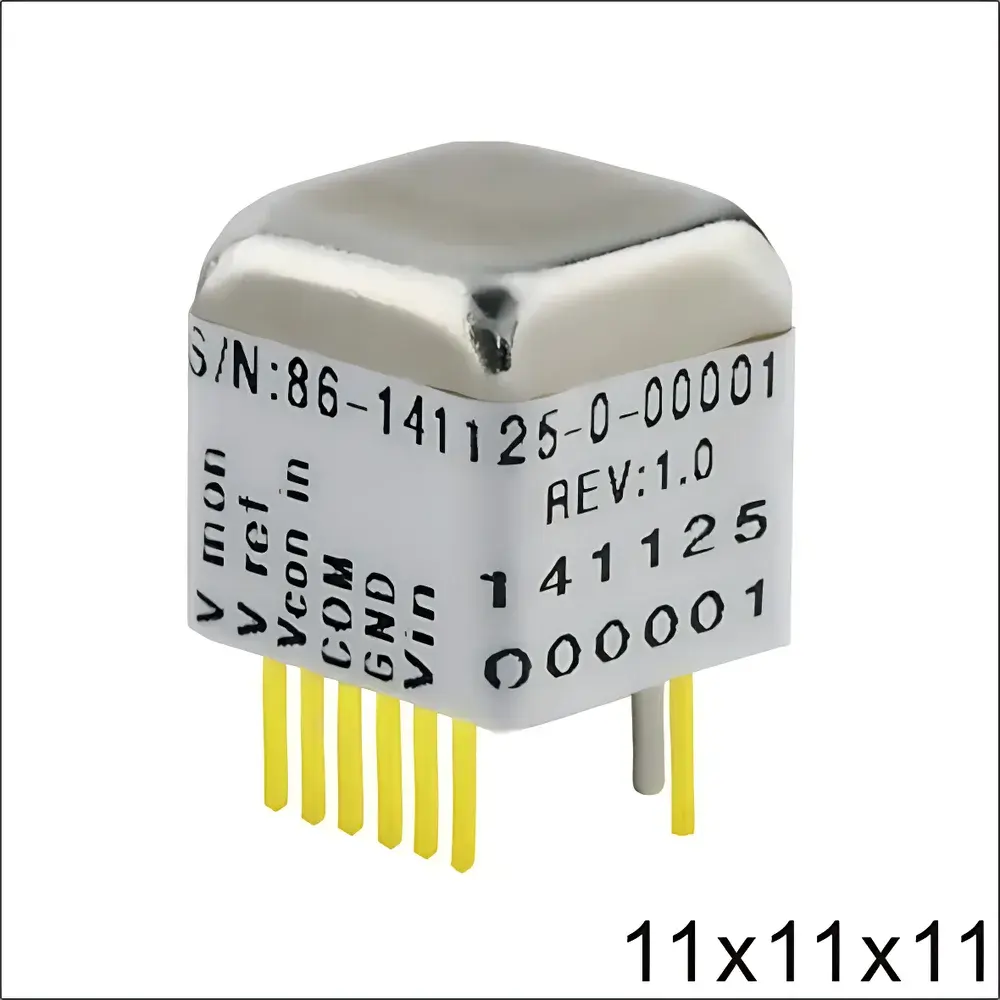
Wiseman BA Series Proportional High-Voltage Power Supply Module – 10 kV / 1.25 W
| Brand | Wiseman |
|---|---|
| Output Voltage Range | 0.1–10 kV (selectable) |
| Output Power | 0.5–1.25 W |
| Input Voltage Options | +5 VDC ±2% (standard), +12/+15/+24 VDC (optional) |
| Input Current | 550 mA |
| Isolation Voltage | ≤ ±500 VDC |
| Voltage Accuracy | ±10% at rated load |
| Operating Temperature | +25 °C to +75 °C |
| Storage Temperature | −55 °C to +105 °C |
| Humidity | ≤80% RH, non-condensing |
| Dimensions | 11 mm × 11 mm × 11 mm (≤2 kV) |
| Weight | 5 g (≤2 kV) |
| Polarity | Bipolar (simultaneous or reversible ± output) |
| Mounting | Floating operation compatible |
| Compliance | Designed for OEM integration in analytical and scientific instrumentation |
Overview
The Wiseman BA Series is a compact, proportional high-voltage power supply module engineered for precision integration into space-constrained scientific and analytical instruments. Unlike regulated high-stability HV sources, the BA series operates on a linear proportional principle: its output voltage scales directly with the input control voltage—enabling dynamic, real-time modulation of high voltage without internal regulation circuitry. This architecture delivers exceptional size-to-power density, low electromagnetic interference (EMI), and high reliability in environments where thermal management, weight, and board-level integration are critical. With output voltages selectable from 0.1 kV up to 10 kV and power ratings of 0.5 W, 1.0 W, or 1.25 W, the BA module is optimized for applications requiring bipolar operation, floating potential referencing, and rapid polarity reversal—particularly in mass spectrometry detector biasing, photomultiplier tube (PMT) gain control, and avalanche photodiode (APD) bias networks.
Key Features
- Bipolar output capability: Simultaneous or user-reversible positive/negative high-voltage output without hardware modification
- Floating design: Fully isolated output stage supports operation referenced to external potentials up to ±500 VDC, enabling direct integration into complex detector stacks or multi-stage acceleration systems
- Proportional control interface: Linear Vout/Vin relationship simplifies closed-loop feedback implementation and eliminates need for external DACs or analog scaling circuits
- Ultra-compact footprint: 11 mm³ form factor for ≤2 kV models; 21.6 mm³ for 2.5–10 kV variants—among the smallest commercially available HV modules in its voltage class
- Low ripple & high stability: Engineered with zero-current resonant topology and proprietary high-voltage insulation materials to maintain <0.05% RMS ripple under full load and long-term drift <±0.1%/°C
- OEM-optimized electrical interface: Standard +5 VDC ±2% input (550 mA), with optional +12/+15/+24 VDC configurations for system-level power rail compatibility
- Robust environmental tolerance: Rated for continuous operation from +25 °C to +75 °C, with storage capability down to −55 °C and up to +105 °C
Sample Compatibility & Compliance
The BA series is routinely deployed in detector subsystems requiring precise, low-noise biasing—including time-of-flight (TOF) and quadrupole mass spectrometers (QMS), electrostatic ion optics, electrophoretic separation platforms, and laser-induced breakdown spectroscopy (LIBS) trigger circuits. Its isolation rating (≤±500 VDC) and low leakage current (<1 nA typical) ensure compatibility with grounded vacuum chambers and high-impedance sensor interfaces. While not certified to IEC 61010-1 or UL 61010 as a standalone benchtop instrument, the module complies with IPC-A-610 Class 3 standards for high-reliability PCB assembly and meets RoHS 3 and REACH material restrictions. When integrated into final analytical systems, it supports adherence to FDA 21 CFR Part 11 data integrity requirements through traceable control voltage sourcing and documented calibration procedures.
Software & Data Management
As a hardware-level analog module, the BA series does not include embedded firmware or digital communication interfaces. However, its proportional architecture enables seamless integration with common laboratory automation frameworks: analog output channels from National Instruments DAQ cards, Keysight PXI controllers, or Raspberry Pi HATs can serve as precision Vin sources. For traceable operation in GLP/GMP environments, users implement external logging of control voltage, ambient temperature, and operational duration—aligning with ISO/IEC 17025 clause 5.9 on measurement uncertainty and equipment calibration records. Wiseman provides comprehensive application notes—including noise mitigation guidelines, grounding topologies for multi-module arrays, and thermal derating curves—for validated system-level qualification.
Applications
- Mass spectrometry: Ion detector biasing (electron multipliers, microchannel plates), lens array focusing, and reflectron acceleration
- Optical detection: PMT and APD biasing in fluorescence lifetime imaging (FLIM), Raman spectroscopy, and single-photon counting
- Materials analysis: Electrostatic charging for SEM sample preparation, dielectric breakdown testing, and piezoelectric actuator excitation
- Industrial instrumentation: Corona discharge control in electrostatic precipitators, inkjet printhead charging, and flammability test cell biasing
- Research infrastructure: Compact HV stages for plasma physics experiments, particle beam collimation, and electrohydrodynamic (EHD) flow control
FAQ
Is the BA module suitable for use in vacuum environments?
Yes—the hermetically sealed ceramic package and absence of outgassing adhesives make it compatible with medium vacuum (10−3 mbar) conditions; extended bake-out requires prior consultation with Wiseman’s engineering team.
Can multiple BA modules be stacked to increase output voltage?
No—modules are not designed for series connection. For higher voltage requirements, Wiseman offers dedicated multi-kilovolt modules (e.g., UHE or EMCO series) with matched creepage and clearance geometries.
Does Wiseman provide calibration certificates for the BA series?
Calibration is performed per batch during manufacturing; individual unit certificates are available upon request with NIST-traceable reference standards (additional lead time and fee apply).
What is the recommended method for polarity reversal in automated systems?
Reversal is achieved by inverting the polarity of the input control voltage—no mechanical switching or relay intervention is required, ensuring sub-millisecond transition times and eliminating contact wear.
How does temperature affect output accuracy across the operating range?
Output voltage exhibits a temperature coefficient of ±0.02%/°C over +25–+75 °C; for metrology-grade applications, active temperature compensation via external thermistor feedback is advised.
Related Products



