
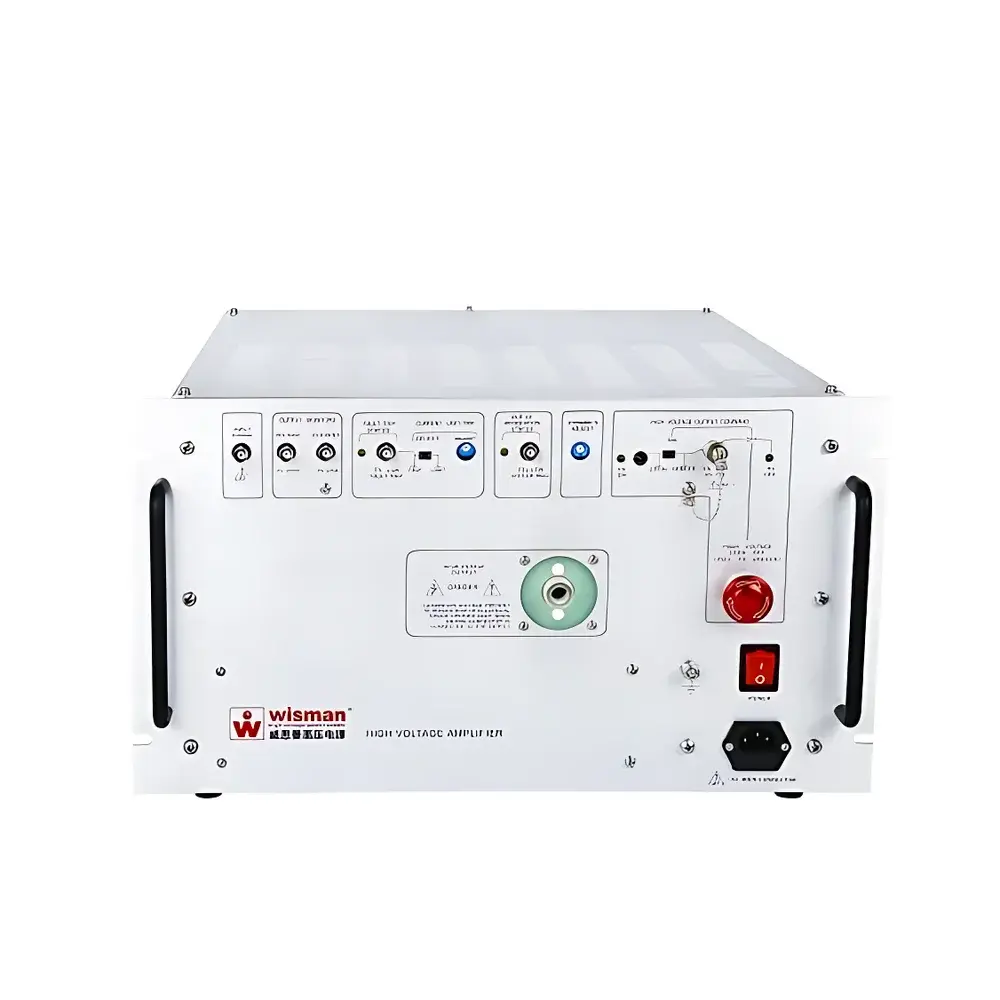
Wisman AMV ±20 kV / 400 W High-Voltage Power Amplifier
| Brand | Wisman |
|---|---|
| Model | AMV |
| Output Voltage | ±20 kV DC or AC peak |
| Output Power | 400 W |
| Output Current | ±20 mA DC or AC peak |
| Input Voltage Range | 0 to ±10 V DC or AC peak |
| Gain | 2000 V/V (DC) |
| Gain Accuracy | Better than 0.1% of full scale |
| Output Noise | <1.5 V RMS |
| Slew Rate | >800 V/µs (10%–90%) |
| Large-Signal Bandwidth | DC to >5.2 kHz (1% THD) |
| Small-Signal Bandwidth | DC to >20 kHz (−3 dB) |
| Stability | <50 ppm/hr (non-cumulative) |
| Temperature Coefficient | <25 ppm/°C |
| Operating Temperature | 0–40 °C |
| Humidity | ≤85% RH, non-condensing |
| Altitude | Up to 2000 m |
| Dimensions | 264 × 483 × 635 mm (H×W×D) |
| Weight | 25 kg |
| Input Impedance | 25 kΩ |
| Output Impedance | 47 Ω |
| Voltage Display Ratio | 2000:1 |
| Voltage Display Accuracy | Better than 0.1% FS |
| Voltage Offset | <±2 mV |
| Current Display Ratio | 1 V / 6 mA |
| Current Display Accuracy | >0.5% FS |
| Current Offset | <±10 mV |
| Current Noise | <30 mV RMS |
Overview
The Wisman AMV ±20 kV / 400 W High-Voltage Power Amplifier is a precision-engineered, fully solid-state instrumentation-grade amplifier designed for demanding scientific and industrial applications requiring stable, low-noise, high-slew-rate bipolar high-voltage excitation. Based on four-quadrant active output architecture, the AMV delivers true bidirectional current sourcing and sinking capability across its full ±20 kV output range—enabling precise control of reactive, capacitive, and resistive loads without signal distortion or instability. Its core operating principle leverages high-voltage MOSFET-based switching stages combined with analog feedback regulation to achieve exceptional DC stability (<50 ppm/hr), ultra-low output noise (20 kHz small-signal, >5.2 kHz large-signal at 1% THD). Unlike transformer-coupled or switched-mode HV supplies, the AMV’s linear, all-solid-state topology ensures minimal electromagnetic interference (EMI), predictable transient response, and compatibility with sensitive measurement environments such as mass spectrometry, electro-optic modulation, and dielectric material characterization.
Key Features
- Four-quadrant active output stage enabling simultaneous voltage control and bidirectional current flow into capacitive, inductive, or resistive loads
- Programmable DC-stable output with gain accuracy better than 0.1% of full scale and offset voltage <±2 mV
- High slew rate (>800 V/µs, 10%–90%) and wide bandwidth supporting fast transient response in closed-loop electrostatic systems
- Ultra-low output noise (<1.5 V RMS) and <30 mV RMS current display noise—critical for low-current sensing and high-resolution biasing
- Integrated short-circuit protection with automatic recovery, safeguarding both amplifier and connected instrumentation
- Dual independent analog monitoring outputs (voltage and current) with calibrated scaling (2000:1 and 1 V/6 mA respectively) and traceable accuracy
- Rugged 19-inch rack-mount chassis (264 × 483 × 635 mm), convection-cooled design, and 25 kg mass optimized for laboratory vibration isolation
Sample Compatibility & Compliance
The AMV is routinely deployed in configurations requiring strict electrical safety, long-term calibration integrity, and electromagnetic compatibility. Its design conforms to IEC 61010-1:2010 (Safety Requirements for Electrical Equipment for Measurement, Control, and Laboratory Use) and meets CE marking requirements for EMC (EN 61326-1) and low-voltage directives. The amplifier supports GLP/GMP-aligned workflows through its stable, drift-compensated analog interface—enabling integration into validated instrument control systems where traceability and reproducibility are mandated (e.g., USP Analytical Instrument Qualification). It is widely specified as the dedicated high-voltage bias source for time-of-flight (TOF) and quadrupole mass spectrometers, where sub-millisecond voltage settling and <0.01% gain drift over 8-hour runs directly impact mass resolution and ion transmission efficiency.
Software & Data Management
While the AMV operates as an analog-controlled amplifier (0 to ±10 V input reference), it is fully compatible with industry-standard DAQ and automation platforms—including National Instruments LabVIEW, MATLAB Data Acquisition Toolbox, and Python-based PyVISA control scripts—via optional IEEE-488 (GPIB) or RS-232 interfaces (available upon request). All analog monitor outputs are galvanically isolated and scaled for direct digitization using 16-bit or higher ADC modules. For regulated environments, the unit supports audit-trail-ready operation when integrated with SCADA or LIMS systems that log setpoint commands, voltage/current readbacks, and thermal status via external analog-to-digital conversion. No embedded firmware or proprietary software is required; configuration remains entirely hardware-defined per IEEE 488.2 and SCPI command subsets.
Applications
- Electrostatic beam deflection and focusing in particle accelerators and electron/ion optics systems
- Biasing of quadrupole and reflectron electrodes in mass spectrometers (including TOF-MS and Orbitrap platforms)
- Electric field poling of ferroelectric and piezoelectric thin films during in situ characterization
- AC/DC biasing of electro-optic modulators (e.g., LiNbO₃ waveguides) for phase and amplitude control
- Driving electrophoretic and dielectrophoretic microfluidic devices for cell manipulation and separation
- Atmospheric pressure plasma generation and dielectric barrier discharge (DBD) actuation
- Current rheology studies using electrorheological (ER) fluids under controlled field gradients
FAQ
Is the AMV suitable for continuous DC operation at ±20 kV?
Yes—the AMV is rated for indefinite DC output at full voltage and current, provided ambient temperature remains within 0–40 °C and airflow is unobstructed.
Can it drive highly capacitive loads, such as multi-kilovolt electrostatic lenses?
Yes—its four-quadrant output and >800 V/µs slew rate ensure stable step response into loads up to 10 nF, with active current limiting preventing oscillation.
Does the unit support remote programming and monitoring?
Standard models feature analog control only; GPIB or RS-232 digital interfaces are available as factory-configured options for programmable setpoint and readback.
What safety certifications does the AMV carry?
It complies with IEC 61010-1:2010 for measurement equipment, EN 61326-1 for EMC, and carries CE marking for use in EU laboratories.
How is calibration maintained over time?
The AMV exhibits <50 ppm/hr non-cumulative drift and <25 ppm/°C temperature coefficient; annual recalibration against NIST-traceable HV standards is recommended for ISO/IEC 17025 compliance.



