
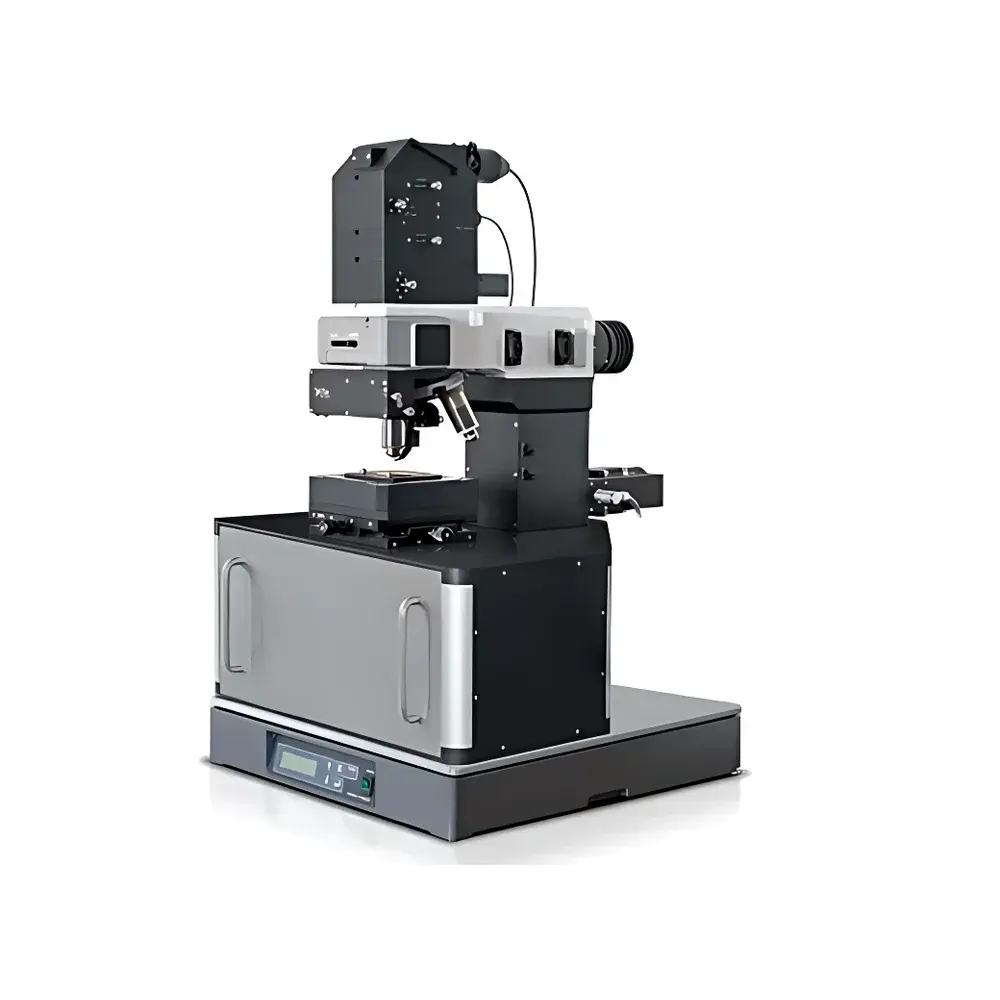
WITec Alpha 300S Scanning Near-Field Optical Microscope (SNOM) with Integrated Confocal Raman Spectroscopy
| Brand | WITec |
|---|---|
| Origin | Germany |
| Model | Alpha 300S |
| Spectral Range | 90–9000 cm⁻¹ |
| Spectral Resolution | ≤0.2 cm⁻¹ |
| Spatial Resolution | Lateral 350 nm, Axial 800 nm |
| Minimum Wavenumber | 10 cm⁻¹ |
| Spectral Reproducibility | ≤±0.02 cm⁻¹ |
Overview
The WITec Alpha 300S is a fully integrated scanning near-field optical microscope (SNOM) engineered for correlative nanoscale chemical and topographic characterization. It combines confocal Raman spectroscopy—based on inelastic light scattering governed by vibrational selection rules—with aperture-type SNOM operating under either bottom-illumination/top-collection or top-illumination/bottom-collection configurations. This dual-modality architecture enables simultaneous acquisition of chemically specific vibrational spectra and sub-diffraction-limit optical images (down to 350 nm lateral resolution), bypassing the Abbe diffraction limit inherent to conventional far-field optics. The system is built upon a robust, vibration-isolated optical table platform and features motorized objective turret switching, allowing seamless transition between Raman mapping and SNOM imaging without sample repositioning—a critical requirement for precise spatial registration in correlative studies. Designed for research-grade laboratories engaged in 2D materials, semiconductor nanostructures, polymer blends, and biological membranes, the Alpha 300S supports rigorous quantitative analysis under ambient or controlled environmental conditions.
Key Features
- Fully integrated confocal Raman and scanning near-field optical microscopy in a single instrument platform
- Motorized objective turret enabling rapid, repeatable switching between Raman and SNOM modes without sample translation
- Three operational SNOM configurations: bottom-illumination/top-collection (far-field excitation, near-field collection), top-illumination/bottom-collection (near-field excitation, far-field collection), and probe-collection (near-field excitation and collection)
- UHTS (Ultra-High Throughput Spectrometer) series fiber-coupled spectrometers with >70% optical throughput and optimized dispersion across UV, VIS, and NIR spectral ranges
- Support for multiple AFM modes—including contact, lateral force, and phase imaging—via optional integration with WITec’s Alpha 300A platform
- Automated Z-stacking, multi-region mapping, and time-resolved Raman acquisition (fast/slow kinetics)
- Optional EMCCD detector and piezo-driven sample stage for ultrafast Raman imaging at up to 1300 spectra per second
Sample Compatibility & Compliance
The Alpha 300S accommodates standard 25 mm diameter and 1 mm thick substrates—including Si wafers, ITO/glass slides, mica, and TEM grids—as well as custom-mounted specimens compatible with WITec’s universal sample holders. Its modular illumination architecture supports transmission, reflection, total internal reflection (TIR), and dark-field configurations. All Raman data acquisition and processing workflows comply with GLP/GMP documentation requirements, including full audit trails, user access control, and electronic signature support in accordance with FDA 21 CFR Part 11 when operated with WITec’s Project Manager software. Spectral calibration traceability follows NIST-traceable standards, and system validation protocols align with ISO/IEC 17025 guidelines for analytical instrumentation.
Software & Data Management
Control, acquisition, and post-processing are executed through WITec’s proprietary Project Manager software suite, which provides a unified interface for hardware orchestration, real-time spectral visualization, and multidimensional data fusion. The software supports batch processing of hyperspectral Raman datasets (up to 1024 × 1024 pixel maps), PCA-based spectral unmixing, and overlay rendering of SNOM amplitude/phase channels with Raman intensity maps. Raw spectral data are stored in vendor-neutral HDF5 format with embedded metadata (laser wavelength, grating, integration time, objective magnification, etc.), ensuring long-term archival integrity and interoperability with third-party analysis tools such as MATLAB, Python (SciPy, scikit-learn), and OriginLab. Automated report generation includes compliance-ready PDF exports with embedded timestamps, operator IDs, and instrument configuration logs.
Applications
- Correlative nanoscale analysis of graphene layer count, strain distribution, and defect density via G- and 2D-band intensity ratios mapped against topographic and near-field optical contrast
- Sub-diffraction imaging of plasmonic hotspots in Au/Ag nanostructures and their coupling to molecular vibrational modes
- Chemical domain identification in phase-separated polymer thin films, where Raman distinguishes chemical composition while SNOM resolves interfacial width and morphology
- In situ monitoring of electrochemical processes on battery electrode surfaces using combined Raman fingerprinting and SNOM conductivity mapping
- Nanoscale photoluminescence and exciton diffusion studies in perovskite quantum wells and transition metal dichalcogenide heterostructures
- Label-free detection of protein aggregation states in amyloid fibrils through amide I band deconvolution correlated with local refractive index contrast from SNOM
FAQ
What laser wavelengths are supported on the Alpha 300S?
Standard configurations include 532 nm and 633 nm lasers; optional modules support 488 nm, 785 nm, and tunable OPO systems for resonance-enhanced measurements.
Can the system perform tip-enhanced Raman spectroscopy (TERS)?
No—the Alpha 300S implements aperture-based SNOM only; TERS capability requires the separate WITec alpha300 RA system with integrated AFM-TERS functionality.
Is vacuum or cryogenic operation available?
The base system operates under ambient conditions; environmental chambers for temperature-controlled (−180 °C to +300 °C) and low-humidity operation are available as factory-installed options.
How is spectral calibration maintained over time?
Automatic daily recalibration is performed using internal neon and argon emission lines; drift compensation algorithms correct for thermal and mechanical instabilities during extended acquisitions.
Does the software support batch analysis of large hyperspectral datasets?
Yes—Project Manager includes parallelized spectral fitting, cluster analysis, and GPU-accelerated denoising routines optimized for terabyte-scale Raman image cubes.





