
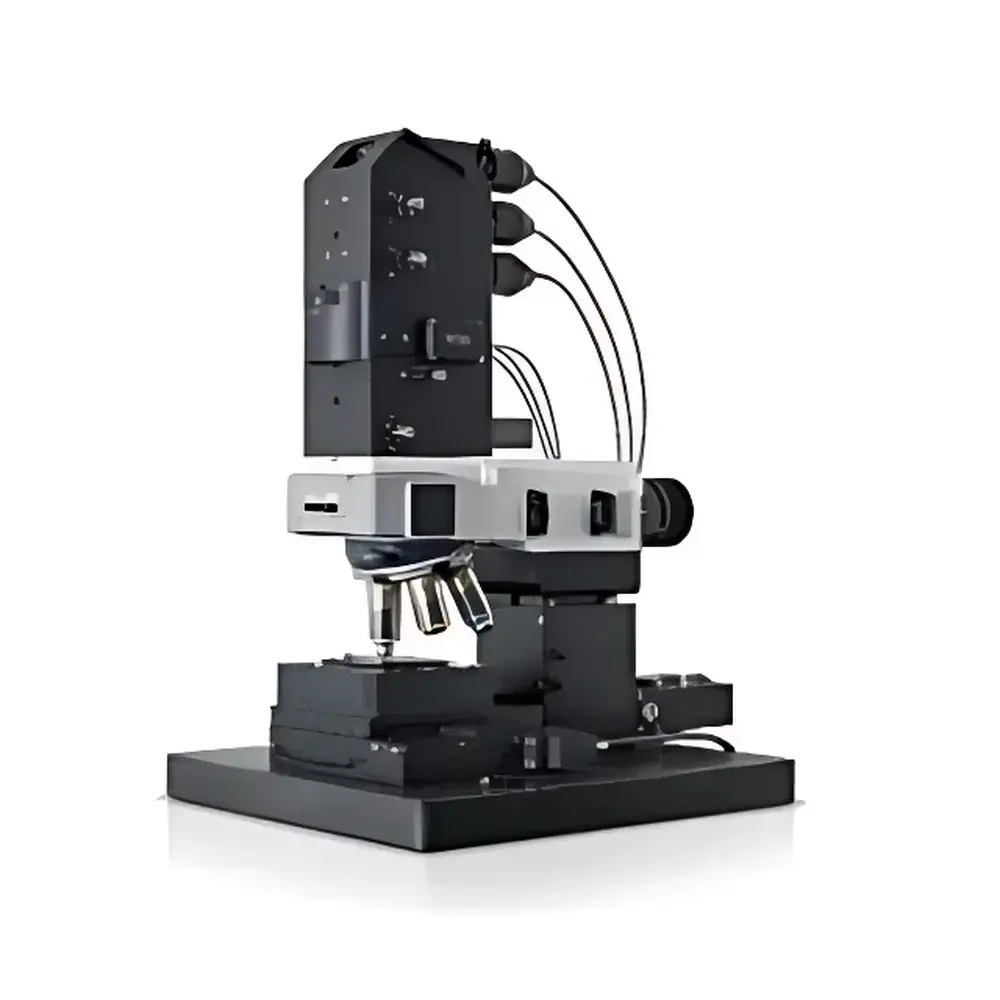
WITec alpha300 R Fast Confocal Raman Imaging Spectrometer
| Brand | Oxford Instruments |
|---|---|
| Origin | Germany |
| Manufacturer Type | Authorized Distributor |
| Product Origin | Imported |
| Model | alpha300 R |
| Instrument Type | Confocal Micro-Raman Spectrometer |
| Spectral Range | 90–9000 cm⁻¹ |
| Spectral Resolution | ≤0.2 cm⁻¹ |
| Spatial Resolution | Lateral 350 nm, Axial 800 nm |
| Minimum Wavenumber | 10 cm⁻¹ |
| Spectral Reproducibility | ≤±0.02 cm⁻¹ |
Overview
The WITec alpha300 R is a high-performance confocal micro-Raman imaging spectrometer engineered for quantitative chemical mapping with nanoscale spatial fidelity and exceptional spectral accuracy. Built upon WITec’s proprietary confocal optical architecture—featuring a true point-scanning design with pinhole-based depth discrimination—the system delivers intrinsic 3D sectioning capability without reliance on computational deconvolution. Its core measurement principle leverages inelastic light scattering (Raman effect) induced by monochromatic laser excitation, with spectral detection performed via high-throughput Czerny–Turner spectrograph coupled to back-illuminated or electron-multiplying CCD detectors. Designed for integration into regulated laboratory environments, the alpha300 R supports traceable calibration workflows compliant with ISO/IEC 17025 requirements for analytical instrument qualification and meets optical alignment stability criteria referenced in ASTM E1840 and USP for vibrational spectroscopic instrumentation.
Key Features
- True confocal Raman microscopy architecture with motorized or piezo-driven XYZ scanning stages for diffraction-limited lateral resolution (350 nm) and axial sectioning (800 nm)
- FAST RAMAN IMAGING® as standard—enabling single-spectrum acquisition times down to 125 ms (back-illuminated CCD) or 38 ms (front-illuminated CCD)
- ULTRAFAST RAMAN IMAGING® option with EMCCD detector: spectral integration time reduced to 0.76 ms per pixel, enabling real-time dynamic process monitoring
- Automated focus stabilization via hardware-integrated confocal feedback loop, ensuring consistent signal intensity across multi-layer or topographically variable samples
- Multi-laser excitation compatibility (e.g., 488 nm, 532 nm, 633 nm, 785 nm) with automatic wavelength calibration and power regulation per channel
- Motorized stage with programmable coordinate navigation, supporting automated grid acquisition, region-of-interest (ROI) stitching, and correlative analysis with SEM or AFM platforms
Sample Compatibility & Compliance
The alpha300 R accommodates a broad range of solid, thin-film, and encapsulated samples—including polymers, pharmaceutical tablets, semiconductor wafers, geological sections, and biological tissue cryosections—without requirement for conductive coating or vacuum conditions. Its modular optical path permits integration with environmental chambers (temperature-controlled, gas-purged, or humidity-regulated) and electrochemical cells. From a regulatory standpoint, the system supports audit-trail-enabled operation under FDA 21 CFR Part 11 when paired with WITec’s Project Manager software (v5.3+), including electronic signatures, user access controls, and immutable data archiving. All spectral calibrations are traceable to NIST-traceable polystyrene and silicon standards, satisfying GLP/GMP documentation requirements for QC laboratories.
Software & Data Management
Control, acquisition, and analysis are unified within WITec’s proprietary Project Manager software suite—a Windows-based platform validated for scientific data integrity. The software provides full scripting support (Python API), batch processing pipelines for multivariate analysis (PCA, cluster analysis), and native export to HDF5, ASCII, and JCAMP-DX formats for third-party chemometric tools. Spectral libraries (e.g., RRUFF, SDBS) can be imported and matched using correlation-based algorithms with adjustable tolerance thresholds. Raw hyperspectral cubes (x, y, λ) are stored with embedded metadata—including laser power, integration time, objective magnification, and stage coordinates—ensuring full experimental reproducibility. Data backups adhere to ISO 27001-aligned encryption protocols during network transfer or local archival.
Applications
- Pharmaceutical solid-state characterization: polymorph distribution mapping in tablet cores, API-excipient interaction analysis, and coating uniformity verification
- Materials science: stress/strain quantification in 2D materials (e.g., graphene, MoS₂), phase segregation in battery cathodes, and defect density profiling in SiC wafers
- Life sciences: label-free subcellular biomolecular mapping (lipids, proteins, nucleic acids) in fixed or live-cell preparations under physiological buffer conditions
- Forensics and art conservation: non-destructive pigment identification, varnish layer stratigraphy, and degradation product localization in historical artifacts
- Nanotechnology: plasmonic hotspot mapping, nanoparticle aggregation kinetics, and surface-enhanced Raman scattering (SERS) substrate homogeneity assessment
FAQ
What distinguishes the alpha300 R from conventional dispersive Raman microscopes?
It implements a mechanically stabilized confocal pinhole combined with a high-efficiency transmission spectrograph and low-noise EMCCD detection—delivering superior signal-to-noise ratio at sub-millisecond integration times without compromising spectral fidelity.
Is the system compatible with ISO 17025-compliant calibration procedures?
Yes—WITec provides certified calibration kits (NIST-traceable standards), documented uncertainty budgets, and SOP templates aligned with ISO/IEC 17025:2017 Clause 6.4 for measurement equipment verification.
Can spectral data be exported for compliance with FDA 21 CFR Part 11 requirements?
When operated with Project Manager v5.3+ and configured with role-based authentication, audit trails, and digital signature modules, full electronic record integrity is maintained per Part 11 Subpart B.
What sample preparation is required for optimal spatial resolution?
Minimal preparation is needed; flat, polished, or cleaved surfaces yield best results. For rough or highly scattering samples, immersion objectives or index-matching fluids may be employed to reduce spherical aberration.
Does the system support time-resolved Raman measurements?
Yes—via external TTL triggering and synchronized stage motion, enabling kinetic studies with temporal resolution limited only by detector readout speed and laser pulse stability.





