
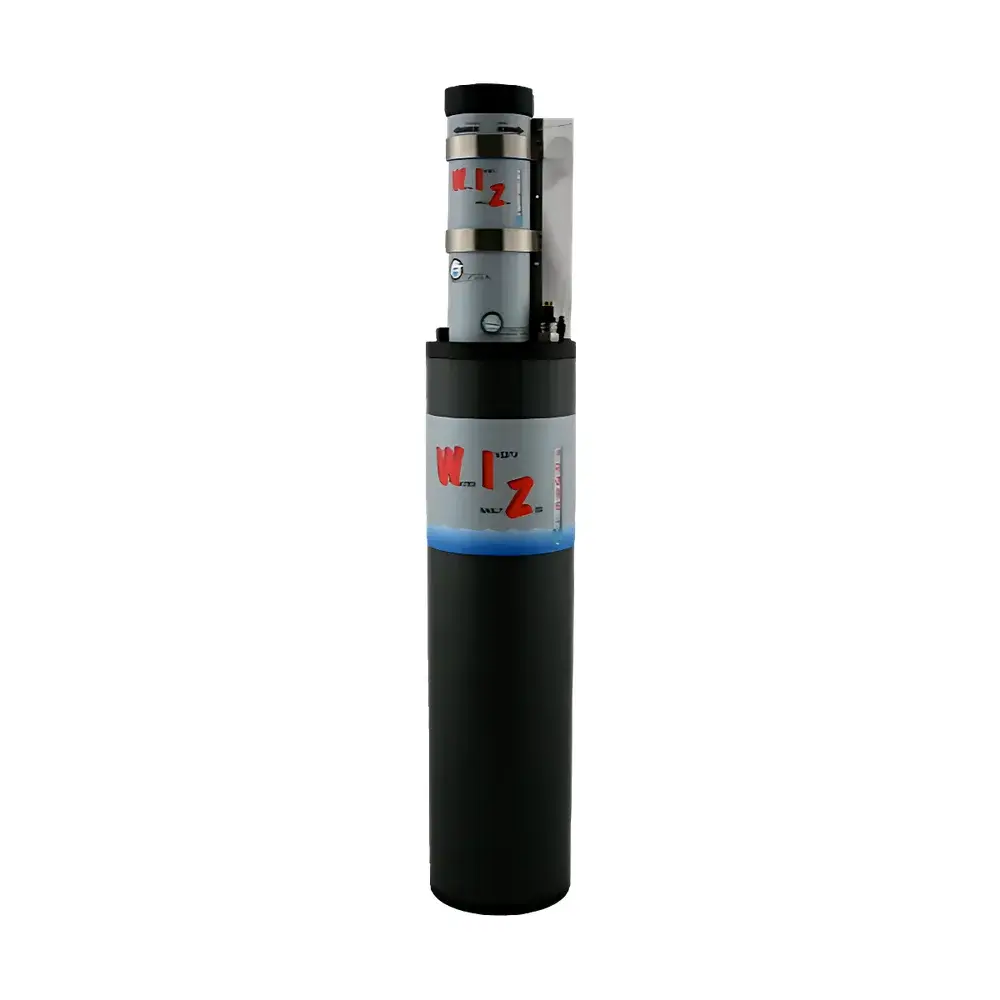
WIZ In-situ Water Quality Analyzer by SYSTEA
| Brand | SYSTEA |
|---|---|
| Model | WIZ |
| Origin | Zhejiang, China |
| Type | Portable In-situ Multiparameter Nutrient Analyzer |
| Measurement Principle | Micro-circulation Flow Analysis with Integrated Fiber-optic Colorimetry and Fluorescence Detection |
| Supported Parameters | Nitrate, Nitrite, Ammonia, Phosphate, Silicate (5 Nutrient Species Simultaneously) |
| Reagent Consumption | 0.12–0.24 mL per analysis |
| Reaction Volume | 1.5 mL micro-circulation reactor |
| Waste Management | Dual-path separation for toxic vs. non-toxic effluents |
| Filtration Options | Self-cleaning filter modules with 0.1 µm or 25 µm pore size |
| Power Supply | 13 V DC (solar-compatible) |
| Remote Operation | Full bidirectional control & status telemetry via external PC |
| Compliance | Designed for ISO 5667-3, ASTM D3370, and EPA Method 353.2–compatible deployment environments |
| Enclosure Rating | IP68 submersible housing (optional buoy-integrated mounting) |
Overview
The WIZ In-situ Water Quality Analyzer is a field-deployable, multiparameter nutrient monitoring platform engineered for continuous, unattended operation in marine, freshwater, groundwater, and drinking water systems. It implements micro-circulation flow analysis (MCFA) — a miniaturized, low-volume variant of segmented flow analysis — to deliver high-fidelity quantification of five key nutrient species: nitrate, nitrite, ammonia, orthophosphate, and silicate. Unlike conventional wet-chemistry analyzers requiring large reagent volumes and complex plumbing, the WIZ employs a 1.5 mL monolithic micro-reactor that reduces reagent consumption to 0.12–0.24 mL per full analytical cycle while maintaining stoichiometric precision and reaction completeness. Its integrated fiber-optic colorimetric detector and solid-state fluorescence sensor operate concurrently within a single optical path, enabling simultaneous absorbance and emission measurements without cross-channel interference. This dual-mode detection architecture significantly enhances selectivity in optically complex matrices — such as turbid estuarine waters or humic-rich groundwater — where spectral overlap and scattering commonly compromise traditional single-wavelength methods.
Key Features
- Single-instrument, five-parameter capability for critical aquatic nutrient species — eliminating need for multiple discrete analyzers
- Modular “plug-in” reagent cartridge design optimized for rapid deployment from buoys, moorings, and autonomous surface vehicles
- Dual-path fluidic routing system: segregated collection of hazardous (e.g., cadmium-based reagent waste) and non-hazardous effluents to meet ISO 14040-compliant waste handling protocols
- On-board auto-dilution module for out-of-range sample correction — supports up to 10× dilution with programmable re-analysis logic
- Self-cleaning filtration options: selectable 0.1 µm ceramic membrane (for phytoplankton- and colloid-rich seawater) or 25 µm stainless-steel mesh (for low-turbidity groundwater or reservoir intake monitoring)
- Intelligent diagnostics: real-time fault detection for air-in-line, sample starvation, pump stall, optical window fouling, and temperature drift — each triggering configurable alarm states and event-logged timestamps
- Low-power architecture: nominal 13 V DC input with <1.2 W average draw; fully compatible with marine-grade solar charge controllers and deep-cycle battery banks
Sample Compatibility & Compliance
The WIZ analyzer is validated for direct immersion or pumped-flow operation across salinities ranging from 0 to 35 ppt, temperatures from 0 to 35 °C, and pH 4–10. It meets mechanical and electrical requirements for long-term submersion per IEC 60529 IP68 (up to 10 m depth, 30-day duration). All wetted materials — including PEEK manifolds, sapphire optical windows, and EPDM-free fluoropolymer tubing — comply with USP Class VI and FDA 21 CFR 177.2400 for potable water contact. Analytical performance adheres to ISO 5667-3 (water sampling guidance), ASTM D3370 (sampling of water from natural sources), and EPA Method 353.2 (determination of nitrate + nitrite by cadmium reduction). Optional audit-trail logging and user-access controls support GLP/GMP-aligned data integrity frameworks.
Software & Data Management
The WIZ operates under SYSTEA’s AquaLink™ embedded firmware, supporting both local serial interface (RS-232/485) and Ethernet/IP-based remote access. A dedicated Windows/Linux application enables full configuration — including method scheduling, calibration curve management, alarm threshold definition, and diagnostic history review. All measurement data are timestamped with UTC-synced GPS-derived time (when connected to external GNSS module) and stored in IEEE-compliant CSV/NetCDF format. Secure FTP and MQTT protocols enable automated upload to cloud platforms (e.g., AWS IoT Core, Azure IoT Hub) with TLS 1.2 encryption. Firmware updates and parameter changes may be executed remotely with digital signature verification to satisfy FDA 21 CFR Part 11 electronic record requirements.
Applications
- Real-time eutrophication monitoring in coastal zones and estuaries using autonomous buoys
- Groundwater nutrient plume tracking at contaminated sites (e.g., agricultural runoff, landfill leachate)
- Drinking water source protection — early detection of phosphate/ammonia breakthrough in raw intake streams
- Research vessel underway systems for high-resolution spatial mapping of silicate gradients in upwelling regions
- Regulatory compliance reporting for wastewater discharge permits requiring multi-nutrient verification
- Long-term ecological observatories (LEOs) requiring >12-month unattended operation with minimal maintenance cycles
FAQ
What power supply options are supported?
The WIZ accepts a regulated 13 V DC input with surge protection and reverse-polarity safeguarding. It is certified for integration with photovoltaic arrays rated ≥20 W and lithium-iron-phosphate (LiFePO₄) battery banks.
Can the WIZ be deployed on existing oceanographic buoys?
Yes — its compact cylindrical form factor (Ø120 × 480 mm), standardized buoy-mount flange, and lightweight design (<4.2 kg dry weight) ensure compatibility with WHOI, NDBC, and SmartBuoy-class platforms.
How often does the system require maintenance in field operation?
With 0.1 µm filtration and weekly automated cleaning cycles, typical service intervals exceed 90 days in open-ocean deployments and 180 days in oligotrophic freshwater environments.
Is calibration traceable to NIST standards?
All factory calibrations use CRMs traceable to NIST SRM 3189 (nitrate), SRM 3188 (phosphate), and EPA-certified secondary standards; on-site verification kits include certified reference materials with expiration-matched uncertainty budgets.
Does the system support third-party SCADA integration?
Yes — Modbus TCP and OPC UA server profiles are available as optional firmware modules, enabling native interoperability with Siemens Desigo, Schneider EcoStruxure, and Honeywell Experion DCS environments.
Related Products







