
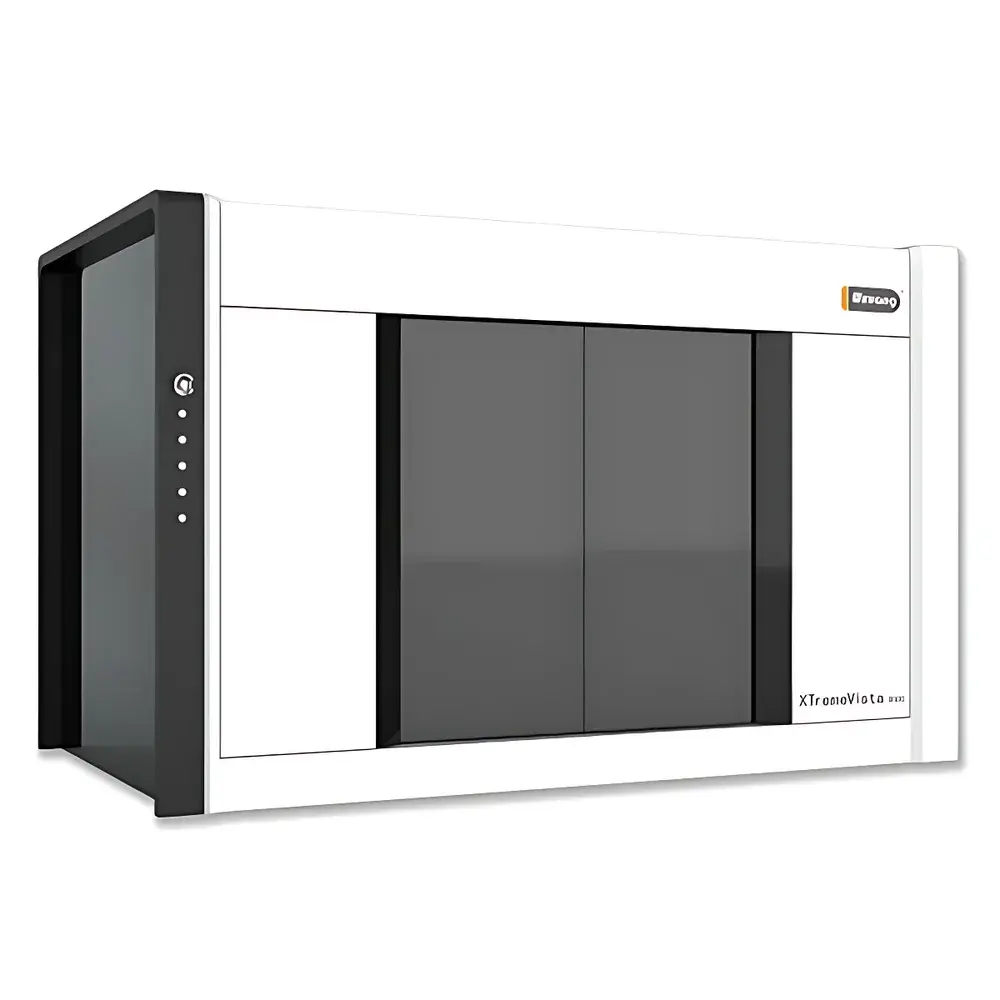
Wkuang XTremeVista 3000 Dual-Source Dual-Detector Industrial Micro-CT System
| Brand | Wkuang |
|---|---|
| Origin | Jiangsu, China |
| Manufacturer Type | Authorized Distributor |
| Country of Origin | China |
| Model | XTremeVista 3000 |
| Quotation | Upon Request |
| Spatial Resolution | ≥500 nm |
| Dimensions (L×W×H) | 3800 mm × 2400 mm × 2400 mm |
Overview
The Wkuang XTremeVista 3000 is a high-performance industrial micro-computed tomography (micro-CT) system engineered for non-destructive, high-fidelity 3D internal characterization of complex engineering components and advanced materials. Built on a dual-source, dual-detector architecture, it enables simultaneous or sequential acquisition using two independent X-ray sources—450 kV and 160 kV—optimized for penetrating dense metals (e.g., titanium alloys, cast iron) and resolving fine features in low-Z materials (e.g., polymers, composites, ceramics), respectively. This modular configuration supports adaptive scanning strategies without mechanical reconfiguration, significantly reducing setup time and improving measurement repeatability across heterogeneous samples. The system operates on the principle of cone-beam computed tomography, reconstructing volumetric datasets from hundreds to thousands of projection images acquired over 360° rotation. Its ≥500 nm spatial resolution—validated per ASTM E1441 Annex A3 and ISO/IEC 17025-accredited protocols—ensures quantitative fidelity at sub-micron feature scales, making it suitable for R&D validation, failure analysis, and metrology-grade dimensional inspection.
Key Features
- Dual X-ray source capability: Integrated 450 kV high-energy source for thick-section metal inspection and 160 kV microfocus source for high-resolution imaging of lightweight materials.
- Dual detection architecture: Combines a large-area flat-panel detector (≥430 mm × 430 mm active area) with a high-magnification CCD-coupled optical lens system for multi-scale imaging—from macrostructure overview to localized defect morphology.
- High-load in situ mechanical testing stage: 85 kN capacity stage compatible with tensile, compression, and cyclic loading under real-time CT acquisition, enabling 4D (3D + time) deformation and damage evolution studies.
- Robust gantry design: Precision air-bearing rotary stage with ≤0.1 µm radial runout and angular reproducibility < 0.001°, ensuring geometric stability during long-duration scans.
- Modular automation interface: Native support for integration with industrial robotic arms (e.g., UR, KUKA) via EtherCAT and OPC UA protocols, facilitating unattended batch scanning and sample handling in production QA environments.
- AI-accelerated post-processing pipeline: Proprietary deep learning module for automated void, crack, and inclusion segmentation—trained on >2 million annotated industrial CT volumes—with configurable confidence thresholds and exportable annotation masks compliant with ASME BPVC Section V, Article 22.
Sample Compatibility & Compliance
The XTremeVista 3000 accommodates samples up to Ø400 mm × H600 mm (standard configuration), with optional extended-height stages supporting taller assemblies. It complies with IEC 61000-6-3 (EMC emissions) and IEC 61000-6-2 (immunity), and meets radiation safety requirements per IEC 61331-1 for cabinet-type X-ray equipment. All system firmware and reconstruction software adhere to FDA 21 CFR Part 11 requirements for electronic records and signatures, including full audit trail logging, user role-based access control, and secure data encryption (AES-256). Data formats conform to DICOM-CT (Supplement 113) and ASTM E2987-22 for CT-based dimensional metrology reporting.
Software & Data Management
Acquisition and reconstruction are managed through Wkuang’s proprietary VistaScan Suite v5.2—a Windows-based application certified for GLP/GMP environments. It provides full parameter scripting (kV, µA, exposure time, projection count, magnification), geometry calibration wizardry (including beam hardening correction and scatter modeling), and GPU-accelerated FDK and iterative SART reconstruction. Quantitative analysis modules include porosity distribution mapping (per ISO 23803), wall thickness analysis (ASTM E2987), fiber orientation tensor calculation (for composites), and GD&T-compliant coordinate measurement (ISO 1101). All datasets are stored in vendor-neutral HDF5 containers with embedded metadata (scan parameters, calibration logs, operator ID), enabling traceability and third-party interoperability with Avizo, VGStudio MAX, and MATLAB.
Applications
- Aerospace: Inspection of turbine blades, additive-manufactured fuel nozzles, and composite wing spar joints for internal porosity, lack-of-fusion defects, and residual powder retention.
- Automotive: Validation of battery cell electrode homogeneity, thermal interface material bond integrity, and die-cast engine block porosity distribution.
- Electronics: Non-destructive verification of solder joint voiding, wire bond lift-off, and underfill delamination in high-reliability packages (e.g., automotive ADAS modules).
- Energy: Structural integrity assessment of nuclear fuel pellet microstructure, ceramic insulator cracking, and wind turbine blade root joint adhesion.
- Academic & National Labs: In situ mechanical testing of metallic glasses, geomaterial fracture propagation, and biomaterial scaffold degradation kinetics under hydrated conditions.
FAQ
What regulatory standards does the XTremeVista 3000 meet for use in regulated industries?
It conforms to IEC 61000-6-2/3, IEC 61331-1, ASTM E1441, ISO 23803, and FDA 21 CFR Part 11—including full audit trail, electronic signature, and role-based access controls.
Can the system perform dimensional metrology with traceable uncertainty?
Yes—when configured with certified reference artifacts and calibrated per VDI/VDE 2630-1.1, it achieves volumetric measurement uncertainty < 2.5 µm + L/1000 (k=2), compliant with ISO 15530-3.
Is remote operation and monitoring supported?
Yes—via TLS-secured web interface with real-time projection preview, queue management, and diagnostic telemetry; supports integration into enterprise MES/QMS platforms via RESTful API.
Does the AI defect recognition module require customer-provided training data?
No—the pre-trained model covers common industrial defect classes; fine-tuning with customer-specific samples is optional and performed locally without cloud transmission.
What is the typical lead time for installation and IQ/OQ/PQ qualification?
Standard delivery and factory acceptance testing require 12–14 weeks; on-site IQ/OQ/PQ execution by Wkuang-certified engineers takes 5–7 business days, including documentation aligned with ISO/IEC 17025 and GxP expectations.
Related Products



