
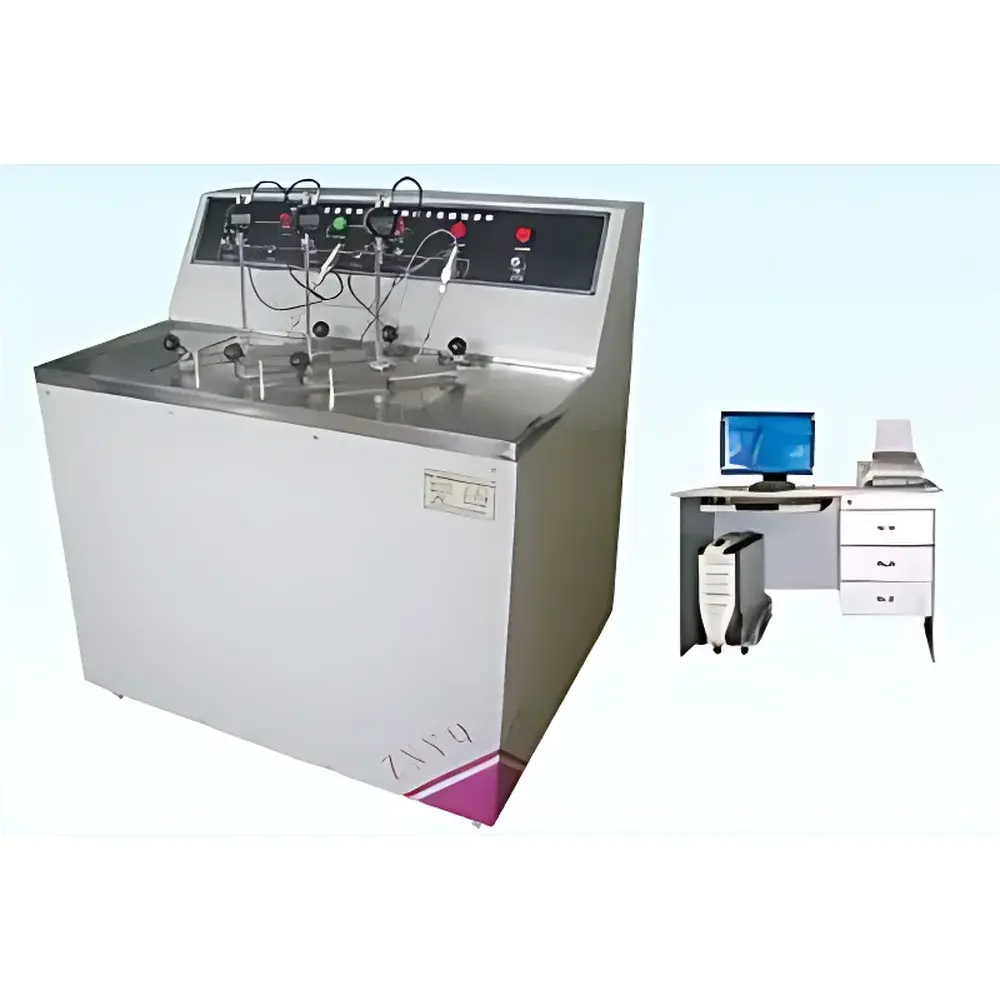
WKW-300 Heat Deflection Temperature and Vicat Softening Point Tester
| Origin | Jilin, China |
|---|---|
| Manufacturer Type | Authorized Distributor |
| Origin Category | Domestic (China) |
| Model | WKW-300 |
| Pricing | Available Upon Request |
| Temperature Range | Ambient to 300 °C |
| Temperature Accuracy | ±0.5 °C |
| Heating Rates | 5 ±0.5 °C/6 min (Method A), 12 ±1.0 °C/6 min (Method B) |
| HDT Deformation Range | 0–0.5 mm |
| Vicat Penetration Range | 0–1 mm |
| Dial Indicator Accuracy | ±0.005 mm |
| Vicat Needle | 3 mm length, cross-sectional area 1.000 ±0.015 mm² |
| HDT Probe Fillet Radius | 3.0 ±0.2 mm |
| Max HDT Load | 5 kgf (≈49.0 N) |
| Vicat Loads | GA = 10 N ±0.2 N, GB = 50 N ±1 N |
| Max Heating Power | ≤4000 W |
| Electrical Supply | 220 V, 50 Hz, 30 A |
| HDT Span Lengths | 64 mm and 100 mm |
| Accuracy Class | Class 1 |
| Cooling Options | Natural convection or water-cooled |
| Over-Temperature Protection | Programmable upper limit |
| Compatible Heat Transfer Medium | Methyl silicone oil (flash point ≥300 °C, kinematic viscosity ≈200 cSt) |
Overview
The WKW-300 Heat Deflection Temperature (HDT) and Vicat Softening Point Tester is a dual-function, microprocessor-controlled thermal analysis instrument engineered for precise determination of thermoplastic and thermosetting polymer behavior under standardized thermal-mechanical loading conditions. It operates on the principles defined in ISO 75 (HDT) and ISO 306 (Vicat), with full compliance to ASTM D648, ASTM D1525, GB/T 1633–2000, and GB/T 1634–2004. The system employs a calibrated silicone oil bath as the heat transfer medium, ensuring uniform thermal distribution across test specimens while maintaining stability at elevated temperatures up to 300 °C. Its core measurement methodology relies on controlled, linear heating rates applied to standardized specimen geometries under fixed bending or axial penetration loads—enabling reproducible quantification of the temperature at which specified deformation thresholds are reached.
Key Features
- Integrated dual-mode operation: simultaneous support for both Heat Deflection Temperature (HDT) per ISO 75-1/-2 and Vicat Softening Temperature (VST) per ISO 306, eliminating need for separate instrumentation
- Programmable, closed-loop temperature control with ±0.5 °C accuracy over the full 20–300 °C range, verified by traceable platinum resistance thermometer (PRT)
- Two certified heating rate profiles: Method A (5 ±0.5 °C/6 min) and Method B (12 ±1.0 °C/6 min), each independently selectable and automatically maintained via adaptive PID algorithm
- High-resolution displacement sensing using three precision dial indicators (±0.005 mm resolution), each independently calibrated and mounted on rigid, low-drift mechanical supports
- Dedicated load application modules: HDT fixtures with 64 mm and 100 mm span options; Vicat probes conforming to ISO 306 specifications (3 mm length, 1.000 ±0.015 mm² cross-section, polished stainless steel)
- Thermal safety architecture including programmable upper temperature limit, redundant over-temperature cutoff, and integrated oil overflow recovery system to prevent bath contamination during extended high-temperature cycles
- Modular hardware design supporting natural convection or external water-cooling for rapid post-test cooldown, reducing cycle time between consecutive measurements
Sample Compatibility & Compliance
The WKW-300 accommodates standard rectangular test bars (e.g., 80 × 10 × 4 mm for HDT; 10 × 10 × ~50 mm for Vicat) fabricated from thermoplastics (PP, PE, ABS, PC, PA6/66), thermosets (epoxy, phenolic), elastomers, and cable insulation compounds. Specimen preparation follows ISO 293, ISO 294, or GB/T 9352 protocols. All mechanical and thermal performance parameters meet ISO/IEC 17025 requirements for calibration traceability. The instrument’s measurement uncertainty budget is documented per ISO/IEC Guide 98-3 (GUM), and its software architecture supports audit-ready data integrity under GLP and GMP environments, including user access control, electronic signatures, and 21 CFR Part 11–compliant audit trails when deployed with validated configurations.
Software & Data Management
The embedded Windows-based control software provides real-time visualization of temperature vs. time and deformation vs. time curves on a high-resolution color CRT display. It enables full test parameter definition—including load selection (GA/GB), span configuration, heating rate, target deformation threshold (0.34 mm for HDT, 1 mm for Vicat), and pass/fail criteria. Raw sensor data (temperature, displacement, load status) are acquired at 10 Hz and stored in encrypted binary format with timestamped metadata. Post-acquisition, users generate customizable reports compliant with ISO 17025 reporting clauses: test ID, operator, calibration certificate numbers, environmental conditions, raw data plots, calculated result (°C), uncertainty statement, and digital signature. Data export supports CSV, PDF, and XML formats for LIMS integration. Software validation documentation (IQ/OQ/PQ protocols) is available upon request for regulated laboratories.
Applications
- Quality control of injection-molded automotive interior components (dashboards, trim panels) where dimensional stability above 80 °C is critical
- R&D evaluation of flame-retardant polyamide formulations for wire & cable applications requiring VST > 250 °C
- Comparative thermal screening of bio-based polyesters versus petroleum-derived PET in packaging substrate development
- Regulatory submission testing for medical device housings (ISO 10993-12) requiring HDT verification under 1.8 MPa or 0.45 MPa load conditions
- Failure analysis of thermoset composite tooling plates exposed to autoclave processing cycles
- Validation of material substitutions in aerospace ducting systems per SAE AMS 3675
FAQ
What heat transfer medium is required for operation?
Methyl silicone oil with a minimum flash point of 300 °C and kinematic viscosity of approximately 200 cSt at 25 °C is specified. Users must supply this medium separately.
Does the system support automatic test sequence execution?
Yes—the software allows batch programming of up to 24 sequential tests with independent parameter sets, including automatic load switching, span adjustment prompts, and post-test cooling initiation.
Is calibration certification included with shipment?
Each unit ships with a factory calibration report covering temperature sensor linearity, dial indicator repeatability, and load cell verification against NIST-traceable standards. On-site IQ/OQ services are available.
Can the WKW-300 be integrated into an existing laboratory network?
The system features Ethernet connectivity and supports OPC UA protocol for seamless integration with MES, LIMS, or SCADA platforms in Industry 4.0-compliant facilities.
What maintenance intervals are recommended?
Oil bath fluid replacement every 12 months or 500 operational hours (whichever occurs first); annual verification of probe geometry and dial indicator calibration; quarterly inspection of cooling circuit integrity for water-cooled configurations.





