
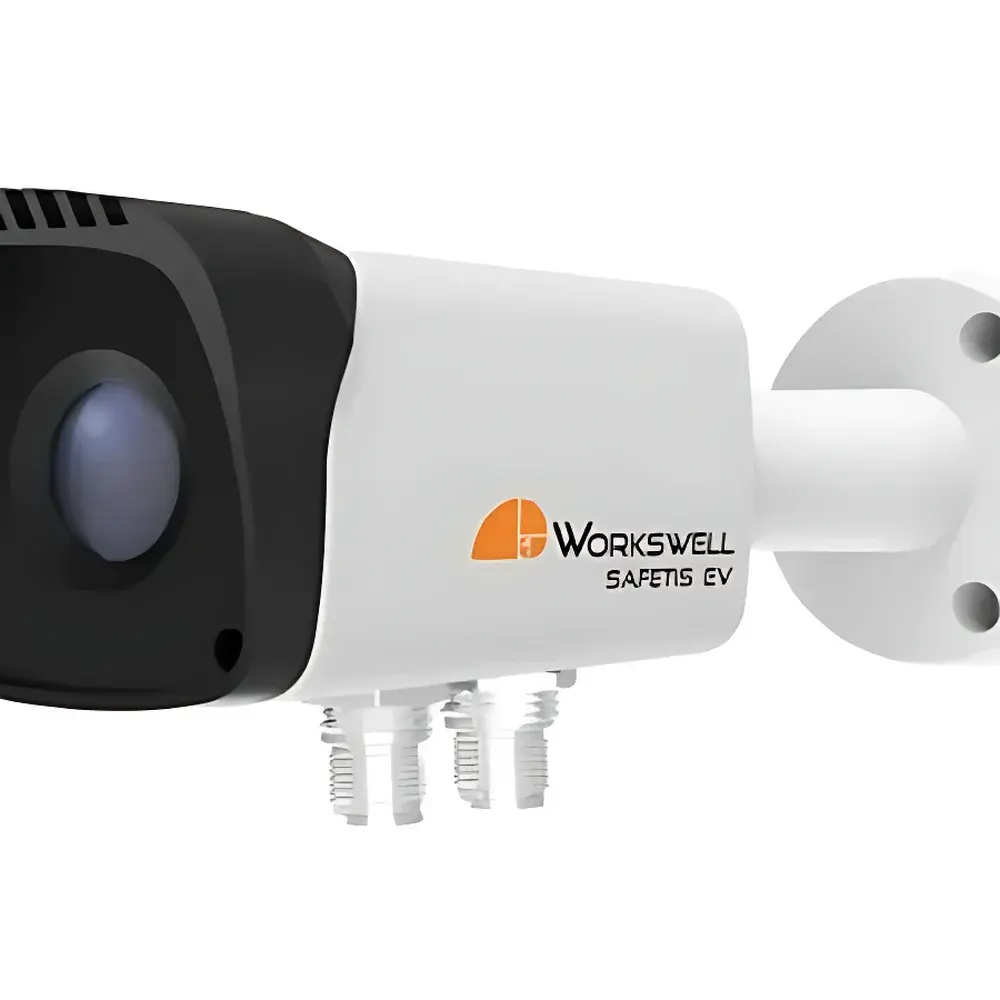
Workswell SAFETIS EV Intelligent Fire Risk Monitoring Sensor
| Brand | Workswell |
|---|---|
| Origin | USA |
| Manufacturer Type | Authorized Distributor |
| Origin Category | Imported |
| Model | SAFETIS EV |
| Pricing | Upon Request |
| Thermal Detector Count | 19,200 |
| Frame Rate | 9 Hz |
| Temperature Range | 0°C to +120°C |
| Thermal Sensitivity | 0.1°C (100 mK) |
| FOV | 57° H × 43° V, f/1.1 Fixed Lens |
| IP Rating | IP64 |
| Weight | <300 g |
| Output Interfaces | 1× Open-Collector (24 VDC / 100 mA), 1× Heartbeat Pulse (24 VDC / 100 mA), 1× Relay (30 VDC / 1.5 A) |
| Communication Protocols | Modbus RTU over RS485 (M12) and Ethernet/IP (Static IP/DHCP) |
| ROI Support | Up to 64 Regions of Interest, each configurable with dual temperature thresholds |
| Onboard Intelligence | Embedded thermal analytics engine, no external PC required |
Overview
The Workswell SAFETIS EV Intelligent Fire Risk Monitoring Sensor is a purpose-built, standalone thermal imaging device engineered for early-stage fire risk detection in industrial, logistics, and critical infrastructure environments. Unlike conventional smoke or point-temperature sensors, the SAFETIS EV employs uncooled microbolometer-based infrared thermography to perform continuous, non-contact surface temperature mapping across wide fields of view. Its core measurement principle relies on radiometric calibration of mid-wave infrared emissions (8–14 µm spectral band) from all objects within the scene—enabling quantitative temperature estimation without physical contact or ambient lighting requirements. With 19,200 active thermal pixels and a native frame rate of 9 Hz, the sensor captures dynamic thermal transients—such as localized overheating in electrical cabinets, friction-induced hotspots in conveyor systems, or exothermic reactions in stored materials—well before visible flame or smoke generation occurs. Designed for integration into existing building management systems (BMS), fire alarm control panels (FACP), or SCADA platforms, the SAFETIS EV operates autonomously with embedded firmware-level analytics, eliminating dependency on external computing resources while maintaining full traceability and deterministic response timing.
Key Features
- High-Density Radiometric Imaging: 19,200-pixel thermal array delivers spatially resolved temperature data at 9 frames per second—sufficient to track rapid thermal escalation in rotating machinery, battery storage racks, or HVAC ductwork.
- Onboard Thermal Analytics Engine: Firmware-integrated evaluation logic performs real-time pixel-wise thresholding, region-of-interest (ROI) analysis, and dual-stage alarm classification—no host PC, SDK, or third-party software required.
- Dual-Stage Programmable Alarm Architecture: Supports two independent temperature thresholds per ROI (warning and critical), with configurable digital outputs (open-collector) and a fail-safe relay (30 VDC / 1.5 A) compliant with EN 54-18 and UL 864 system interface standards.
- Robust Industrial Enclosure: Machined aluminum housing rated IP64—resistant to dust ingress and water splashing from any direction—validated for continuous operation between −20°C and +60°C ambient, with internal thermal compensation ensuring accuracy across the full 0°C to +120°C measurement range.
- Standardized Industrial Connectivity: Dual communication paths: isolated RS485 (EIA/TIA-485-A, M12 connector) supporting Modbus RTU, and Ethernet/IP with static IP or DHCP configuration—enabling seamless integration into legacy and modern control networks without protocol gateways.
- Flexible Deployment Footprint: Compact form factor (<300 g) and universal mounting hardware allow ceiling, wall, or pole installation in warehouses, data centers, manufacturing lines, and cold-chain storage facilities—no structural reinforcement or dedicated cabling infrastructure needed.
Sample Compatibility & Compliance
The SAFETIS EV is optimized for monitoring solid surfaces and equipment enclosures—not gases, flames, or transparent media. It is validated for use on painted metal, composite panels, insulated cables, lithium-ion battery modules, and conveyor belt components. All thermal measurements are calibrated per ISO 18434-1 (Condition monitoring — Thermography) and traceable to NIST-traceable blackbody references. The device complies with CE marking requirements under the EU Machinery Directive 2006/42/EC and EMC Directive 2014/30/EU. Its relay output meets SIL 2 functional safety requirements per IEC 61508 when deployed in safety-related circuits. For regulated environments—including pharmaceutical warehousing and food processing—the onboard logging and alarm event timestamps support audit readiness under FDA 21 CFR Part 11 and EU Annex 11 when integrated with compliant data acquisition systems.
Software & Data Management
Configuration and diagnostics are performed via a secure web-based interface accessible through standard Ethernet connection (RJ-45 to M12 adapter included). Users define up to 64 ROIs using a drag-and-drop thermal overlay viewer; each ROI supports dual independent temperature thresholds, hysteresis settings, and output routing to discrete I/O channels. Alarm events—including timestamp, ROI ID, peak temperature, and duration—are logged internally with circular buffer storage (72 hours at default sampling) and exportable via HTTP GET or Modbus register polling. No proprietary runtime or license keys are required; firmware updates are delivered as signed binary packages verified via SHA-256 checksum. Audit trails include user login history, parameter change logs, and alarm acknowledgment records—all retained for ≥90 days and exportable in CSV format for GLP/GMP documentation workflows.
Applications
- Early detection of thermal anomalies in electrical switchgear, UPS systems, and transformer enclosures
- Continuous hotspot monitoring of automated storage and retrieval systems (AS/RS) and pallet racking structures
- Preventive oversight of lithium-ion battery charging stations and energy storage containers
- Thermal integrity verification of insulated refrigerated chambers and cold-room door seals
- Process-critical equipment surveillance in chemical blending areas and paint-spray booths
- Complementary layer to optical flame detectors in high-ceiling aircraft hangars and warehouse distribution centers
FAQ
Does the SAFETIS EV require periodic recalibration?
No—factory radiometric calibration is stable for the lifetime of the sensor under normal operating conditions. Field verification using a certified blackbody source is recommended annually per ISO/IEC 17025 guidelines.
Can multiple SAFETIS EV units be synchronized for time-aligned thermal event correlation?
Yes—Ethernet-connected units can be configured with NTP synchronization; RS485 deployments rely on master-slave polling timing for sub-100 ms temporal alignment.
Is the thermal video stream encrypted during transmission?
Raw RTP streams are unencrypted by default; however, TLS-secured HTTP configuration access and VLAN segregation are supported for network-level data protection.
What is the minimum detectable temperature difference across the field of view?
Thermal sensitivity is specified as ≤0.1°C (100 mK) at 30°C ambient, measured per ISO 16509 under uniform irradiance conditions.
How does the device handle condensation or frost accumulation on the lens?
The IP64-rated housing prevents ingress, but direct lens exposure to high-humidity or sub-zero dew-point environments may cause temporary obscuration; optional heated lens kits (sold separately) mitigate this in cold-storage applications.







