
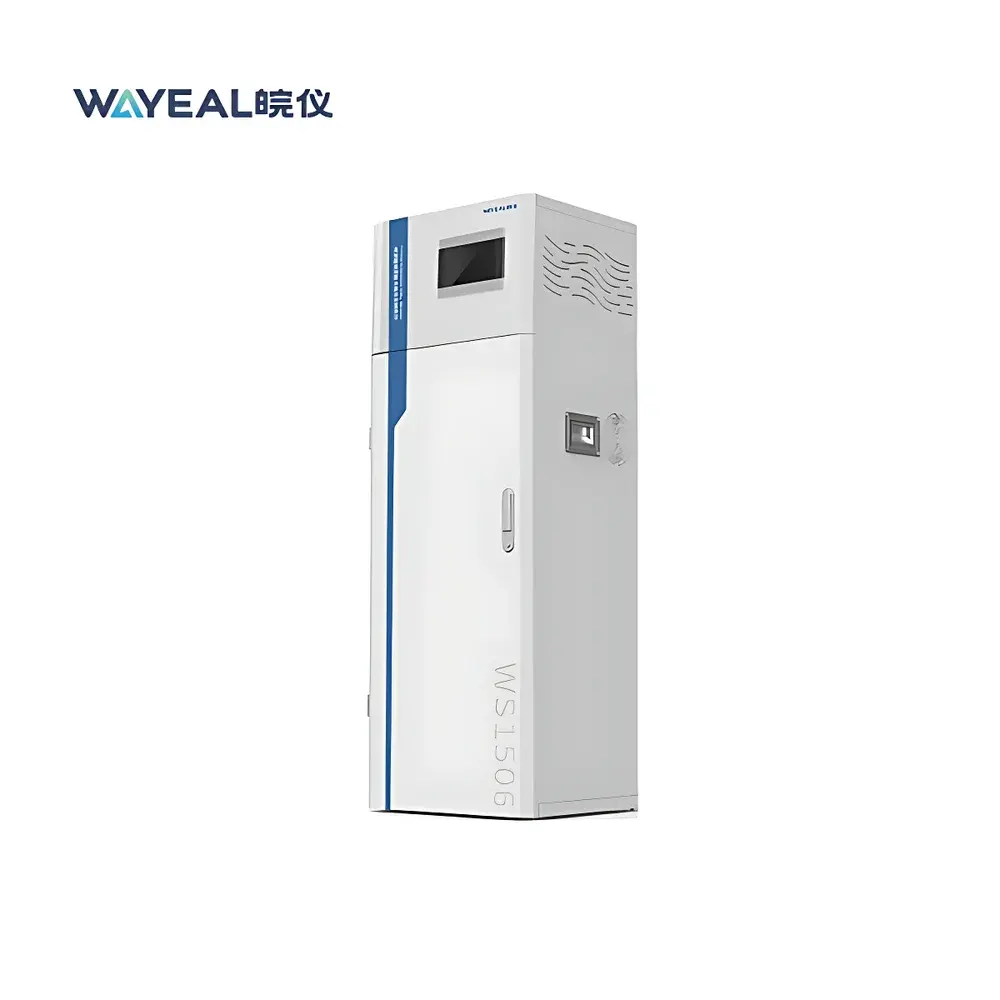
WS1506 Online Permanganate Index (CODMn) Analyzer by WAYEAL
| Brand | WAYEAL |
|---|---|
| Origin | Anhui, China |
| Manufacturer Type | Direct Manufacturer |
| Product Category | Domestic |
| Model | WS1506 |
| Measurement Principle | Potassium Permanganate Oxidation with ORP Endpoint Detection |
| Instrument Type | Online Analyzer |
| Range | 0–25.0 mg/L (expandable) |
| Repeatability | ≤5% RSD |
| Accuracy | ±10% of reading |
| LOD | ≤1.5 mg/L |
| Resolution | 0.01 mg/L |
| Single Analysis Time | 30–9999 min |
Overview
The WAYEAL WS1506 Online Permanganate Index (CODMn) Analyzer is a fully automated, continuous-monitoring instrument engineered for reliable, long-term quantification of the permanganate index—a critical surrogate parameter for organic pollution load in freshwater systems. It operates on the standardized potassium permanganate oxidation method under acidic conditions (ISO 8467:1993, GB/T 5750.7–2006), where sample organic matter is oxidized by excess KMnO4 at elevated temperature, followed by back-titration of unreacted permanganate with sodium oxalate and subsequent re-titration using standardized KMnO4. Endpoint detection is achieved via high-stability ORP (oxidation-reduction potential) electrode monitoring, ensuring precise stoichiometric determination without reliance on subjective colorimetric interpretation. Designed for unattended operation in ambient outdoor or sheltered cabinet environments, the WS1506 integrates thermal control, fluidic precision, and fail-safe hardware protection to meet the operational demands of municipal water utilities, wastewater treatment plants, and surface water quality surveillance networks.
Key Features
- Triple-stage opto-fluidic metering system: Combines photoelectric sensing, stepper-motor-driven syringe pumps, and pressure-compensated peristaltic delivery to achieve sub-1% volumetric accuracy—minimizing drift caused by tubing fatigue or viscosity variation.
- Adaptive thermal management: Integrated PID-controlled heating/cooling module maintains ±0.5 °C stability during digestion (typically 100 °C, 30 min) and post-digestion titration phases; includes real-time ambient light compensation and auto-zeroing for optical sensors.
- Robust reagent handling architecture: Chemically resistant solenoid selection valves (PTFE/PFA wetted path), quartz-glass digestion vials rated for repeated thermal cycling, and redundant leak detection via capacitive sensor arrays.
- Comprehensive safety interlocks: Real-time monitoring of digestion chamber pressure, thermal cutoff at 120 °C, automatic emergency venting, and motorized safety door with dual-sensor position verification (IEC 61508 SIL2 compliant logic).
- Field-programmable maintenance scheduler: On-device HMI allows operators to define custom calibration, cleaning, and reagent replacement intervals—supporting predictive maintenance logs exportable via Modbus TCP or RS485.
- Low-temperature reagent preservation: Integrated thermoelectric cooler (TEC) maintains reagent storage compartments at 4–8 °C, extending KMnO4 and Na2C2O4 shelf life beyond 90 days without external refrigeration.
Sample Compatibility & Compliance
The WS1506 is validated for use with raw and treated freshwater matrices including river, lake, reservoir, drinking water intake, and secondary effluent. Turbidity up to 100 NTU and suspended solids ≤100 mg/L are accommodated via integrated 50-µm inline filtration. All wetted materials comply with USP Class VI and FDA 21 CFR 177.2600 requirements. The analyzer supports audit-ready data integrity per GLP and ISO/IEC 17025 frameworks: full electronic records—including timestamped method parameters, raw ORP curves, reagent lot traceability, and operator ID—are stored locally (16 GB embedded flash) and exportable in CSV/CSV-T format. Firmware implements secure user roles (admin/operator/maintainer), password complexity enforcement, and immutable event logging aligned with FDA 21 CFR Part 11 principles.
Software & Data Management
The embedded Linux-based firmware provides a 7-inch capacitive touchscreen interface with multilingual support (English, Spanish, Portuguese, Arabic). Configuration, diagnostics, and historical trend review are accessible without external software. Remote access is enabled via HTTPS-secured web server (TLS 1.2+) supporting JSON-RPC API for integration into SCADA, EMS, or cloud-based water intelligence platforms (e.g., OSIsoft PI, Siemens Desigo, or AWS IoT Core). All measurement data include metadata tags for sampling point ID, instrument serial number, method version, and QC flag status (e.g., “Calibration Valid”, “Drift Alert”, “Maintenance Due”). Automated report generation supports daily/weekly/monthly summary PDFs with embedded calibration certificates and statistical process control (SPC) charts.
Applications
- Real-time compliance monitoring of surface water bodies per national environmental standards (e.g., China’s GB 3838–2002, EU WFD Annex V).
- Early-warning detection of organic contamination events at drinking water intakes and distribution system entry points.
- Process optimization in wastewater treatment plants—tracking influent biodegradability and evaluating biological treatment efficiency.
- Long-term trend analysis for watershed management authorities assessing seasonal organic loading variations.
- Reference-grade validation of portable field CODMn test kits and laboratory benchtop analyzers.
FAQ
What regulatory standards does the WS1506 comply with for online water quality monitoring?
It adheres to ISO 8467:1993 for analytical methodology, GB/T 5750.7–2006 for drinking water testing, and meets electromagnetic compatibility (EMC) requirements per IEC 61326-1:2013.
Can the instrument be integrated into existing SCADA systems?
Yes—via Modbus RTU/TCP, OPC UA (optional firmware module), or HTTP RESTful API with configurable polling intervals and alarm thresholds.
How often is manual maintenance required under typical operating conditions?
With clean influent water, routine tasks (reagent refill, filter replacement, electrode cleaning) are scheduled every 30 days; full calibration verification is recommended every 90 days.
Is remote firmware update supported?
Yes—signed firmware packages can be uploaded via secure HTTPS or USB drive, with rollback capability and pre-update integrity checksum verification.
Does the analyzer support multi-point calibration and drift correction?
Yes—up to 5-point non-linear calibration curves are stored per method; automatic drift compensation adjusts for electrode aging using reference solution measurements at user-defined intervals.
Related Products







