
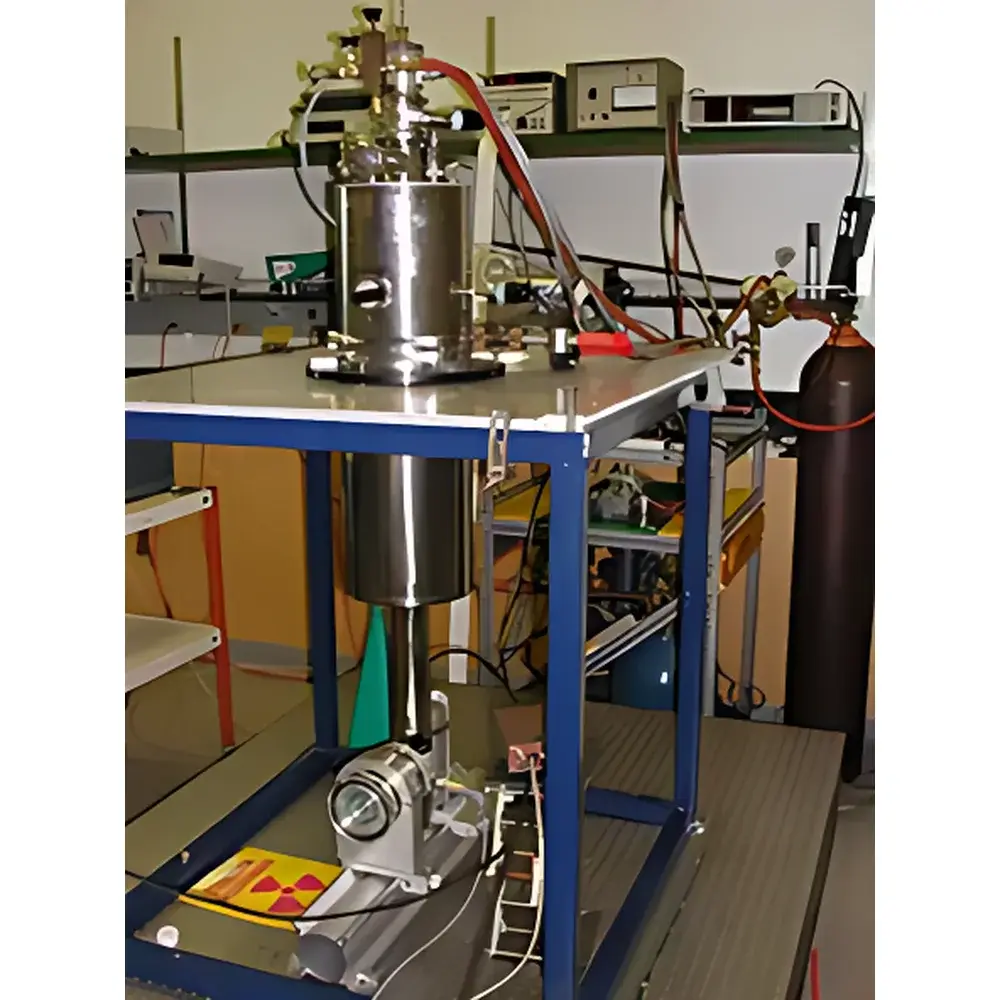
WSSL-10 Mossbauer Spectroscopy System
| Origin | Germany |
|---|---|
| Manufacturer Type | Authorized Distributor |
| Origin Category | Imported Instrument |
| Model | WSSL-10 |
| Pricing | Available Upon Request |
Overview
The WSSL-10 Mossbauer Spectroscopy System is a modular, research-grade platform engineered for high-resolution nuclear resonance spectroscopy based on the Mössbauer effect. It enables quantitative analysis of hyperfine interactions—including isomer shift, quadrupole splitting, and magnetic hyperfine splitting—in solid-state materials containing Mössbauer-active nuclei (e.g., 57Fe, 119Sn, 151Eu). The system supports both transmission Mössbauer spectroscopy (TMS) and scattering-based configurations including gamma-ray scattering (GMS), X-ray scattering (XMS), and conversion electron Mössbauer spectroscopy (CEMS). Its design emphasizes mechanical stability, thermal control fidelity, and spectral reproducibility—critical for studies in condensed matter physics, inorganic chemistry, mineralogy, corrosion science, and catalysis research.
Key Features
- Modular architecture supporting eight distinct experimental configurations: six TMS variants (room-temperature, cryogenic, and high-temperature), one GMS/XMS/CEMS scattering system, and one integrated high-temperature furnace module.
- Temperature range coverage from 4 K to 1500 K via interchangeable cryostats and furnaces—enabling phase-transition studies, magnetic ordering investigations, and thermally activated relaxation analyses.
- Floating optical table base with active vibration isolation, ensuring sub-nanometer mechanical stability during long-duration scans (typical acquisition times: 12–72 hours).
- High-precision velocity calibration using Wissel laser interferometry (traceable to NIST standards), achieving Doppler velocity resolution better than ±0.01 mm/s over full scan ranges.
- Dual-sensor compatibility: Wissel transducers for ultra-high-resolution low-noise detection and Ranger piezoelectric drivers for robust routine operation.
- Integrated 9 T superconducting magnet cryostat (11 cc bore) with vertical sensor orientation optimized for cold-source absorption measurements and polarized-beam experiments.
- Five liquid-helium cryostats available—four operating from 4 K to 400 K (three equipped with 9 T longitudinal fields), and one VSM-compatible unit for simultaneous magnetization and Mössbauer data acquisition.
Sample Compatibility & Compliance
The WSSL-10 accommodates diverse sample geometries and environments: thin films, bulk powders, single crystals, frozen solutions, and gas-exposed surfaces (for CEMS/XMS). All cryogenic modules comply with IEC 61000-6-3 (EMC) and ISO 14001 environmental safety requirements for helium-handling infrastructure. The system meets GLP-compliant data integrity standards through hardware-timestamped acquisition, audit-trail-enabled software logging, and user-access-controlled parameter locking. While not FDA 21 CFR Part 11 certified out-of-the-box, the acquisition software architecture supports validation protocols required for regulated pharmaceutical or nuclear materials characterization under ASTM E2877 and ISO 11270.
Software & Data Management
Data acquisition and analysis are performed using proprietary Windows-based software fully compatible with x64 architectures and modern PC platforms. The suite includes real-time spectrum preview, automated velocity calibration, multi-spectrum overlay tools, and least-squares fitting routines incorporating constrained hyperfine parameter models. Raw data are stored in ASCII and HDF5 formats for third-party interoperability (e.g., with Python-based MossWinn, Recoil, or MATLAB toolboxes). All processing steps—including background subtraction, efficiency correction, and thickness normalization—are scriptable and reproducible. Audit trails record operator ID, timestamp, instrument configuration, and raw-to-fitted parameter history—ensuring traceability per ISO/IEC 17025 laboratory accreditation requirements.
Applications
- Quantitative speciation of iron-bearing phases in geological samples (e.g., olivine, pyroxenes, spinels) and extraterrestrial materials (meteorites, lunar regolith simulants).
- In situ monitoring of oxidation state changes in catalysts during CO oxidation or Fischer–Tropsch synthesis under controlled atmospheres.
- Magnetic anisotropy mapping in thin-film heterostructures via temperature- and field-dependent CEMS measurements.
- Probing local symmetry distortions in perovskite oxides and battery cathode materials (e.g., LiFePO4, NMC) across charge/discharge cycles.
- Characterization of radiation-damaged nuclear fuel matrices and actinide-bearing ceramics under inert or reducing atmospheres.
- Validation of DFT-predicted hyperfine parameters through direct comparison with experimental isomer shifts and quadrupole coupling tensors.
FAQ
What Mössbauer isotopes are supported by the WSSL-10 platform?
The system is optimized for 57Fe (14.4 keV), but its velocity drive linearity and detector energy window allow adaptation to 119Sn (23.9 keV), 151Eu (21.6 keV), and 121Sb (37.2 keV) with appropriate source and absorber selection.
Can the WSSL-10 perform time-resolved Mössbauer measurements?
No—this is a continuous-wave (CW) spectrometer; it does not support synchrotron-based time-domain or nuclear resonance vibrational spectroscopy (NRVS) modes.
Is remote operation supported?
Yes—via secure RDP or VNC connections to the acquisition PC; all hardware control and data streaming functions remain fully accessible without performance degradation.
What maintenance is required for the liquid-helium cryostats?
Annual vacuum integrity verification and cold-head performance calibration are recommended; full service intervals are specified in the OEM technical manual and align with ISO 13374 condition monitoring guidelines.
Are application-specific method templates provided?
Yes—the software includes validated templates for common use cases: hematite/goethite quantification, Fe2+/Fe3+ ratio determination in silicates, and magnetic hyperfine field distribution analysis in amorphous alloys.





