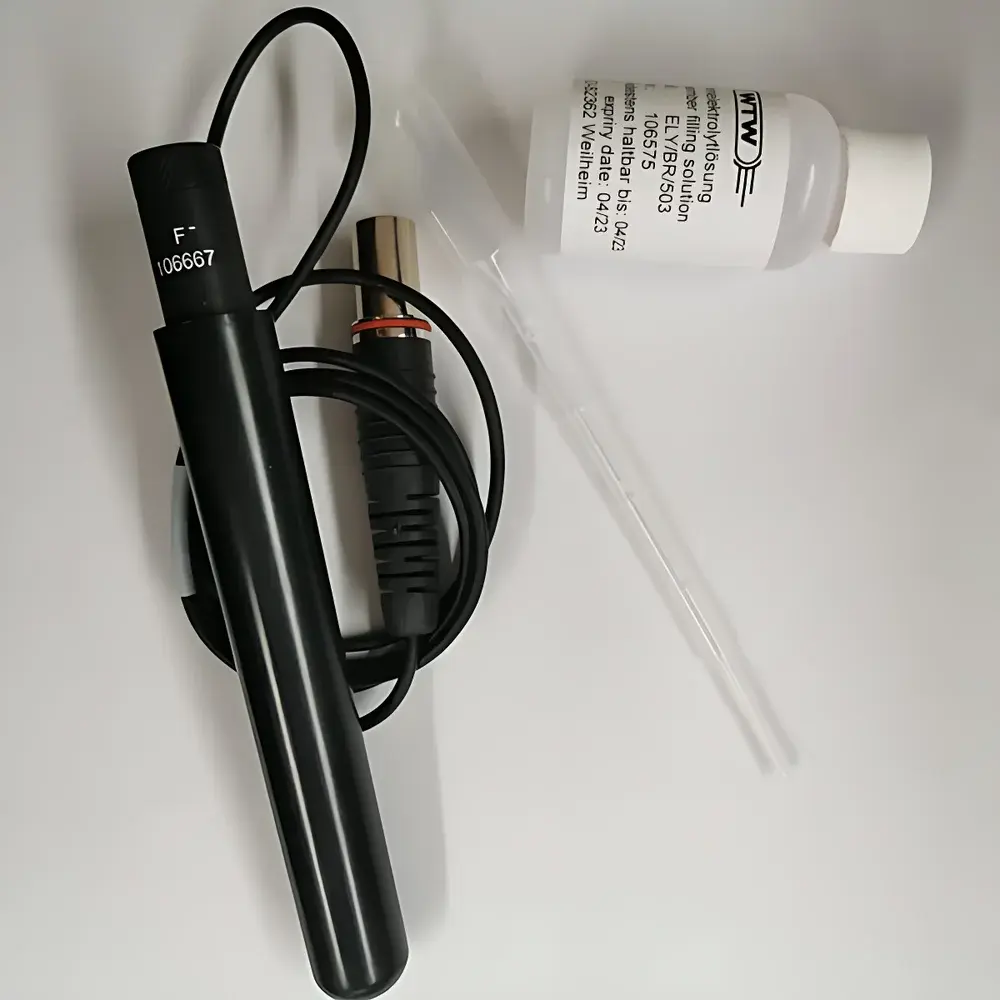
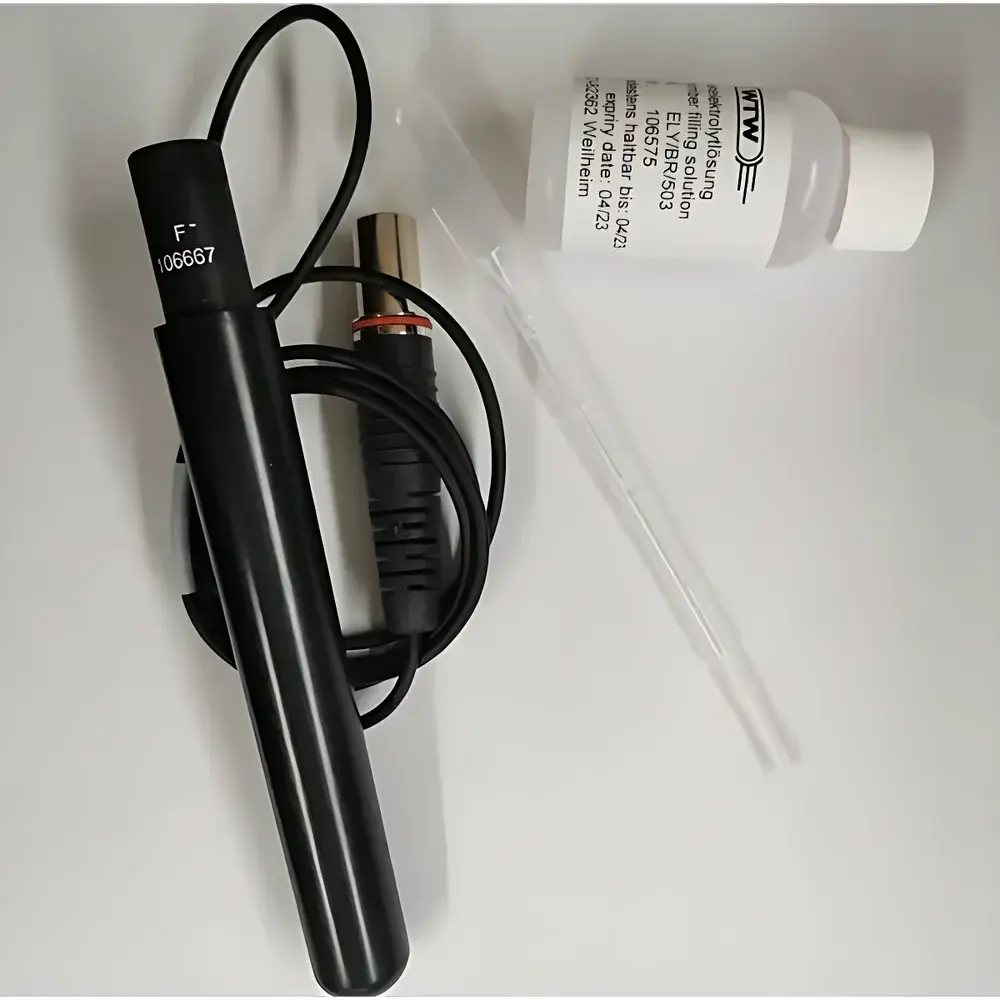
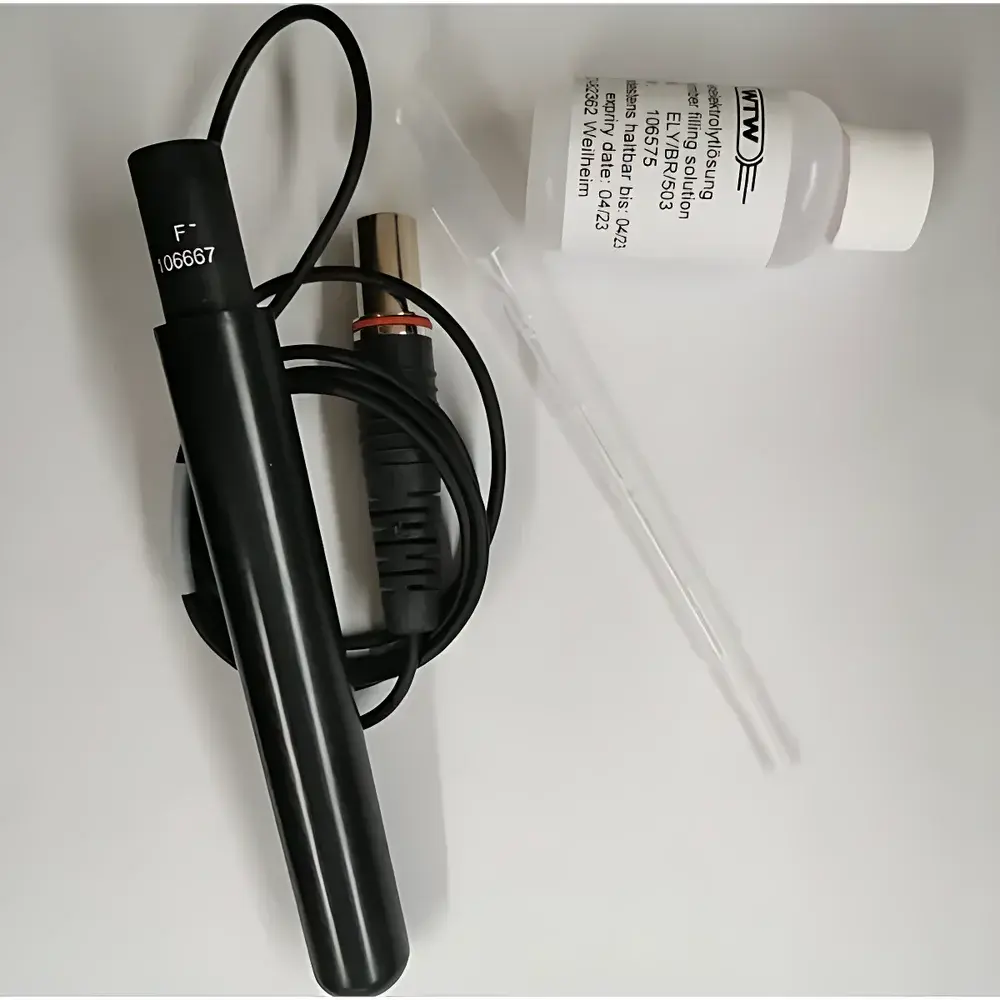
WTW F 800 DIN Fluoride Ion-Selective Electrode (Model 106667)
| Brand | WTW |
|---|---|
| Origin | Germany |
| Model No. | 106667 |
| Electrode Type | Combined ISE with Integrated Reference System |
| Measuring Ion | Fluoride (F⁻) |
| pH Range | 5–7 |
| Membrane Material | Lanthanum Fluoride (LaF₃) Crystal |
| DIN Standard Compliance | DIN 38404-7, DIN EN ISO 10304-1 |
| Output Signal | mV vs. Ag/AgCl reference |
| Temperature Range | 0–50 °C |
| Response Time | <2 min (t₉₀) |
| Detection Limit | ≤1 µg/L (0.05 µM) F⁻ |
| Storage Solution | 0.001 mol/L NaF or 10 g/L NaF standard solution |
Overview
The WTW F 800 DIN Fluoride Ion-Selective Electrode (Model 106667) is a high-precision, combined-type potentiometric sensor engineered for reliable and reproducible quantification of fluoride ions (F⁻) in aqueous samples. Based on the thermodynamic Nernst principle, the electrode employs a single-crystal lanthanum fluoride (LaF₃) membrane that selectively interacts with fluoride anions, generating a stable, logarithmic millivolt response proportional to the negative logarithm of F⁻ activity. Its integrated double-junction reference system—filled with saturated KCl and equipped with a ceramic frit junction—minimizes liquid junction potential drift and prevents clogging during routine analysis of complex matrices such as drinking water, wastewater, soil extracts, and industrial process streams. Designed and manufactured in Germany to meet stringent DIN and ISO metrological requirements, this electrode conforms to DIN 38404-7 (C7) for determination of fluoride in water and DIN EN ISO 10304-1 for ion chromatography validation support.
Key Features
- Combined ISE architecture with built-in Ag/AgCl reference and LaF₃ sensing membrane—no external reference electrode required
- DIN-compliant mechanical design (DIN 19263 thread) ensuring compatibility with WTW handheld meters (e.g., Multi 3630 IDS), benchtop analyzers (e.g., inoLab® pH/ION), and third-party potentiometers supporting BNC or DIN connectors
- Optimized for use with Total Ionic Strength Adjustment Buffer (TISAB), particularly TISAB III, to mask interfering ions (e.g., Al³⁺, Fe³⁺), control pH, and maintain constant ionic strength
- Robust epoxy body with chemical-resistant O-rings; IP67-rated housing for field-deployable durability
- Calibration-ready geometry: linear response over 10⁻⁶ to 10⁻¹ mol/L F⁻ (0.02–1900 mg/L), with typical slope of −57.0 ± 1.5 mV/decade at 25 °C
- Low-drift performance: <0.5 mV/h baseline stability after equilibration; reproducibility ≤±2% RSD across triplicate measurements
Sample Compatibility & Compliance
The F 800 DIN electrode is validated for direct measurement in clarified, low-turbidity aqueous solutions with conductivity between 100 µS/cm and 2 mS/cm. It supports regulatory workflows aligned with EPA Method 300.0 (for fluoride in drinking water), ASTM D4327 (ion chromatography confirmation), and ISO 10304-1 Annex A. Sample types include potable water, groundwater, effluent from fluoridation plants, semiconductor rinse water, and leachates from construction materials. For high-aluminum or acidic samples (pH 5 mg/L without prior filtration (0.45 µm).
Software & Data Management
When paired with WTW’s IDS-enabled instruments (e.g., Multi 3630 IDS), the electrode integrates seamlessly into traceable digital workflows. Sensor identification is auto-recognized via embedded RFID chip (model-specific). Calibration data—including up to five-point standard addition or direct calibration curves, date/time stamps, operator ID, and temperature compensation coefficients—is stored locally and exportable via USB or Bluetooth to CSV or PDF reports. All measurement sessions comply with GLP/GMP documentation standards, supporting audit-ready records with full metadata (electrode serial number, calibration history, TISAB lot number, environmental conditions). Optional software integration with LabX® (Mettler Toledo) or custom LIMS via Modbus TCP enables centralized instrument management and 21 CFR Part 11–compliant electronic signatures where required.
Applications
- Regulatory compliance testing for fluoride in municipal drinking water (WHO guideline: 1.5 mg/L; EU limit: 1.5 mg/L)
- Quality control of fluoride-containing dental products (toothpaste, mouth rinses) per ISO 11609
- Environmental monitoring of fluoride leaching from coal ash, phosphate fertilizers, and aluminum smelting residues
- Process analytics in glass etching, semiconductor wafer cleaning, and uranium enrichment facilities
- Research-grade speciation studies in geochemical systems, including F⁻/OH⁻/AlFₓ equilibria modeling
FAQ
What is the recommended storage solution for long-term preservation?
Store the electrode tip immersed in 0.001 mol/L NaF solution or 10 g/L NaF standard solution. Never store dry or in deionized water.
Can this electrode measure fluoride in serum or biological fluids?
No—direct measurement is not advised due to protein fouling, high ionic complexity, and matrix-induced junction potential errors. Enzymatic digestion followed by dilution and TISAB III addition may enable semi-quantitative screening, but certified clinical methods (e.g., ion chromatography) are preferred.
How often should calibration be performed?
Perform two-point calibration before each analytical session using 1 mg/L and 10 mg/L F⁻ standards prepared in TISAB III. Re-calibrate if drift exceeds ±2 mV or after measuring >10 samples.
Is the electrode compatible with non-WTW meters?
Yes—provided the meter accepts DIN 19263 connectors and offers manual mV mode with temperature input; verify input impedance (>10¹² Ω) to prevent signal loading errors.
Does the electrode require membrane polishing or reconditioning?
No—LaF₃ crystal membranes are maintenance-free. Avoid abrasive cleaning; rinse thoroughly with deionized water after each use and blot gently with lint-free tissue.