
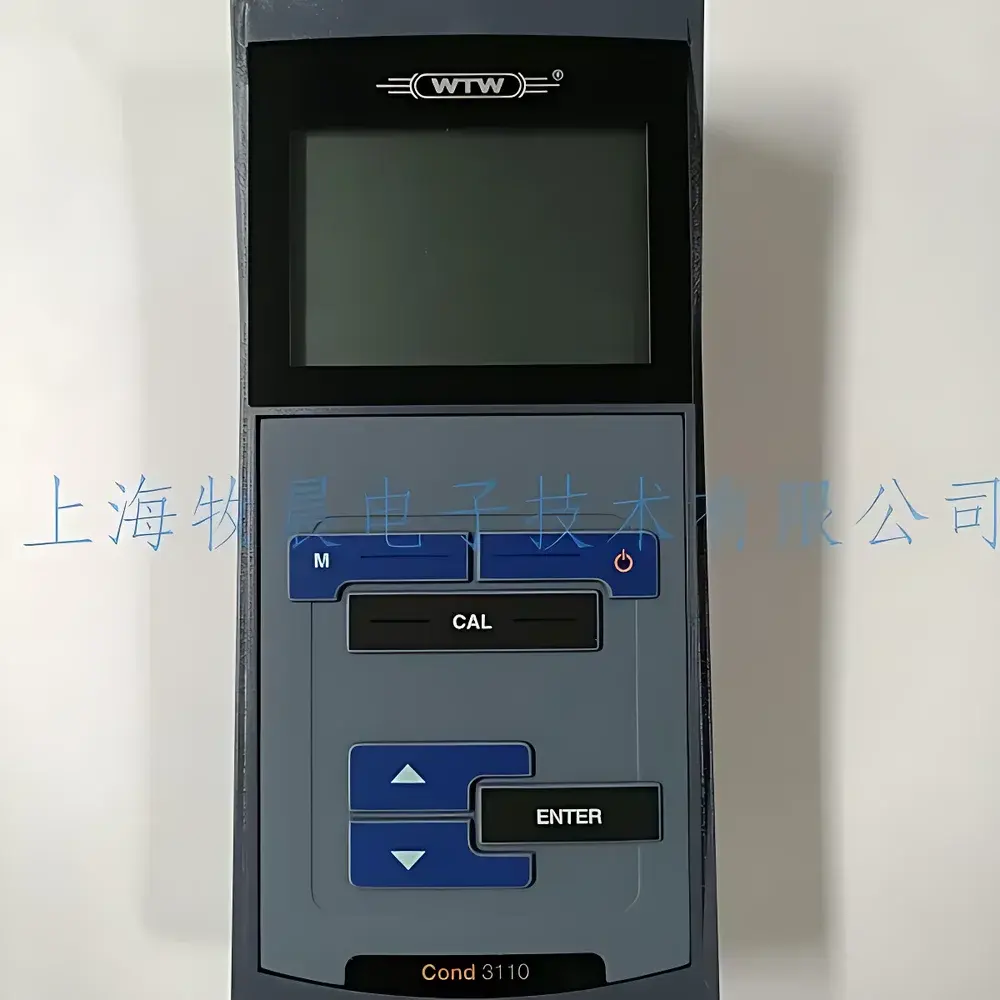
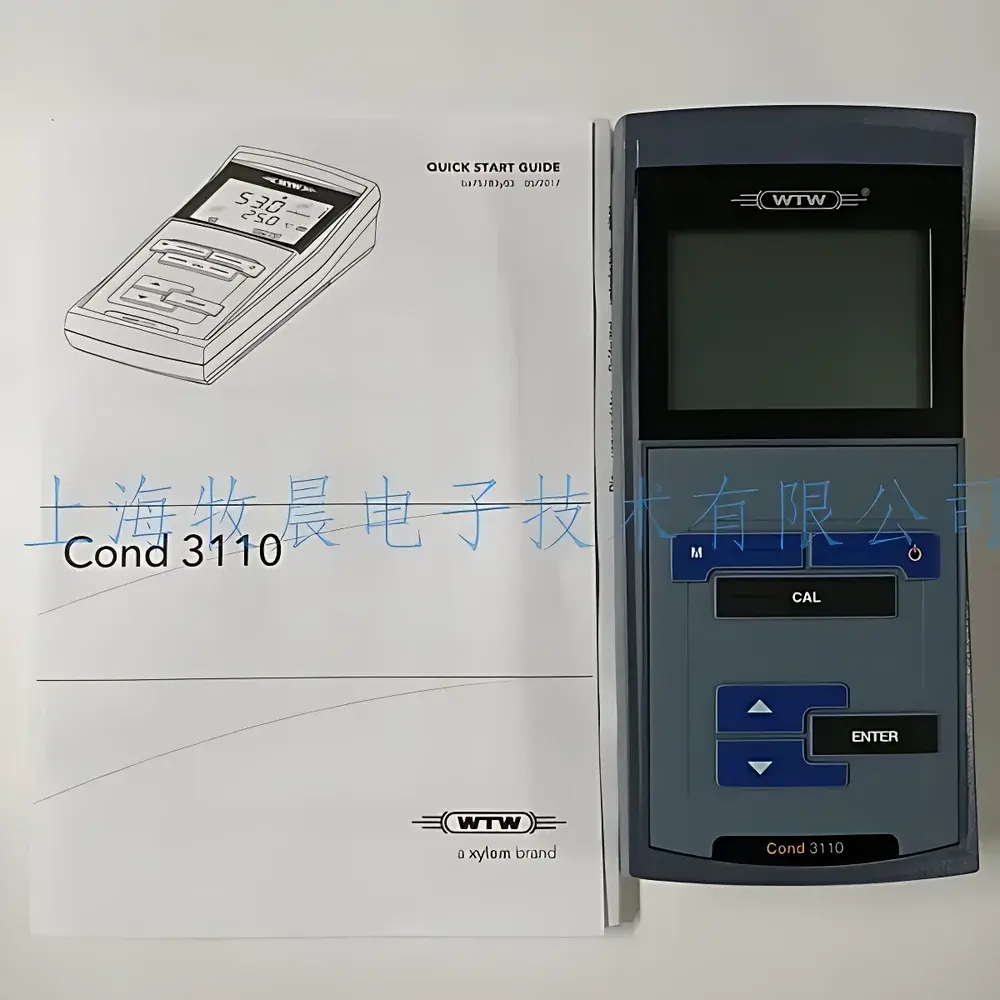
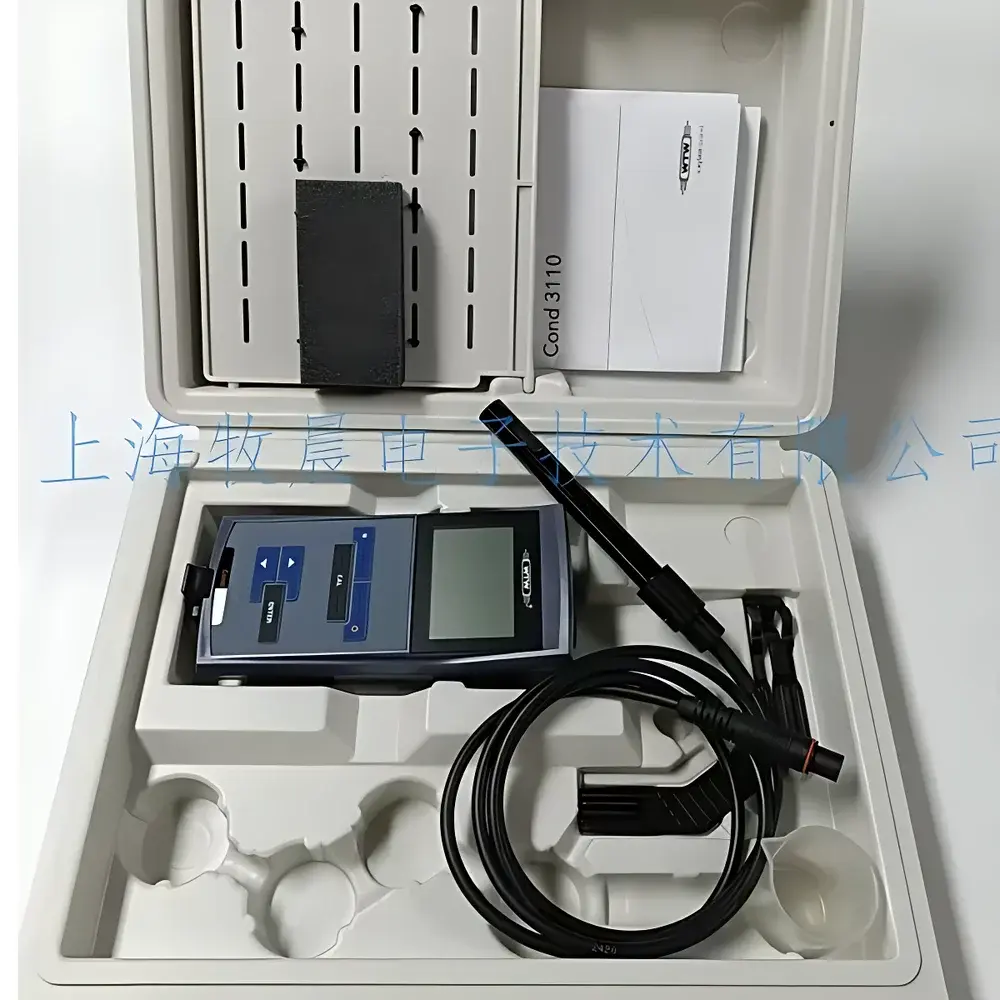
WTW Cond 3110 Portable Conductivity Meter
| Brand | WTW |
|---|---|
| Origin | Germany |
| Model | Cond 3110 |
| Portability | Portable |
| Application | Laboratory & Field Use |
| Conductivity Range | 0.0–1000 mS/cm |
| Accuracy | ±0.5% of reading |
| Temperature Range | –5.0 to +105.0 °C |
| Temp. Accuracy | ±0.1 °C |
| Cell Constants | Fixed 0.475 cm⁻¹ or 1.0 cm⁻¹ |
| Salinity Range | 0.0–70.0 ppt (IOT) |
| TDS | Calculated |
| Auto-Temperature Compensation (ATC) | Yes |
| Reference Temp | 20 °C / 25 °C |
| Calibration Timer | Built-in |
| Display | 7-segment LCD with high-contrast, large-font digits |
| IP Rating | IP66/IP67 |
| Battery | 4 × 1.5 V AA or 4 × 1.2 V NiMH |
| Data Storage | None |
| Interface | None |
| Compliance | Designed for GLP-compliant field and lab workflows |
Overview
The WTW Cond 3110 is a rugged, handheld conductivity meter engineered for precision electrochemical measurement in demanding laboratory and environmental field applications. Based on the fundamental principle of two-electrode AC conductometric measurement, the Cond 3110 determines solution conductivity by applying a low-frequency alternating current across an electrode pair and measuring the resulting voltage drop—enabling stable, polarization-free readings even in high-conductivity or fouling-prone samples. Its architecture integrates automatic temperature compensation (ATC) using a built-in NTC thermistor, referenced to standard temperatures of 20 °C or 25 °C per ISO 7888 and DIN EN 27888, ensuring metrologically traceable results across variable thermal conditions. Designed as part of WTW’s PROFILINE series, the Cond 3110 prioritizes operational reliability over feature bloat—delivering calibrated, repeatable conductivity data without dependency on proprietary software or external connectivity.
Key Features
- Rugged IP66/IP67-rated housing with silicone-sealed keypad—certified for dust-tight operation and temporary immersion, enabling consistent performance in rain, humidity, or splash-prone environments including wastewater treatment outfalls and coastal monitoring stations.
- High-visibility 7-segment LCD display with oversized, high-contrast digits—optimized for rapid visual verification under low-light or outdoor daylight conditions without glare or parallax error.
- Intuitive tactile feedback keypad—designed for gloved-hand operation and minimizing miskeying during extended field surveys or routine QC checks.
- Integrated calibration timer—automatically logs time elapsed since last calibration, supporting audit-ready GLP documentation and facilitating scheduled recalibration per internal SOPs or regulatory expectations (e.g., EPA Method 120.1, ASTM D1125).
- Multi-range cell constant support—including fixed 0.475 cm⁻¹ and 1.0 cm⁻¹ sensors, plus adjustable ranges spanning 0.450–1.200 cm⁻¹—allowing precise matching to sample matrix (e.g., ultrapure water vs. seawater) while maintaining compliance with cell constant verification requirements in USP and Ph. Eur. 2.2.38.
- Extended battery life—up to 2500 hours in standby or 1000 hours of continuous use with AA alkaline or rechargeable NiMH cells—reducing logistical overhead in remote deployments or multi-site monitoring programs.
Sample Compatibility & Compliance
The Cond 3110 is validated for aqueous solutions across diverse matrices: municipal and industrial wastewater, surface water (rivers, lakes, estuaries), groundwater, aquaculture effluents, pharmaceutical process water, food-grade brines, and swimming pool recirculation systems. Its ±0.5% accuracy specification meets the repeatability thresholds required for Tier 2 environmental reporting under EU Water Framework Directive (WFD) Annex V monitoring protocols. While not equipped with onboard data logging, its manual readout workflow aligns with laboratories operating under ISO/IEC 17025:2017 Clause 7.7 (result reporting) when paired with controlled paper-based or LIMS-integrated recording procedures. The instrument’s ATC algorithm implements non-linear (nLF) temperature compensation—critical for accurate conversion of raw conductance to standardized conductivity in non-linear electrolyte systems such as NaCl or KCl reference solutions.
Software & Data Management
The Cond 3110 operates as a standalone, firmware-controlled measurement device with no embedded memory, USB interface, or Bluetooth connectivity. All data acquisition is manual—users record readings directly into field notebooks, LIMS spreadsheets, or validated electronic lab notebooks (ELN). This architecture intentionally avoids FDA 21 CFR Part 11 electronic signature and audit trail requirements, making it suitable for environments where regulatory validation complexity must be minimized—such as teaching labs, contract environmental sampling crews, or pre-screening stages in GMP manufacturing facilities. Calibration parameters—including cell constant, reference temperature, and date/time stamp—are displayed in real time but not stored; users are expected to maintain independent calibration logs per ISO/IEC 17025 Clause 6.4.10.
Applications
- Environmental monitoring: Conductivity profiling of freshwater bodies for salinity intrusion detection, TDS estimation in groundwater vulnerability assessments, and effluent discharge compliance per local wastewater ordinances.
- Pharmaceutical water systems: Routine verification of purified water (PW) and water for injection (WFI) conductivity against pharmacopoeial limits (USP , EP 2.2.38) during system sanitization cycles or distribution loop audits.
- Aquaculture and hydroponics: Real-time tracking of nutrient solution strength and osmotic stability via conductivity–TDS correlation, supporting automated dosing control logic.
- Food & beverage QA: Batch-to-batch consistency checks for brining solutions, syrups, and dairy processing rinse waters where ionic strength correlates with composition integrity.
- Academic instruction: Teaching core principles of solution conductivity, Kohlrausch’s law, and temperature dependence in undergraduate analytical chemistry and environmental science curricula.
FAQ
Does the Cond 3110 support data export or PC connectivity?
No. It is a dedicated, non-networked instrument with no serial, USB, or wireless interface. Data must be manually transcribed.
Can it measure resistivity or total dissolved solids (TDS) directly?
It calculates TDS from conductivity using user-selectable conversion factors (e.g., 0.5–0.7 for natural waters); resistivity is derived mathematically as the reciprocal of conductivity but is not displayed as a primary parameter.
Is calibration verification traceable to national standards?
Yes—when used with certified KCl reference solutions (e.g., 1413 µS/cm at 25 °C, traceable to NIST SRM 3194), calibration satisfies ISO/IEC 17025 requirements for intermediate checks.
What maintenance is required beyond regular calibration?
Electrode cleaning with mild detergent or dilute HNO₃ (for scaling), periodic inspection of O-rings for IP integrity, and replacement of battery compartment gaskets every 24 months under continuous field use.
Does it comply with ASTM D1125 or ISO 7888?
Its measurement methodology, temperature compensation logic, and accuracy specification conform to the technical requirements of both standards for routine conductivity determination in water analysis.



