
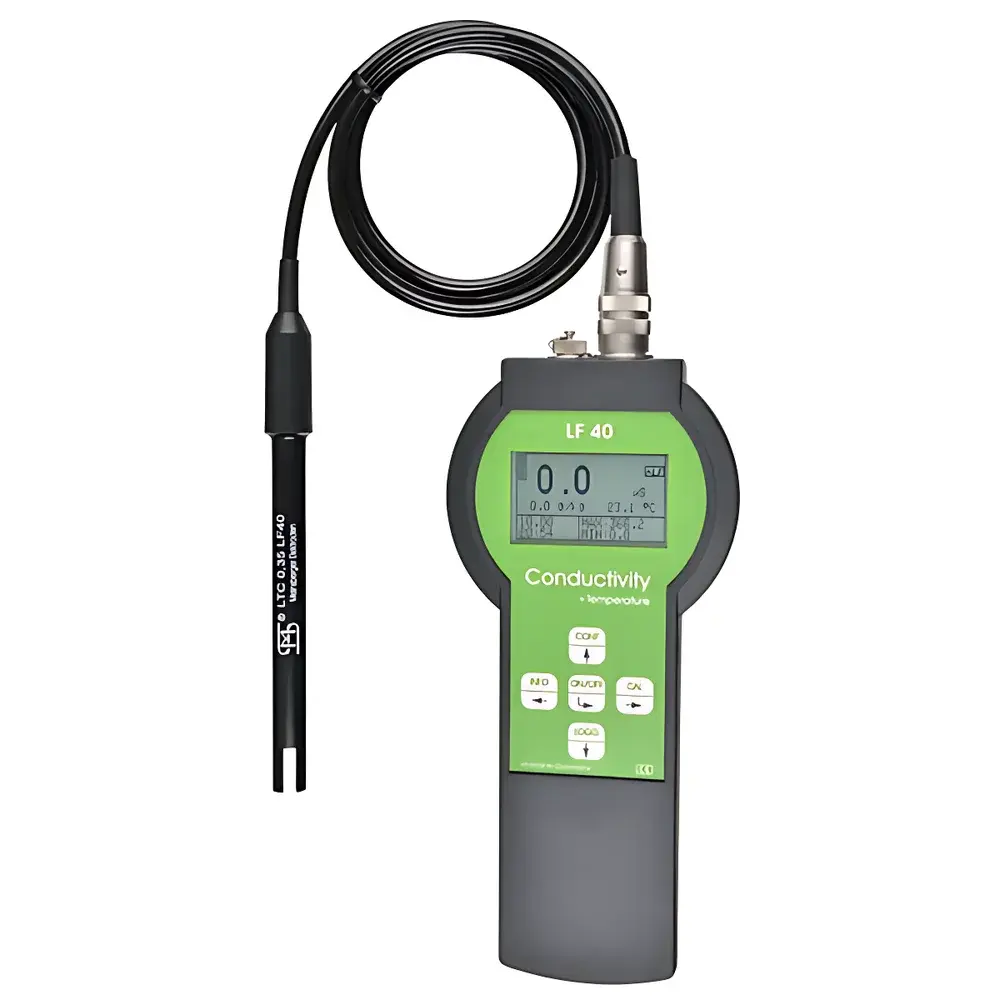
WTW LF40 Portable Conductivity Meter
| Brand | WTW |
|---|---|
| Origin | Germany |
| Model | LF40 |
| Instrument Type | Portable |
| Parameter Type | Single-parameter (Conductivity, Salinity, TDS, Temperature) |
| Measurement Ranges | 0–200 μS/cm, 0–2000 μS/cm, 0–20 mS/cm, 0–500 mS/cm (auto-ranging) |
| TDS | 0–200 mg/L, 0–2000 mg/L, 0–20 g/L, 0–500 g/L |
| Salinity | 0–70 g/kg |
| Temperature | −10 to +100 °C |
| Resolution | 0.1 μS, 1 μS, 0.01 mS, 0.1 mS, 0.1 °C |
| Temperature Compensation | Pt1000 (automatic or fixed) |
| Display | LCD, 128 × 64 pixels, backlit |
| Data Storage | 4000 measurement sets with timestamp |
| Connectivity | USB (galvanically isolated) |
| Enclosure | ABS housing, IP65 rated |
| Dimensions | 200 × 95 × 40 mm (W × H × D) |
| Weight | 290 g (incl. 3 × AA batteries) |
| EMC Compliance | EN 61326 Class B |
| Recommended Electrode | LTC 0.35/LF 40 (4-pole, cell constant 0.33 cm⁻¹, integrated Pt1000 temperature sensor, 1 m cable, BK connector) |
| Standard Kit | LF40 instrument, LTC 0.35/LF 40 electrode, calibration solution (50 mL, 0.1 N KCl, 12.9 mS/cm @ 25 °C), portable carrying case |
Overview
The WTW LF40 Portable Conductivity Meter is a field-deployable, single-parameter electrochemical analyzer engineered for high-reproducibility measurement of electrical conductivity, salinity, total dissolved solids (TDS), and temperature in aqueous environmental and process samples. Based on four-electrode (tetrapolar) AC conductivity measurement principle, the LF40 eliminates polarization effects and electrode fouling errors common in two-electrode systems—making it especially suitable for low- and high-conductivity applications across turbid, particulate-laden, or biofouling-prone matrices such as surface water, groundwater, wastewater, and industrial effluents. Its auto-ranging capability spans five decades—from ultra-pure water monitoring (0.1 μS/cm) to concentrated brines (500 mS/cm)—while maintaining traceable accuracy through built-in Pt1000 temperature compensation and factory-calibrated cell geometry.
Key Features
- Four-pole conductivity measurement architecture for stable, drift-free readings in variable sample conditions
- Integrated Pt1000 temperature sensor within the LTC 0.35/LF 40 electrode ensures synchronous, spatially co-located thermal compensation
- Auto-ranging across four conductivity scales (μS/cm, mS/cm) with automatic unit conversion and TDS calculation using user-selectable conversion factors (e.g., NaCl, KCl, 442™)
- GLP-compliant data management: time-stamped storage of up to 4,000 measurement records with operator ID, electrode ID, calibration history, and environmental metadata
- IP65-rated ABS housing with sealed keypad and backlit LCD (128 × 64 px) for reliable operation in outdoor, humid, or splash-prone environments
- Galvanically isolated USB interface supporting direct data export to PC-based software (WTW LabX® Light or generic CSV-compatible tools) without ground-loop interference
- Min/Max value tracking with real-time statistical display during continuous logging mode
- Comprehensive internal diagnostics including electrode resistance monitoring, cable integrity check, and battery voltage reporting
Sample Compatibility & Compliance
The LF40 is validated for use with natural waters (rivers, lakes, aquifers), municipal and industrial wastewater streams, cooling tower fluids, desalination plant intakes, and agricultural runoff. Its tetrapolar electrode design mitigates errors from electrode coating, corrosion, or redox-active species—critical for long-term unattended monitoring in biologically active or chemically aggressive media. The instrument conforms to ISO 7888 (water quality — determination of electrical conductivity), ASTM D1125 (standard test method for electrical conductivity of water), and supports audit-ready documentation required under GLP and GMP frameworks. Firmware and data export workflows are compatible with FDA 21 CFR Part 11 requirements when deployed with WTW LabX® Light software configured for electronic signatures and audit trails.
Software & Data Management
Data acquisition and post-processing are supported via WTW’s LabX® Light software—a lightweight, Windows-based application enabling configuration upload/download, batch calibration management, report generation (PDF/CSV), and trend visualization. All stored measurements include embedded calibration timestamps, electrode serial numbers, temperature values, and operator-defined sample IDs. The USB interface operates in CDC (Communication Device Class) mode, requiring no proprietary drivers on modern operating systems. Exported files retain full GLP metadata, facilitating integration into LIMS environments or regulatory submissions. Firmware updates are delivered via signed binary packages and verified through CRC-32 checksum validation prior to installation.
Applications
- Environmental field surveys: rapid assessment of conductivity gradients in watershed mapping and pollution source tracing
- Drinking water distribution network monitoring: detection of cross-connections or pipe corrosion events via anomalous salinity spikes
- Wastewater treatment plant process control: real-time feedback for biological nutrient removal (BNR) and membrane filtration performance
- Aquaculture and hydroponics: precise salinity and nutrient concentration tracking in recirculating systems
- Geothermal and mining site characterization: high-range conductivity profiling of brine-influenced groundwater
- Educational laboratories: hands-on instruction in electrochemical principles, sensor calibration, and water quality parameter interrelationships
FAQ
What conductivity cell constant is used with the standard LTC 0.35/LF 40 electrode?
The included electrode has a certified cell constant of 0.33 cm⁻¹, optimized for broad-range measurements from 10 μS/cm to 500 mS/cm.
Does the LF40 support manual temperature compensation or only automatic Pt1000-based compensation?
Both modes are available: automatic compensation using the integrated Pt1000 sensor or fixed-temperature compensation at user-defined setpoints (e.g., 25 °C).
Can the instrument store calibration data for multiple electrodes?
Yes—up to three independent electrode calibrations can be saved, each with unique identification, date, standard used, and slope/offset values.
Is the USB interface compatible with macOS or Linux systems?
The LF40 uses standard CDC-class USB communication; while LabX® Light is Windows-only, raw data export via terminal emulation or custom Python scripts is fully supported on macOS and Linux.
What is the battery life under typical field use conditions?
With three AA alkaline cells, continuous operation lasts approximately 200 hours; power consumption drops to <10 µA in sleep mode with auto-off enabled.




