
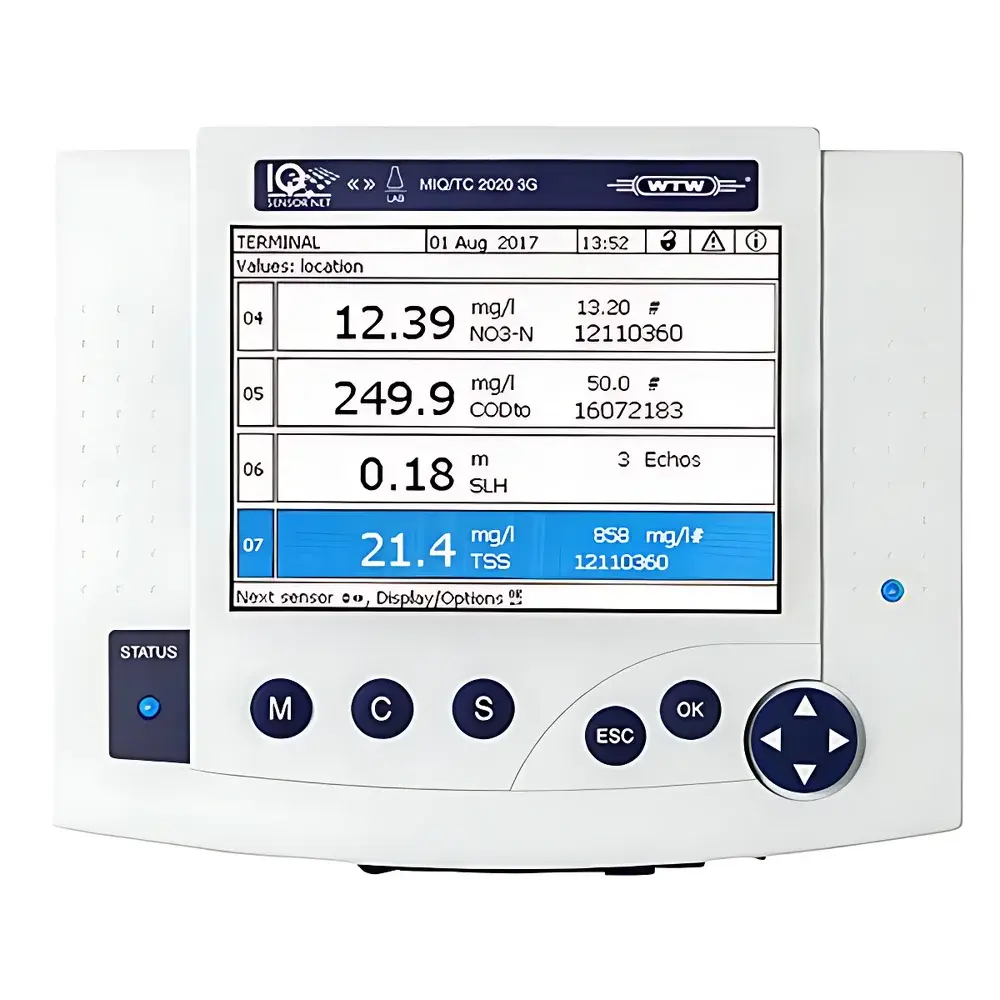
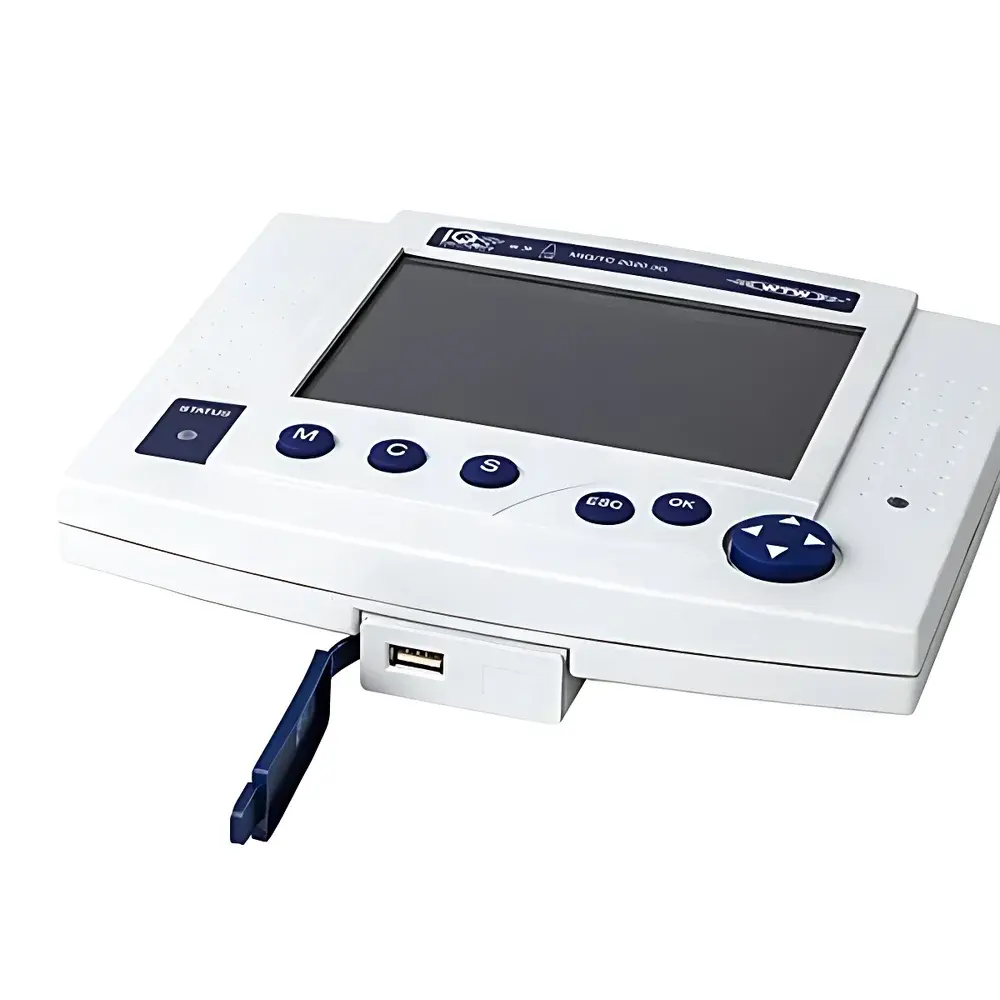
WTW MIQ/TC 2020 3G Multi-Channel Water Quality Controller
| Brand | WTW |
|---|---|
| Origin | Germany |
| Model | MIQ/TC 2020 3G |
| Instrument Type | Online Water Quality Analyzer |
| Measured Parameters | pH/ORP, Temperature, Dissolved Oxygen (DO), Conductivity, Turbidity, Sludge Concentration, COD/BOD/TOC/DOC/SAC/UVT, Ammonia-N, Nitrate-N, Nitrite-N, Sludge Interface, Phosphate |
| Max Sensor Channels | 20 |
| Analog Outputs & Relays | up to 48 |
| Max Total Cable Length | 1000 m |
| Data Storage Capacity | 526,600 records |
| Enclosure Rating | IP66 |
| Communication Protocols | PROFIBUS-DP, MODBUS RTU, Ethernet/IP, MODBUS TCP, PROFINET |
| USB Interface | Data export & password-protected system unlock via USB key |
| Optional Remote Connectivity | GSM/Analog modem, Wireless module |
| Calibration Support | IQ-LabLink intelligent calibration system |
| Surge Protection | Integrated lightning protection |
| Redundancy | Standby controller functionality with automatic failover to MIQ/CM3 display unit |
Overview
The WTW MIQ/TC 2020 3G is a modular, industrial-grade multi-channel water quality controller engineered for continuous, real-time monitoring across complex wastewater treatment processes. Based on WTW’s proven MIQ platform architecture, the 2020 3G employs digital sensor communication and distributed intelligence to unify measurement, control, data logging, and system diagnostics into a single scalable backbone. Its core operational principle relies on standardized digital signal acquisition from smart sensors—each equipped with embedded calibration memory and temperature compensation algorithms—enabling high reproducibility and long-term stability without manual recalibration drift. Designed specifically for municipal and industrial wastewater applications, the system supports full lifecycle process oversight: from influent characterization (pH, conductivity, COD/TOC) through biological treatment zones (DO, NH₄⁺-N, NO₃⁻-N, NO₂⁻-N, sludge concentration), clarifier performance (turbidity, sludge interface), to final effluent compliance verification (phosphate, UVT, residual nitrogen species). The controller operates independently of PC-based supervision, delivering deterministic response times and deterministic I/O handling suitable for integration into SCADA and DCS environments under IEC 61131-3-compliant automation frameworks.
Key Features
- Modular hardware architecture supporting up to 20 digital sensor inputs—expandable without host replacement or firmware reconfiguration
- Digital-only sensor interface eliminating analog noise susceptibility and enabling plug-and-play commissioning
- Native support for five industrial communication protocols: PROFIBUS-DP, MODBUS RTU/TCP, Ethernet/IP, and PROFINET—ensuring seamless interoperability with legacy and modern PLC systems
- Integrated surge protection compliant with IEC 61000-4-5 Level 4 (4 kV line-to-earth), critical for outdoor or ungrounded installation sites
- USB port enabling encrypted data export and secure system access control via hardware-based USB key authentication
- Redundant controller capability: MIQ/CM3 display units automatically assume full control functions upon primary controller failure, minimizing process downtime
- IQ-LabLink-enabled calibration management—stores sensor-specific calibration history, date stamps, operator IDs, and drift trends in non-volatile memory per EN ISO/IEC 17025 traceability requirements
Sample Compatibility & Compliance
The MIQ/TC 2020 3G is compatible with WTW’s full range of MIQ-series intelligent sensors—including IQ SENSOR NET pH/ORP, FDO 925 DO, COND 925 conductivity, TU 925 turbidity, and NITRATAX plus sc nitrate sensors—as well as third-party devices conforming to MIQ protocol specifications. All connected sensors must meet IP68 submersion rating for permanent immersion in raw sewage or activated sludge environments. The system complies with EU Machinery Directive 2006/42/EC, EMC Directive 2014/30/EU, and RoHS 2011/65/EU. For regulatory reporting, measurement data satisfies EPA Method 1600-series requirements for nutrient and organic load parameters when paired with certified WTW sensor modules. System validation documentation supports GLP and GMP audit readiness, including electronic signature capability aligned with FDA 21 CFR Part 11 Annex 11 principles.
Software & Data Management
Data acquisition occurs at configurable intervals (1 s to 24 h) with time-stamped, sensor-validated records stored locally in flash memory (526,600 entries, ring-buffer managed). Internal clock synchronization supports NTP over LAN. Export formats include CSV and XML, both embeddable with digital signatures for chain-of-custody integrity. The embedded web server enables remote configuration via HTTPS with TLS 1.2 encryption; user roles are defined by RBAC (Role-Based Access Control) with audit logs recording all configuration changes, calibration events, and login attempts. Firmware updates are performed via signed binary packages verified using SHA-256 hash validation prior to installation.
Applications
- Municipal wastewater treatment plants: continuous monitoring of influent, aeration basins, secondary clarifiers, and discharge points for regulatory compliance (e.g., EU Urban Wastewater Treatment Directive, US Clean Water Act NPDES permits)
- Industrial pre-treatment facilities: real-time tracking of BOD/COD loading, ammonia spikes, and phosphate surges from food processing, textile, or pharmaceutical effluents
- Sludge digestion optimization: dissolved oxygen profiling in nitrification zones and redox potential mapping in denitrification stages
- Combined sewer overflow (CSO) early warning systems: rapid detection of turbidity and conductivity anomalies indicating stormwater intrusion
- Decentralized treatment units: compact deployment for remote pumping stations or small communities requiring autonomous operation with GSM telemetry fallback
FAQ
Can the MIQ/TC 2020 3G operate without a local display?
Yes—the MIQ/MC3 series controller modules provide identical functional capability without integrated display, intended for panel-mount installations where HMI is provided externally.
Is sensor calibration traceable to national standards?
Calibration data—including reference standard IDs, uncertainty budgets, and environmental conditions—is stored per sensor in IQ-LabLink format and exportable for metrological traceability per ISO/IEC 17025 Clause 7.7.
What happens during a power interruption?
Non-volatile memory retains all configuration, calibration, and logged data; system resumes operation at last known state with no manual recovery required.
Does it support predictive maintenance alerts?
Yes—built-in sensor health diagnostics monitor signal noise, response time degradation, and membrane fouling indicators, triggering configurable alarms before measurement accuracy falls outside ±2% tolerance bands.
How is cybersecurity implemented?
The device implements defense-in-depth: disabled default credentials, TLS 1.2 for web interface, USB key authentication, firmware signature verification, and configurable firewall rules for Ethernet ports per IEC 62443-3-3 SL2 requirements.
Related Products







