
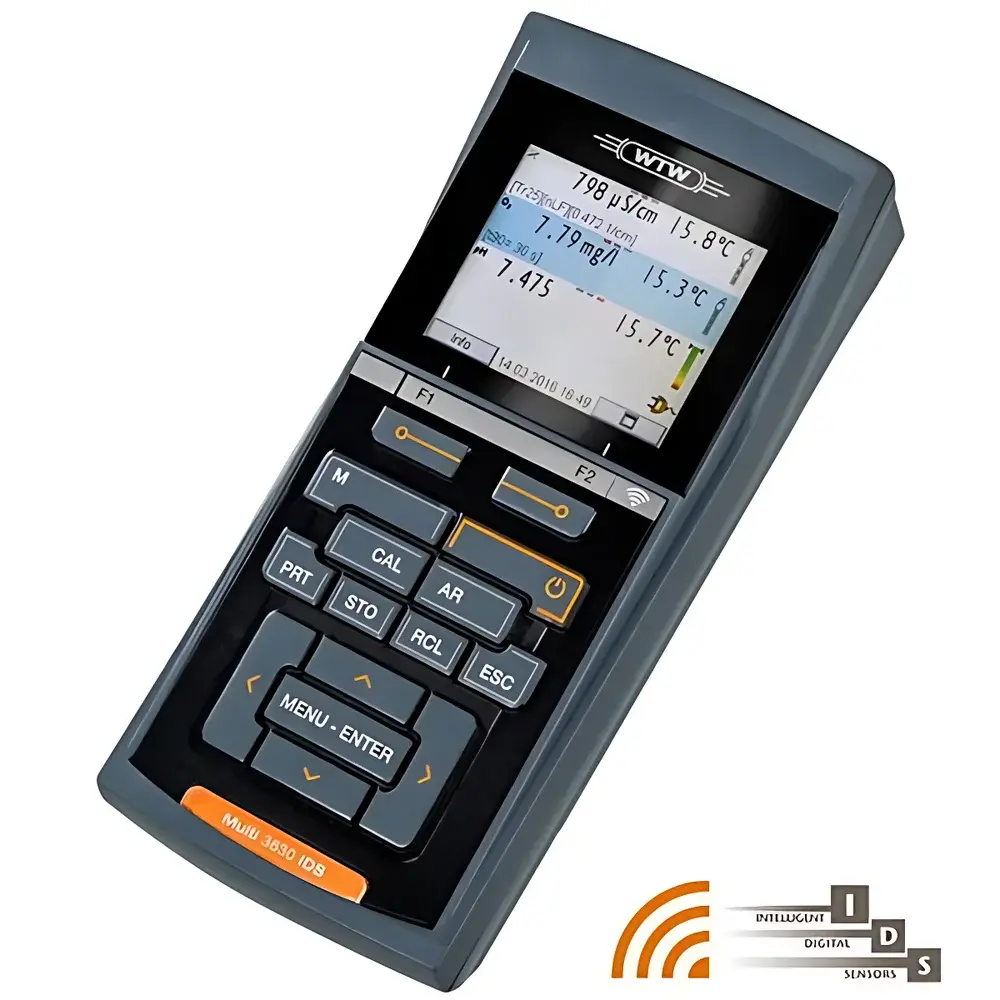
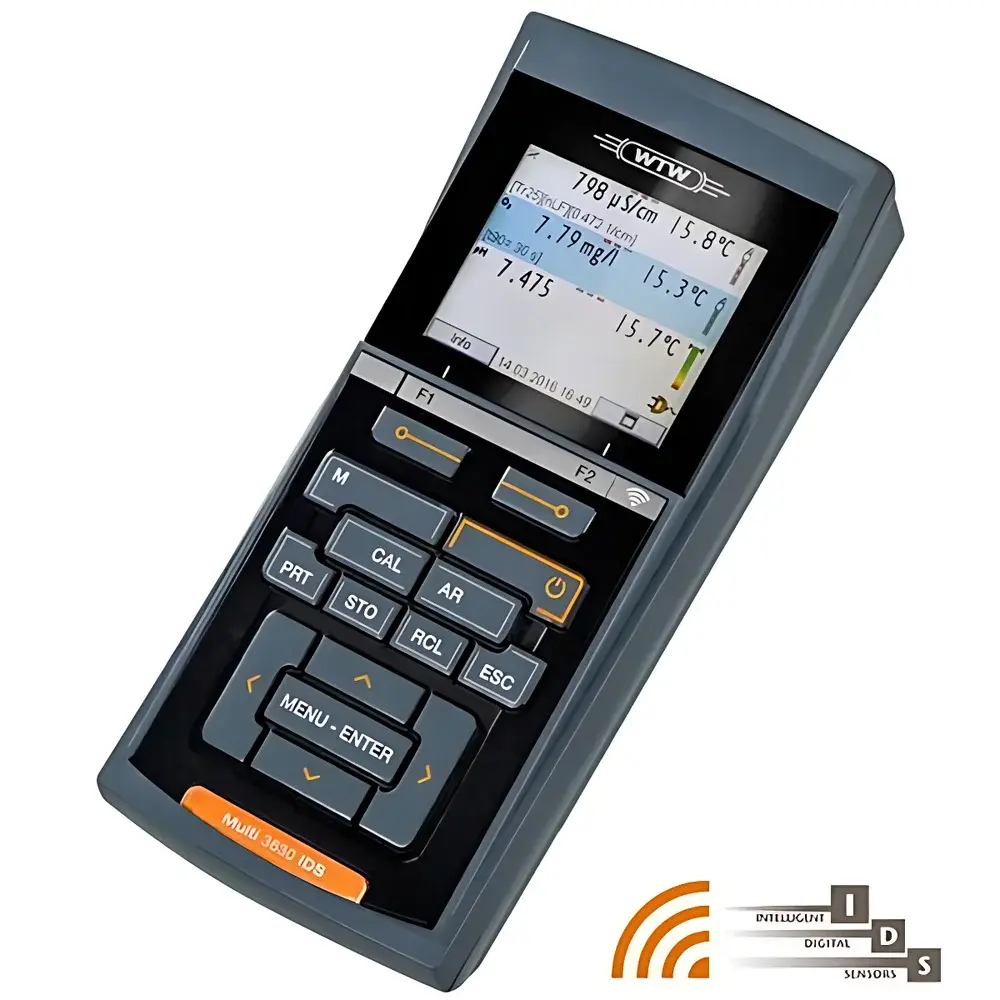
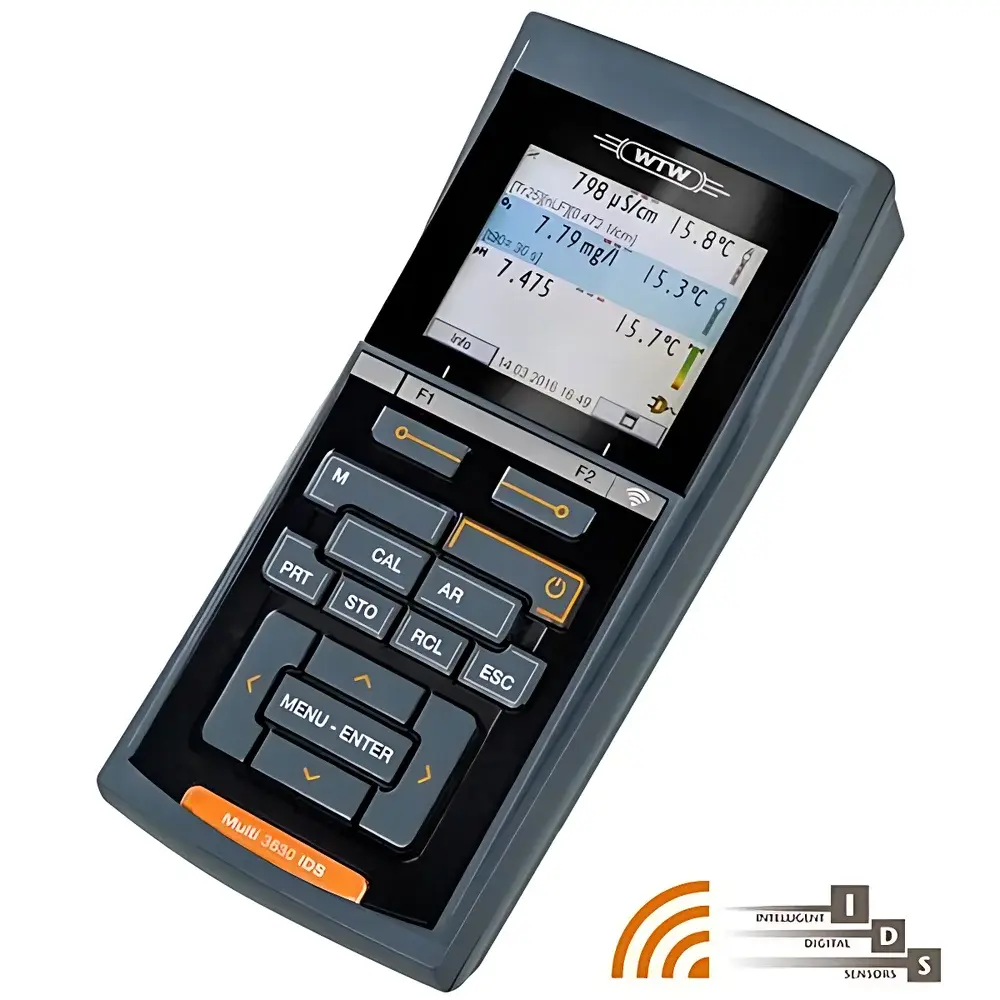
WTW Multi 3630 IDS Portable Five-Parameter Water Quality Analyzer
| Brand | WTW |
|---|---|
| Origin | Germany |
| Model | Multi 3630 IDS |
| Instrument Type | Portable |
| pH Range | 0.000–14.000 |
| Dissolved Oxygen | 0.00–20.00 mg/L |
| Conductivity | 10 µS/cm – 2000 mS/cm |
| Turbidity | 0–4000 FNU |
| Data Storage Capacity | Up to 10,000 datasets |
| Display | Graphical LCD |
| Protection Rating | IP67 |
| Power Supply | 4×AA alkaline or rechargeable NiMH batteries, or USB bus power |
| Interface | Micro-USB-B, USB-A (for memory card and printer) |
| Probe Communication | Digital IDS (Intelligent Digital Sensor) wireless-capable architecture |
| Depth Measurement (with MPP 930 IDS) | 0.05–100 m (pressure- and density-compensated for seawater) |
| Temperature Compensation | Integrated, automatic |
Overview
The WTW Multi 3630 IDS is a high-precision, portable multi-parameter water quality analyzer engineered for field-deployable, regulatory-grade measurements in environmental monitoring, wastewater management, drinking water distribution, and limnological research. Built upon WTW’s Intelligent Digital Sensor (IDS) platform, the instrument operates on a digital sensor communication protocol that eliminates analog signal degradation, ensures traceable calibration integrity, and supports plug-and-play probe recognition. It measures five core water quality parameters—pH, dissolved oxygen (DO), electrical conductivity (EC), turbidity (FNU), and temperature—with optional expansion to ORP, salinity, TDS, resistivity, oxygen saturation (% air saturation), partial pressure of oxygen (pO₂), and depth (when paired with MPP 930 IDS). The system adheres to fundamental metrological principles: pH via Nernstian potentiometry; DO via optical luminescence quenching (Ruthenium-based sensor); EC via four-electrode AC conductivity measurement to minimize polarization effects; turbidity via 90° scattered light detection compliant with ISO 7027; and depth via piezoresistive pressure transduction with real-time seawater density and thermal compensation.
Key Features
- Digital IDS architecture enabling automatic probe identification, embedded calibration history storage, and sensor-specific configuration retention—no manual setup required upon connection.
- Wireless-capable probe interface: Eliminates cable-induced noise and mechanical wear; supports both wired IDS connectors and Bluetooth-enabled wireless probes (e.g., IQ SENSOR NET-compatible variants).
- Triple-channel expandability: Simultaneously interfaces up to three IDS probes—including the MPP 910 IDS (single-parameter) and MPP 930 IDS (triple-parameter deep-water sensor with integrated depth, temperature, and pressure compensation).
- Robust field-ready design: IP67-rated housing withstands immersion up to 1 m for 30 minutes and full dust ingress protection; operating temperature range: −10 °C to +50 °C.
- Extended data management: Internal memory stores up to 10,000 measurement sets with timestamp, GPS metadata (when connected to external GNSS module), and sensor-specific metadata (e.g., calibration date, slope, offset).
- Power flexibility: Operates on four AA alkaline or rechargeable NiMH cells (with onboard charging circuitry via USB), or direct USB bus power—enabling continuous operation during lab-based validation or extended field surveys.
- Galvanically isolated sensor inputs prevent ground-loop interference and ensure signal fidelity in electrically noisy environments (e.g., near pumps, inverters, or cathodic protection systems).
Sample Compatibility & Compliance
The Multi 3630 IDS is validated for use across freshwater, estuarine, marine, wastewater effluent, groundwater, and industrial process water matrices. Its IDS probe ecosystem includes chemically resistant materials (POM housing, stainless steel 316L wetted parts, sapphire optical windows) suitable for aggressive media including chlorinated disinfectant residuals, sulfide-rich anaerobic digesters, and high-salinity brines. Regulatory alignment includes compliance with ISO 5814 (DO), ISO 7027 (turbidity), ISO 7888 (conductivity), and EN ISO 10523 (pH). When deployed in GLP/GMP-regulated contexts (e.g., drinking water utilities under EU Directive 98/83/EC or US EPA Method 180.1), the instrument supports audit-trail-enabled calibration logging and user-access control via optional software authentication modules compatible with FDA 21 CFR Part 11 requirements.
Software & Data Management
Data export and configuration are managed through WTW’s proprietary LabX® Light software (Windows-based) and the mobile-compatible WTW SmartConnect app (iOS/Android). Both platforms support encrypted CSV and PDF report generation, time-synchronized multi-probe trend visualization, and automated QA/QC flagging (e.g., out-of-range DO vs. temperature deviations). Raw datasets include full metadata: sensor serial numbers, firmware versions, calibration certificates (traceable to PTB or NIST), and environmental context tags. USB-A port enables direct printing to compatible thermal printers or bulk transfer to USB flash drives—critical for paper-trail compliance in municipal field operations. Firmware updates are delivered via signed binary packages to maintain cryptographic integrity and version-controlled device configuration.
Applications
- Regulatory field monitoring under national water framework directives (e.g., EU WFD, US Clean Water Act Section 305(b)).
- Wastewater treatment plant (WWTP) influent/effluent profiling, including nitrification/denitrification zone DO mapping.
- Lake and reservoir stratification studies—paired with MPP 930 IDS for depth-resolved profiling down to 100 m with automatic barometric and density correction.
- Coastal and offshore aquaculture site assessment, where simultaneous salinity, DO, and turbidity inform feeding protocols and disease risk modeling.
- Landfill leachate monitoring, leveraging corrosion-resistant IDS probes for long-term deployment in high-TDS, low-pH environments.
- Educational and research field campaigns requiring ISO-compliant, transportable instrumentation with minimal operator training burden.
FAQ
Does the Multi 3630 IDS require manual calibration verification before each measurement series?
No—calibration data, including date, buffer values, slope, and offset, are stored within each IDS probe’s onboard memory. The instrument auto-recalls this information upon connection, ensuring method consistency and reducing operator-dependent error.
Can the MPP 930 IDS be used in seawater without recalibration for depth accuracy?
Yes—the sensor applies real-time density and temperature compensation per IAPSO standard algorithms, maintaining ±0.25 m depth accuracy across salinities from 0 to 42 g/kg and temperatures from 0 °C to 40 °C.
Is raw sensor data exportable in machine-readable format for integration into LIMS or SCADA systems?
Yes—CSV exports include all measured parameters, timestamps (UTC), sensor IDs, and QA flags. Optional Modbus TCP or MQTT gateways (via WTW’s IQ SENSOR NET infrastructure) enable direct telemetry to industrial automation platforms.
What is the battery life under continuous logging mode with three active IDS probes?
With four fully charged NiMH AA cells (2500 mAh), typical field operation yields ≥16 hours at 15-second logging intervals and backlight enabled; alkaline cells provide ~12 hours under identical conditions.
How does the IDS platform ensure measurement traceability for accreditation purposes?
Each IDS probe carries a unique cryptographic signature and stores its full calibration chain—including reference standard IDs, uncertainty budgets, and technician signatures—accessible via LabX® Light audit reports compliant with ISO/IEC 17025 documentation requirements.
Related Products







