
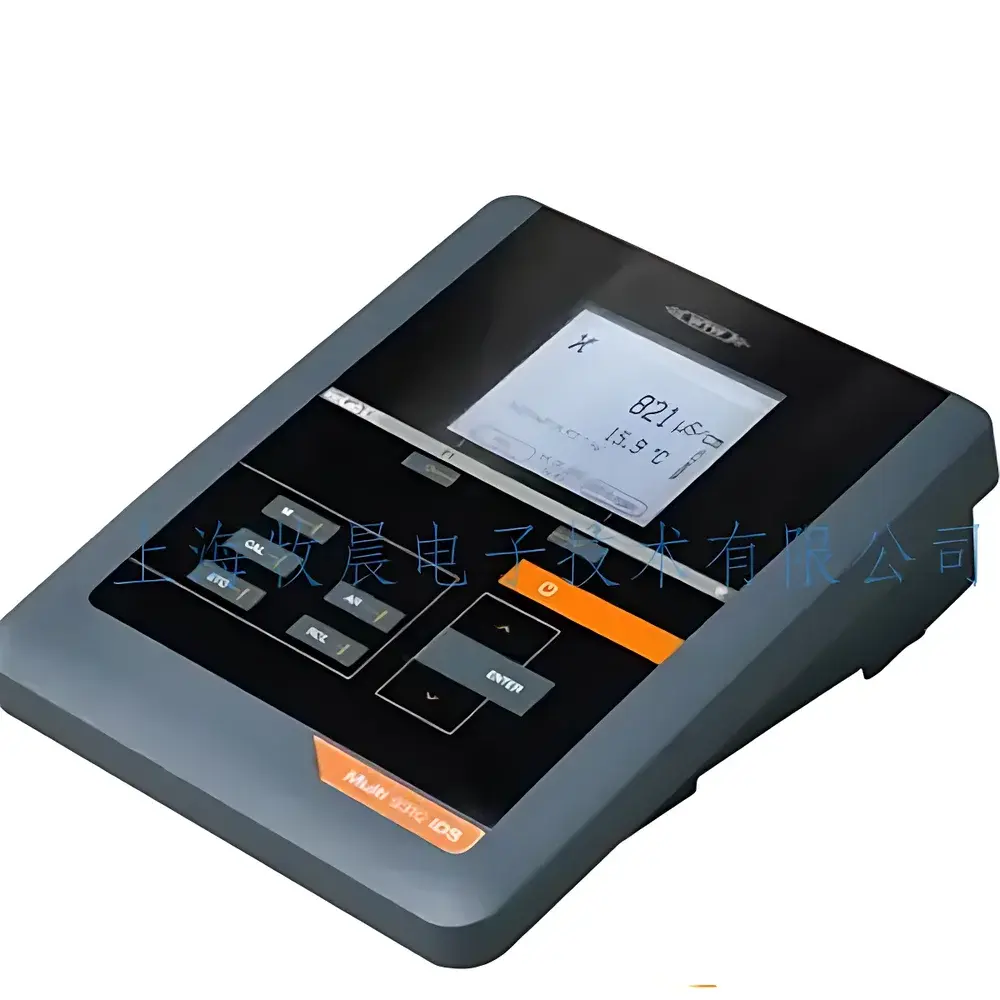
WTW Multi 9310 IDS Digital Multiparameter Laboratory Water Quality Analyzer
| Brand | WTW |
|---|---|
| Origin | Germany |
| Model | Multi 9310 IDS |
| Instrument Type | Laboratory Water Quality Analyzer |
| Detection Principle | Electrochemical Sensing (pH, ORP, Conductivity, Dissolved Oxygen) |
| Measurable Parameters | pH, ORP, Dissolved Oxygen (DO), Oxygen Saturation (%), Partial Pressure of Oxygen (pO₂), Conductivity, Resistivity, Salinity, TDS, Turbidity (with optional turbidity sensor), Ion Concentration (with ISE adapter) |
| Display | Backlit Graphical LCD |
| Data Storage | Up to 10,000 datasets (manual + automatic logging) |
| Connectivity | Micro-USB-B, USB-A (for printer/storage), Optional Wireless Module (Bluetooth® Class 2) |
| Probe Interface | Digital IDS (Intelligent Digital Sensor) protocol with auto-recognition |
| Smart Diagnostics | QSC (Quality Sensor Check) and CMC (Continuous Measurement Control) |
| Power Supply | 4 × AA alkaline batteries or USB-B powered |
| Protection Rating | IP43 |
| Compliance | Designed for GLP-compliant workflows |
Overview
The WTW Multi 9310 IDS is a high-precision, digital multiparameter laboratory water quality analyzer engineered for rigorous environmental, regulatory, and research-grade applications. Built upon WTW’s Intelligent Digital Sensor (IDS) platform, the instrument employs electrochemical transduction principles—potentiometric for pH/ORP/ISE, amperometric for dissolved oxygen, and conductometric for conductivity-related parameters—to deliver traceable, temperature-compensated measurements in accordance with ISO 5667, ASTM D1293, ASTM D3223, and EN 27888 standards. Its modular architecture allows seamless integration of up to three simultaneous IDS probes—such as SenTix 940 pH, CellOx 325 DO, and TetraCon 925 conductivity sensors—without manual calibration coefficient entry. All probe-specific calibration history, serial number, sensor age, and drift diagnostics are stored directly within the probe’s embedded memory and automatically loaded upon connection, eliminating transcription errors and ensuring full measurement traceability.
Key Features
- Digital IDS interface with plug-and-play probe recognition and on-board calibration memory storage
- Graphical backlit LCD display supporting real-time trend visualization and multi-parameter overlay
- QSC (Quality Sensor Check): Continuous evaluation of electrode impedance, membrane integrity, and reference junction stability—providing pass/fail status and predictive maintenance alerts
- CMC (Continuous Measurement Control): Real-time validation of signal stability, temperature correlation, and sensor response kinetics during measurement
- Antimicrobial keypad surface compliant with ISO 22196 for hygienic lab environments
- Internal data logger with configurable manual and time-based recording (intervals from 1 s to 24 h); up to 10,000 datasets with timestamp, operator ID, and probe metadata
- USB-B port for direct PC connectivity and firmware updates; USB-A host port for thermal printer (58 mm width) or USB flash drive export
- Optional Bluetooth® wireless module enables remote probe deployment and decentralized sampling without cable constraints
Sample Compatibility & Compliance
The Multi 9310 IDS is validated for aqueous matrices including drinking water, wastewater effluent, surface water, groundwater, and process water in municipal and industrial settings. It meets the functional requirements of EPA Method 150.1 (conductivity), EPA Method 365.2 (phosphate via ISE), ISO 5814 (electrochemical DO), and USP (pH in pharmaceutical water). When configured with certified IDS probes and operated under documented SOPs, the system supports 21 CFR Part 11–compliant workflows when paired with WTW LabX software (via USB export), enabling electronic signatures, user access control, and immutable audit trails. The IP43 enclosure rating ensures operational reliability in controlled laboratory environments with incidental splashing.
Software & Data Management
Raw measurement data export is natively supported in comma-separated values (CSV) format—fully compatible with Microsoft Excel, MATLAB, and LIMS platforms. Each exported file includes column headers with parameter names, units, temperature, probe IDs, calibration dates, and QSC diagnostic flags. For centralized management, LabX Lite (free download) provides basic report generation, calibration certificate templates, and batch export tools. Full LabX software (optional license) adds role-based user management, electronic batch records, deviation tracking, and automated PDF report generation aligned with GLP/GMP documentation requirements. All data files retain embedded metadata required for ISO/IEC 17025 accreditation audits.
Applications
- Regulatory compliance testing for potable water (WHO Guidelines, EU Drinking Water Directive 2020/2184)
- Wastewater treatment plant process control and discharge monitoring (BOD/COD correlation support via DO kinetics)
- Environmental field lab analysis of lake, river, and estuarine systems
- Pharmaceutical water system qualification (PW, WFI) per USP and Annex 1
- Academic and method development laboratories requiring traceable, multi-analyte benchmarking
- Calibration verification and inter-laboratory comparison studies
FAQ
Does the Multi 9310 IDS support analog (non-digital) electrodes?
Yes—using the optional ADA 94 adapter, conventional BNC or DIN pH/ORP/ISE electrodes can be connected, though without IDS-level diagnostics or auto-recognition.
Can QSC results be exported with measurement data?
Yes—QSC status (e.g., “Sensor OK”, “Membrane aging detected”) is embedded in each CSV record and visible in LabX reports.
Is the instrument suitable for ISO/IEC 17025-accredited laboratories?
When used with certified IDS probes, documented calibration procedures, and LabX software, it fulfills metrological traceability and record-keeping requirements for accreditation.
What is the battery life under typical lab use?
Approximately 200 hours with alkaline AA cells at room temperature and moderate backlight usage; USB-B power enables continuous operation.
How is temperature compensation handled across parameters?
Each IDS probe contains a built-in Pt1000 RTD; the instrument applies parameter-specific algorithms (e.g., Nernst equation for pH, Stokes-Einstein for conductivity) with real-time dual-point temperature correction.







