
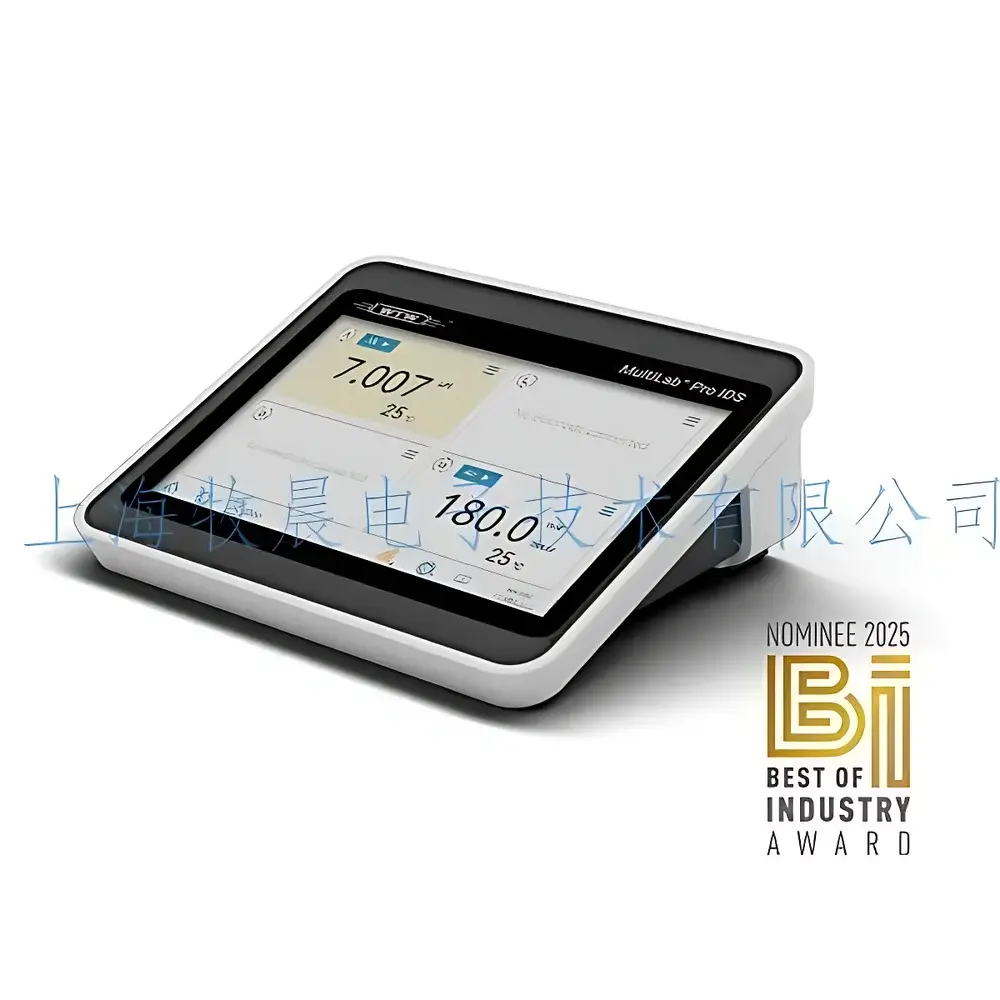
WTW MultiLab® Pro20 IDS Laboratory Multiparameter Analyzer
| Brand | WTW |
|---|---|
| Origin | Germany |
| Model | Pro20 |
| Instrument Type | Laboratory Water Quality Analyzer |
| Measurement Principle | Electrochemical Methods |
| Measurable Parameters | pH, ORP, Conductivity, Dissolved Oxygen (DO), Turbidity, mV |
| Channel Configuration | Dual electrically isolated measurement channels |
| Display | 7-inch high-brightness color touchscreen with chemically strengthened sanitary glass |
| Sensor Interface | IDS (Intelligent Digital Sensors) compatible, supports optional wireless module |
| Compliance | Designed for GxP environments |
| Data Export Formats | PDF/A, JSON, CSV |
| Software Features | QSC (Quality Sensor Check), AutoRead, customizable calibration buffers & methods, LIMS integration support |
| Operating Environment | Suitable for fume hoods, biosafety cabinets, and cleanroom-grade labs |
| Glove-Compatible Touchscreen | Yes, resistant to ethanol and common disinfectants |
| ISE Compatibility | Planned future expansion (not yet available) |
Overview
The WTW MultiLab® Pro20 IDS is a high-precision, dual-channel laboratory multiparameter analyzer engineered for rigorous water quality analysis in regulated research, environmental testing, and pharmaceutical QC laboratories. Built upon WTW’s IDS (Intelligent Digital Sensors) platform, it employs electrochemical transduction principles—potentiometric for pH and ORP, conductimetric for conductivity, amperometric for dissolved oxygen, and nephelometric for turbidity—to deliver traceable, repeatable measurements aligned with ISO 5667, ASTM D1293, D3694, D888, and USP . Its dual electrically isolated input channels enable simultaneous acquisition of two independent parameters—such as pH and DO, or conductivity and ORP—without cross-talk or grounding interference, a critical advantage when analyzing complex matrices like wastewater effluents, purified water (PW), or water-for-injection (WFI). The instrument is purpose-built for compliance-driven workflows, featuring hardware-level isolation, encrypted sensor communication, and firmware architecture validated under IEC 62304 for medical device software safety.
Key Features
- Dual electrically isolated measurement channels ensure signal integrity in electrically noisy lab environments—including fume hoods and biosafety cabinets—eliminating ground loops and enabling concurrent multi-parameter acquisition.
- 7-inch high-resolution capacitive touchscreen with chemically strengthened sanitary glass—tested per DIN EN ISO 15223-1—resists ethanol, isopropanol, and quaternary ammonium disinfectants, supporting glove operation in GMP and GLP settings.
- IDS digital sensor interface auto-detects connected probes, retrieves embedded calibration history, serial number, and sensor-specific metrological data—enabling full traceability without manual entry.
- QSC (Quality Sensor Check) continuously monitors electrode health in real time, evaluating slope, offset, response time, and membrane integrity—flagging drift or contamination before calibration failure occurs.
- AutoRead function automatically locks readings once stability criteria (±0.01 pH / ±0.1 mV / ±0.5% FS conductivity / ±0.05 mg/L DO) are met—reducing operator dependency and improving inter-analyst reproducibility.
- GxP Mode enforces 21 CFR Part 11 compliance: role-based user accounts, immutable audit trail (including parameter changes, calibrations, and result edits), electronic signatures, and irreversible data retention—no deletion permitted once enabled.
Sample Compatibility & Compliance
The MultiLab® Pro20 IDS is validated for aqueous samples across a broad operational range: pH 0–14, ORP ±2000 mV, conductivity 0.01 µS/cm–2 S/cm, dissolved oxygen 0–20 mg/L (or 0–200% saturation), and turbidity 0–1000 FNU. It supports standard reference materials (SRMs) including NIST-traceable pH buffers (4.01, 7.00, 10.01), KCl conductivity standards (84 µS/cm, 1413 µS/cm, 12.88 mS/cm), and WTW-certified DO zero and saturation solutions. All firmware and calibration routines comply with ISO/IEC 17025:2017 requirements for testing laboratories, and the system undergoes factory verification against WTW’s internal metrological standards—certified per DAkkS-accredited procedures. Optional wireless IDS modules (e.g., IDS-WL) maintain full data integrity during transmission via AES-128 encryption and operate within EU RED Directive limits.
Software & Data Management
Data integrity is enforced at the firmware level: every measurement event—calibration, sample reading, buffer selection, or method invocation—is timestamped, user-attributed, and appended to an encrypted, non-erasable audit trail stored on-device and exportable in PDF/A (archival format), JSON (for API integration), or CSV (for statistical software import). LIMS connectivity is supported via RS232, USB, or Ethernet (TCP/IP), with configurable data packet structure compliant with ASTM E1384 and HL7 v2.x. Customizable method templates allow labs to embed SOP-specific tolerances, pass/fail logic, and automatic report generation—including headers with lab ID, analyst name, instrument serial number, and sensor calibration expiry dates. A dedicated trial mode permits full evaluation of GxP functionality—including signature capture and audit log review—prior to formal activation.
Applications
This analyzer serves as a core platform in environmental monitoring labs conducting EPA Method 150.1 (pH), 120.1 (conductivity), and 365.1 (DO); in pharmaceutical facilities performing pharmacopeial testing per USP (DO), (pH), and (conductivity); and in academic research requiring high-fidelity kinetic profiling of bioreactor media or corrosion studies in simulated cooling water systems. Its dual-channel architecture is particularly valuable for parallel monitoring—for example, tracking pH-induced shifts in DO solubility during aerobic biodegradation assays, or correlating conductivity changes with ion leaching from polymer packaging in extractables studies. The sanitary glass display and disinfectant resistance make it suitable for shared instrumentation suites in cGMP manufacturing environments.
FAQ
Does the Pro20 IDS support ISE electrodes?
ISE capability is planned for future firmware release and corresponding IDS-compatible ion-selective sensors; no ISE probes are currently certified or shipped with the Pro20 IDS.
Can calibration data be transferred between instruments?
Yes—calibration records, including date, buffer IDs, slope, offset, and temperature compensation coefficients, are stored within each IDS sensor’s memory and automatically loaded upon connection to any compatible MultiLab® IDS instrument.
Is wireless operation validated for regulatory submissions?
Wireless IDS modules (IDS-WL) transmit only raw sensor data and metadata—not processed results—and are validated for use in FDA-submitted studies when paired with documented risk assessment per ICH Q9 and ALCOA+ data governance principles.
What happens if power fails during a GxP-mode measurement?
All unsaved data is retained in non-volatile memory; the audit trail logs the interruption event, and the system resumes with full traceability upon reboot—no data loss or gap in sequence numbering.
How often does the QSC diagnostic require verification?
QSC runs continuously during measurement; however, WTW recommends quarterly functional verification using certified reference electrodes and documented challenge tests per internal SOP or ISO/IEC 17025 clause 7.7.
Related Products







