
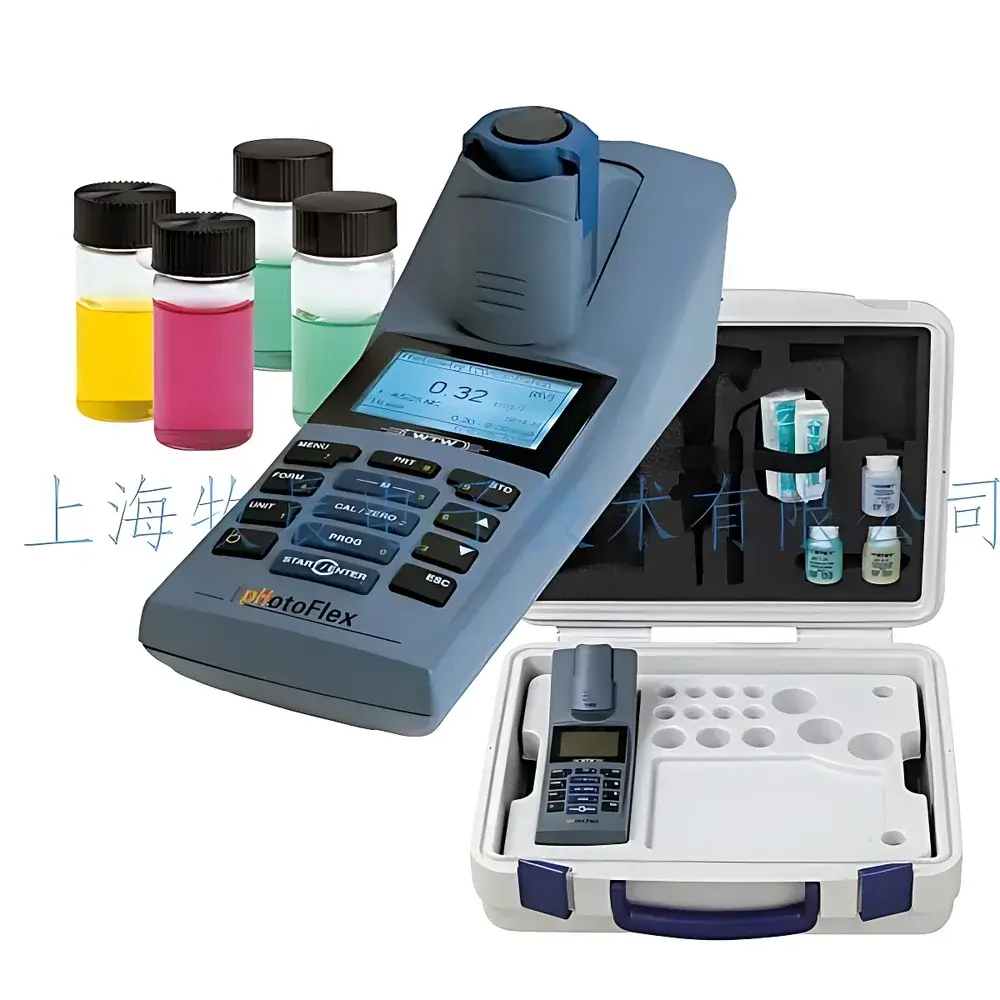
WTW pHotoFlex pH Portable Photometer
| Brand | WTW |
|---|---|
| Origin | Germany |
| Manufacturer Type | Authorized Distributor |
| Product Origin | Imported |
| Model | pHotoFlex pH |
| Price | ¥28,100 |
| Wavelengths | 436, 517, 557, 594, 610, 690 nm |
| Wavelength Repeatability | ≤0.005 nm |
| Wavelength Accuracy | ±2 nm |
| Photometric Range | −2.000 A to +2.000 A |
Overview
The WTW pHotoFlex pH Portable Photometer is a field-deployable, multi-parameter analytical instrument engineered for precision photometric and electrochemical measurements in environmental, municipal, industrial, and laboratory settings. Unlike conventional single-function meters, this device integrates dual optical and electrochemical sensing architectures: a fixed-wavelength LED-based photometer with six discrete, factory-calibrated wavelengths (436, 517, 557, 594, 610, and 690 nm) and a built-in pH/ORP/temperature electrode interface compliant with DIN 19262 and ISO 7888 standards. Its measurement principle relies on Beer–Lambert law-compliant absorbance detection at defined spectral bands for quantitative colorimetric analysis, coupled with potentiometric ion-selective electrode (ISE) response for pH and redox potential determination. Designed for rugged outdoor use, it meets IP67 ingress protection—ensuring full dust-tightness and resistance to immersion in 1 m of water for up to 30 minutes—making it suitable for wastewater outfalls, drinking water distribution networks, aquaculture sites, and emergency response scenarios where portability, reliability, and regulatory traceability are critical.
Key Features
- Integrated photometric and electrochemical functionality: simultaneous absorbance (−2.000 to +2.000 A), transmittance (1–150 %), concentration, pH (−2.00 to +16.00), ORP (−1000 to +1000 mV), and temperature (−5 °C to +100 °C) measurement
- Six high-stability LED light sources with nominal peak wavelengths at 436, 517, 557, 594, 610, and 690 nm—selected to align with standard EPA, ISO, and DIN methods for chlorine, nitrate, phosphate, COD, iron, copper, and other priority analytes
- Onboard storage for 1,000 measurement records with timestamp, method ID, sample ID, and operator tag; data export via RS232 or optional USB interface
- 100 user-definable calibration curves compatible with third-party reagents; supports method editing and validation per ISO/IEC 17025 documentation requirements
- Automatic zero adjustment at power-on; self-diagnostic routine for optical path integrity, battery voltage, electrode impedance, and calibration status
- Powered by four AA alkaline batteries (≥5,000 measurements per set) or optional rechargeable battery pack (RB Flex/430); operating time unaffected by ambient temperature between 0 °C and 40 °C
- Robust housing (236 × 86 × 117 mm; 0.6 kg without batteries) certified to cETLus safety standard and RoHS-compliant materials
Sample Compatibility & Compliance
The pHotoFlex pH accommodates both 16 mm and 28 mm round cuvettes, enabling compatibility with standardized test kits from Hach, Merck, Palintest, and WTW’s own SpectroQuant® line. Its photometric performance adheres to DIN EN ISO 7027 (turbidity reference), DIN 38404-4 (ammonium), and DIN 38405-27 (phosphate), while pH and ORP accuracy (±0.01 pH, ±1 mV) satisfies ASTM D1293 and USP . The instrument supports GLP-compliant data handling through optional PC software Lsdata (v5.2+), which provides full audit trail, electronic signature capability, and 21 CFR Part 11–ready configuration when deployed with LabStation (LS Flex/430). All firmware updates—including new photometric methods and regulatory revisions—are delivered free-of-charge via secure HTTPS download.
Software & Data Management
Lsdata PC software enables method synchronization, batch report generation (PDF/CSV), calibration certificate export, and trend analysis across multiple instruments. Raw data files include embedded metadata: measurement date/time, wavelength used, cuvette type, calibration history, and QC flag status. The RS232 interface supports direct integration into SCADA or LIMS environments using Modbus RTU or ASCII protocols. USB connectivity (with AK 540 B cable) allows drag-and-drop file transfer without driver installation on Windows/macOS/Linux platforms. Firmware versioning is tracked internally (e.g., v3.8.12), and all update logs are retained in non-volatile memory for internal audit review.
Applications
- Drinking water quality control: residual chlorine (DPD), nitrate (Cd reduction), fluoride (SPADNS), and hardness (calmagite)
- Wastewater treatment monitoring: orthophosphate (ascorbic acid), ammonium (salicylate), COD (dichromate digestion), and sulfide (methylene blue)
- Aquaculture and hydroponics: pH stability tracking, alkalinity titration support, and nutrient dosing verification
- Industrial process water: boiler feedwater conductivity correlation, cooling tower biocide residual checks, and rinse water pH compliance
- Field education and research: undergraduate environmental chemistry labs, citizen science water surveys, and rapid-response contamination screening
FAQ
Does the pHotoFlex pH support calibration traceability to national standards?
Yes—each unit ships with a factory calibration certificate referencing NIST-traceable standards for photometric absorbance and pH buffer solutions (4.01, 7.00, 10.01). Optional annual recalibration services are available through WTW-accredited service centers.
Can third-party reagents be used with custom curve programming?
Yes—the 100-user-method memory accepts arbitrary slope/intercept inputs and polynomial fits; users must validate method performance per ISO 8466-1 prior to routine use.
Is the device compatible with modern LIMS systems?
Yes—via RS232 ASCII output or USB virtual COM port, supporting HL7, ASTM E1381, and custom delimiter formats for seamless ingestion into LabVantage, Thermo Fisher SampleManager, or LabWare LIMS.
What is the expected lifetime of the integrated pH electrode interface?
The DIN-compatible socket is rated for ≥10,000 mating cycles; electrode longevity depends on usage frequency and storage conditions—SenTix 41 electrodes typically maintain specification for 12–18 months under proper maintenance.
How is firmware integrity verified during remote updates?
All firmware packages are digitally signed using SHA-256 and validated against embedded public key before installation; failed verification halts update and triggers error log entry.





