
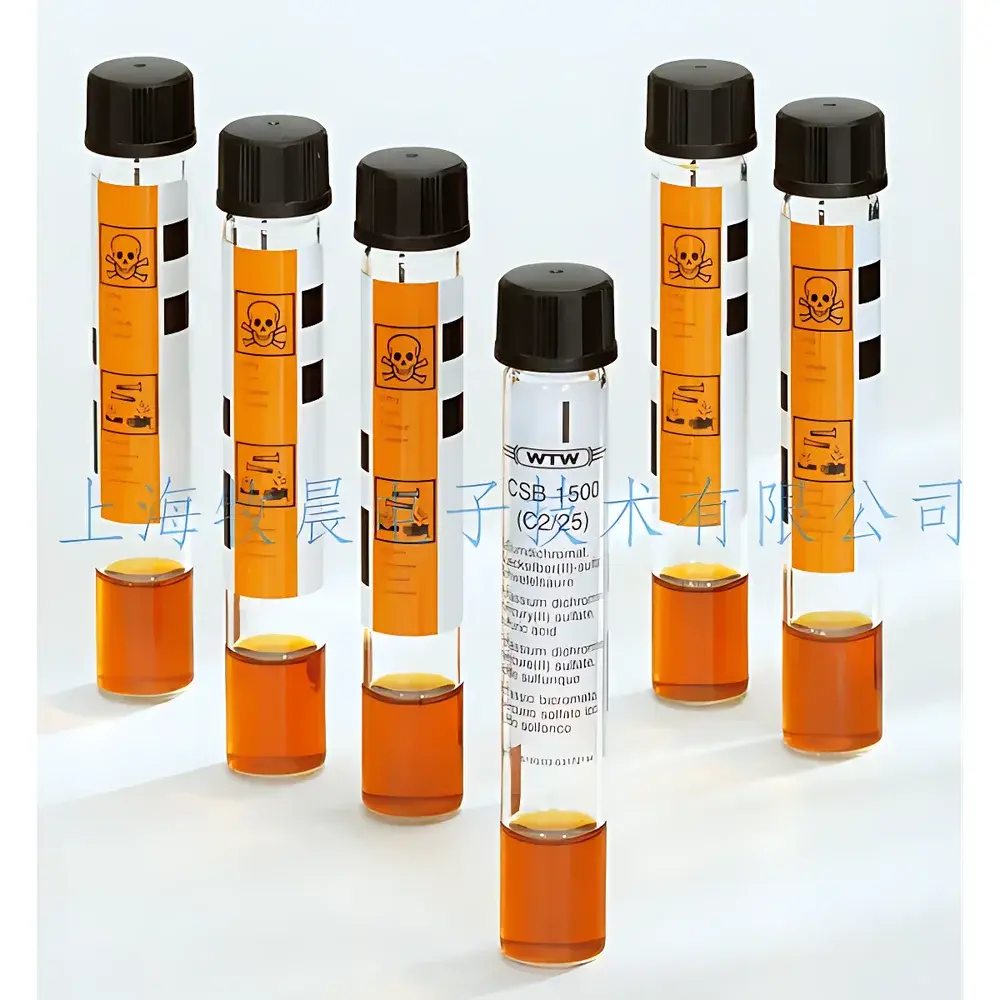
WTW photoFlex & photoLab Spectrophotometer Reagents
| Brand | WTW |
|---|---|
| Origin | Germany |
| Instrument Compatibility | photoFlex STD, photoFlex pH, photoFlex Turb, photoLab S6, photoLab S12, photoLab 6100, photoLab 6600, photoLab 7100, photoLab 7600 |
| Test Parameters | COD, Ammonia-N, Total Nitrogen, Total Phosphorus, Heavy Metals (e.g., Cr, Cu, Ni, Zn, Pb) |
| Format | Pre-filled Ready-to-Use Cuvettes & Reagent Kits |
| Calibration & QC | Certified Standard Solutions & Reference Water Samples |
| Regulatory Alignment | Compliant with DIN EN ISO 15586, DIN 38405, DIN 38414, and EPA Method 410.4 (COD), EPA 350.1 (Ammonia), EPA 365.4 (Phosphate) |
Overview
WTW photoFlex and photoLab spectrophotometer reagents are a comprehensive portfolio of pre-qualified, factory-prepared chemical test kits engineered for use with WTW’s full range of portable and benchtop photometric analyzers. These reagents operate on the principle of colorimetric analysis—where analyte-specific reactions generate stable, stoichiometrically proportional chromophores whose absorbance is quantified at defined wavelengths (typically 430–860 nm) using integrated tungsten-halogen or LED light sources and precision optical filters. Designed to meet the metrological requirements of environmental monitoring laboratories, municipal water utilities, and industrial process control facilities, the reagent system ensures traceable, repeatable, and interference-resistant quantification across critical water quality parameters—including chemical oxygen demand (COD), ammonia nitrogen (NH₃-N), total nitrogen (TN), total phosphorus (TP), and regulated heavy metals such as chromium, copper, nickel, zinc, and lead.
Key Features
- Pre-calibrated, ready-to-use cuvettes: All reagents are supplied in sealed, UV-stabilized glass or high-clarity polystyrene cuvettes with batch-specific calibration curves embedded in instrument firmware—eliminating manual curve generation and reducing operator error.
- Matrix-matched formulation: Reagents are optimized for complex aqueous matrices (e.g., wastewater, surface water, digested sludge extracts) with built-in masking agents to suppress chloride, nitrite, and turbidity interferences per DIN 38405-41 and ISO 15586 protocols.
- Stability & shelf life: Unopened cuvettes maintain certified performance for ≥24 months at 2–8 °C; room-temperature stability ≥6 months post-opening (with cap resealed), validated per ICH Q1A(R2) accelerated stability testing.
- Traceability & documentation: Each lot includes a Certificate of Analysis (CoA) with uncertainty budgets, reference method cross-validation data (vs. ISO 6060 for COD, ISO 7150-1 for NH₃-N), and traceability to NIST SRM 2783 (COD) and BAM CRM 391 (phosphate).
- Instrument integration: Auto-detection via QR-coded cuvette labels enables seamless method selection, wavelength assignment, and unit conversion (mg/L, µmol/L, ppm) directly within photoLab 7600 and photoFlex firmware v3.2+.
Sample Compatibility & Compliance
The reagent system supports liquid samples with turbidity ≤200 NTU (pre-filtration recommended above this threshold) and salinity up to 35 g/L (seawater-compatible formulations available upon request). All kits conform to European Union Water Framework Directive (2000/60/EC) analytical requirements and are validated under GLP conditions per OECD Series 1, 2, and 4 guidelines. For regulated environments—including drinking water compliance (DIN EN ISO 9001:2015 certified manufacturing), wastewater discharge reporting (EU Directive 91/271/EEC), and pharmaceutical process water monitoring—the reagents support full audit trails, electronic signature capture, and 21 CFR Part 11-compliant data integrity when used with photoLab 7100/7600 equipped with WTW LabX™ Lite software.
Software & Data Management
When paired with WTW LabX™ Lite or LabX™ Connect (optional), reagent usage, calibration history, sample IDs, and raw absorbance values are automatically logged with time stamps, user credentials, and instrument serial numbers. The system generates PDF reports compliant with ISO/IEC 17025:2017 clause 7.8.2, including measurement uncertainty estimation per GUM (JCGM 100:2008). Raw spectral scans (320–1100 nm, 1 nm resolution) can be exported in .csv or .jdx format for third-party chemometric analysis. Firmware updates preserve legacy method compatibility—ensuring continuity during regulatory inspections or method transfer between photoFlex and photoLab platforms.
Applications
- Regulatory compliance testing for municipal wastewater treatment plants (WWTPs) under national discharge permits
- In-process monitoring of biological nutrient removal (BNR) systems for real-time TN/TP feedback control
- Drinking water safety verification per WHO Guidelines for Drinking-water Quality (4th ed.) and US EPA Safe Drinking Water Act (SDWA)
- Industrial effluent screening for metal plating, textile dyeing, and food processing facilities
- Educational laboratory instruction in environmental chemistry and instrumental analysis curricula
- Field-deployable emergency response for contamination events (e.g., ammonia spills, phosphate runoff incidents)
FAQ
Are these reagents compatible with Hach DR series spectrophotometers?
Yes—select photoLab reagent kits (e.g., COD LR, NH₃-N HR, PO₄-P) are functionally interoperable with Hach DR1900, DR3900, and DR6000 instruments when using Hach’s “Custom Method” mode and applying WTW-provided wavelength and factor settings.
Do the cuvettes require refrigeration before first use?
Unopened cuvettes must be stored at 2–8 °C; however, they may be equilibrated to ambient temperature (15–25 °C) for 30 minutes prior to analysis without performance degradation.
Is there a reagent kit for total suspended solids (TSS) measurement?
No—TSS is a gravimetric parameter requiring filtration and drying per ISO 11923; photoFlex/photoLab reagents are exclusively for soluble or digestible analytes measured photometrically.
Can I perform multi-wavelength kinetic assays with these reagents?
Only photoLab 7600 and photoLab 7100 support kinetic acquisition modes (up to 600 s, 0.1 s intervals); photoFlex models are limited to endpoint measurements.
How often must calibration standards be replaced?
Certified standard solutions have a stated shelf life of 12 months unopened; once opened and recapped, use within 30 days when stored at 4 °C with inert gas purge to prevent oxidation drift.
Related Products





