
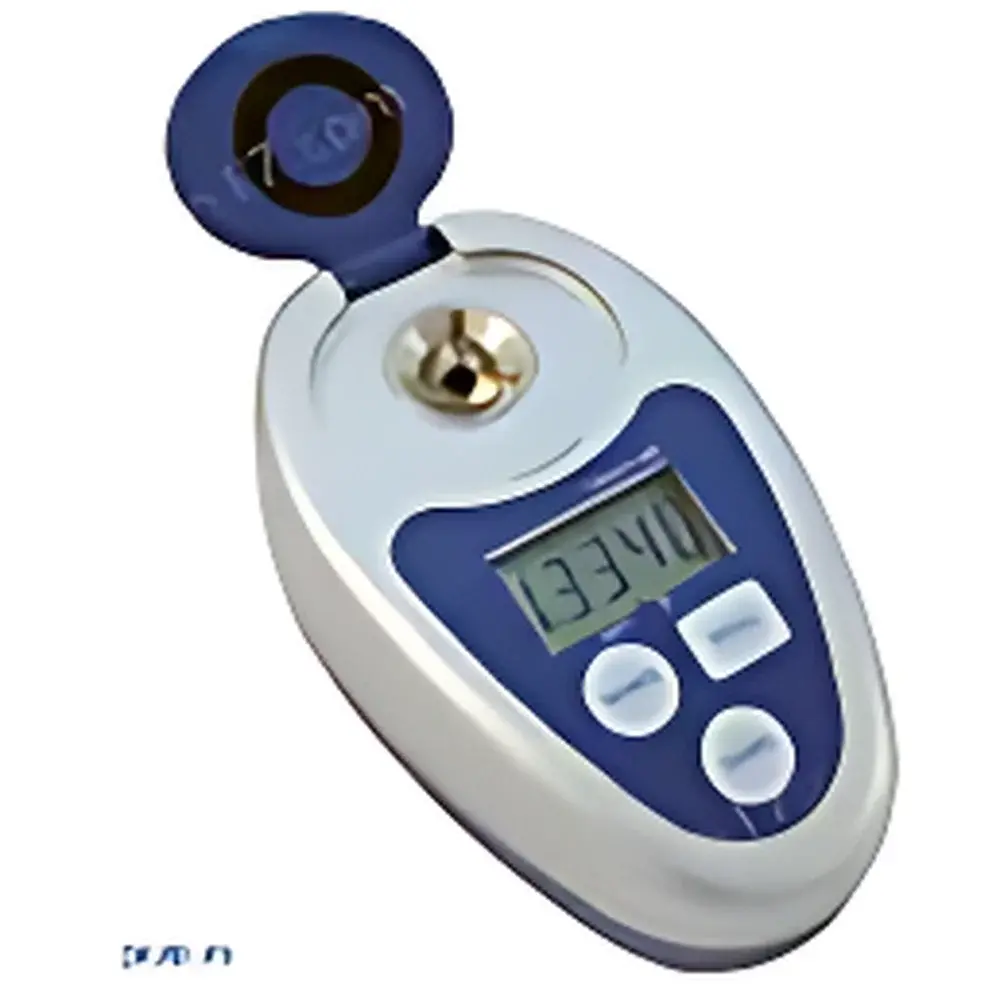
Bellingham + Stanley DR Series Digital Handheld Refractometer
| Brand | Bellingham + Stanley |
|---|---|
| Origin | United Kingdom |
| Manufacturer Status | Authorized Distributor |
| Origin Category | Imported |
| Model | DR Series Digital Handheld |
| Temperature Control | Yes (ATC) |
| Digital Display | Yes |
| Product Type | Handheld Refractometer |
| Construction | Full-metal body with thermal-insulating rubber grip |
| Prism cover | Slide-action flip cover |
| Sample application | Drop-on method |
| Sample temperature range | Compatible with both chilled and heated samples |
| Key Specifications (DR103L) | Brix 0–45%, resolution 0.1%, accuracy ±0.2% |
| Key Specifications (DR112) | Brix 28–65%, resolution 0.1%, accuracy ±0.2% |
| Key Specifications (DR122) | Brix 60–92%, resolution 0.1%, accuracy ±0.2% |
Overview
The Bellingham + Stanley DR Series Digital Handheld Refractometer is a precision optical instrument engineered for rapid, field-deployable measurement of refractive index (RI) and related concentration units—including °Brix, % w/w, and specific gravity—based on the fundamental principle of total internal reflection at the prism-sample interface. Unlike traditional analog refractometers, the DR Series integrates a high-stability LED light source, a calibrated sapphire or optical glass prism, and a photodiode array coupled with proprietary firmware to convert critical angle displacement into digital readouts with traceable metrological integrity. Designed specifically for ruggedized operational environments—from agricultural harvest sites and food processing lines to pharmaceutical cleanrooms and chemical distribution hubs—the instrument features automatic temperature compensation (ATC) across its full operating range (typically 10–40 °C), eliminating manual correction and ensuring consistent repeatability under variable ambient conditions. Its measurement principle conforms to ISO 21745:2020 (Refractometry — General principles and practice) and supports alignment with ASTM D1218 and AOAC Official Methods for liquid-phase concentration verification.
Key Features
- Full-metal housing with thermal-insulating rubber overmold grip—optimized for prolonged handheld use and resistance to mechanical shock and thermal drift
- Ergonomic contouring and anti-roll support feet—ensures stable placement on uneven or vibrating surfaces during field operation
- Slide-action prism cover mechanism—enables rapid, contamination-resistant access while protecting the optical surface from scratches and particulate ingress
- Drop-on sample application—requires only 0.3–0.5 mL per measurement; compatible with viscous, opaque, or low-surface-tension liquids when used with appropriate cleaning protocols
- Dual-scale digital display—simultaneously shows primary unit (e.g., °Brix) and secondary unit (e.g., RI) with user-selectable units via intuitive button interface
- ATC-corrected optics—real-time compensation using integrated platinum RTD sensor (±0.1 °C accuracy) referenced to standard calibration curves per model-specific calibration certificate
- IP65-rated enclosure—dust-tight and protected against low-pressure water jets, enabling reliable deployment in humid, washdown, or outdoor settings
Sample Compatibility & Compliance
The DR Series accommodates aqueous solutions, glycol-based coolants, sugar syrups, fruit juices, battery electrolytes, antifreeze formulations, and pharmaceutical excipient solutions. It is not intended for strongly corrosive media (e.g., concentrated HCl, HF, or oxidizing acids) or volatile organic solvents without prior validation. All models are supplied with individual factory calibration certificates traceable to NPL (National Physical Laboratory, UK) standards. The instruments comply with CE marking requirements under the EU Measuring Instruments Directive (MID 2014/32/EU) for portable refractometers and support audit readiness for GLP and GMP environments through documented calibration history and ATC validation logs. Optional NIST-traceable calibration kits (certified sucrose standards, RI reference oils) are available for on-site verification per ISO/IEC 17025 procedures.
Software & Data Management
While the DR Series operates as a standalone field instrument, optional Bluetooth-enabled data logging modules (sold separately) allow wireless transmission of measurement records—including timestamp, ambient temperature, operator ID, and unit selection—to secure cloud-hosted platforms or local LIMS systems. Firmware supports CSV export with embedded metadata fields compliant with FDA 21 CFR Part 11 requirements when paired with validated software clients. Audit trails record all configuration changes, calibration events, and firmware updates. Internal memory retains up to 500 measurements with time/date stamping, and data export occurs via micro-USB without requiring proprietary drivers.
Applications
- Agriculture & Horticulture: Rapid assessment of fruit maturity (°Brix), sap concentration in maple syrup production, and irrigation solution strength
- Food & Beverage QA/QC: In-line verification of juice blends, dairy product solids content, honey purity screening, and jam consistency control
- Automotive & Industrial Fluids: Glycol concentration monitoring in engine coolants and brake fluids per SAE J1087 and ASTM D3372
- Pharmaceutical Manufacturing: Excipient solution concentration checks during buffer preparation and API suspension formulation
- Academic & Teaching Labs: Undergraduate physical chemistry experiments on solution thermodynamics and colligative properties
- Maintenance & Field Service: On-site verification of cutting fluid concentration, hydraulic fluid dilution, and battery electrolyte density
FAQ
Does the DR Series require periodic recalibration?
Yes—annual recalibration is recommended per ISO/IEC 17025 guidelines; more frequent verification is advised for high-usage or regulated environments.
Can the instrument measure non-aqueous samples?
It can measure miscible organic-aqueous mixtures (e.g., ethanol-water); however, pure solvents require model-specific RI calibration and are outside standard warranty coverage.
Is the ATC function adjustable or fixed?
ATC is factory-programmed per model’s specified RI/Brix correlation curve and is not user-adjustable; deviation beyond the calibrated range triggers an alert flag.
What cleaning agents are safe for the prism surface?
Use only lens-grade tissue with reagent-grade isopropanol or distilled water; avoid acetone, chlorinated solvents, or abrasive cloths.
How is traceability maintained across instrument batches?
Each unit ships with a unique serial-numbered calibration certificate referencing NPL-traceable reference materials and certified uncertainty values at two points per scale.





