
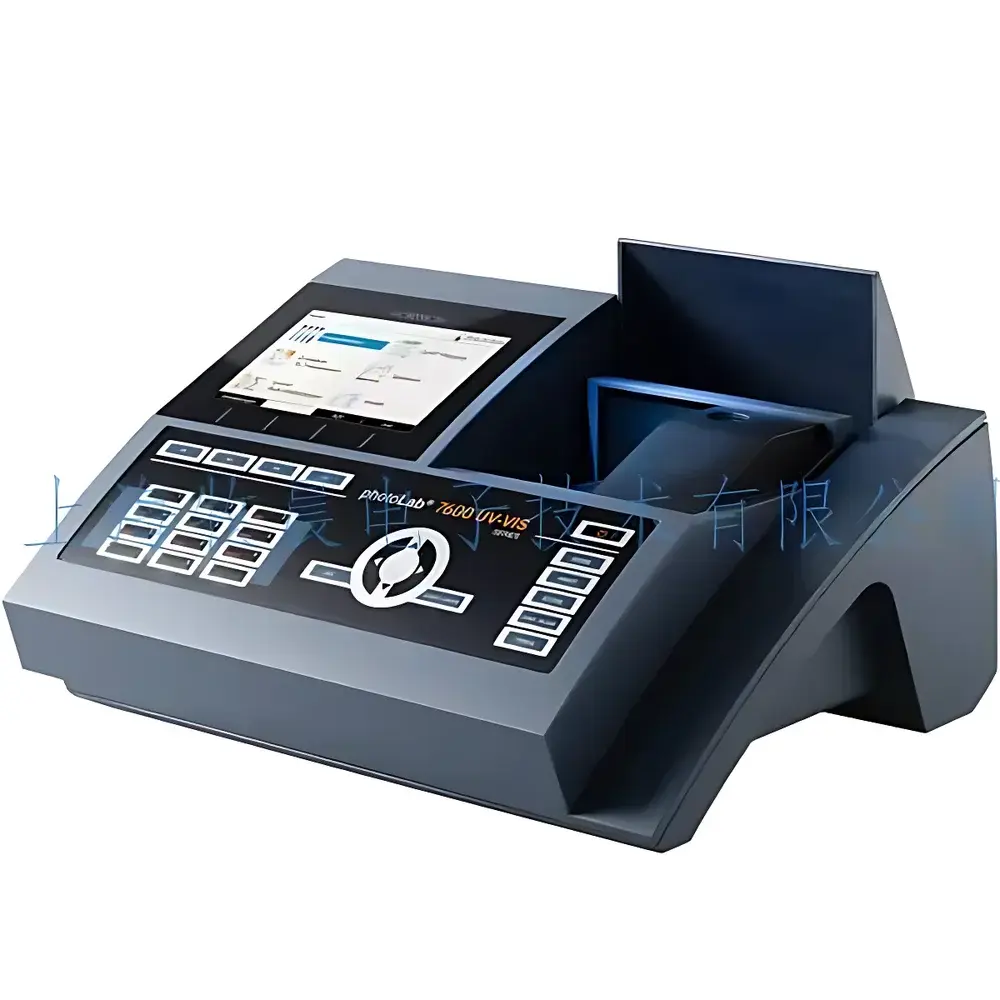
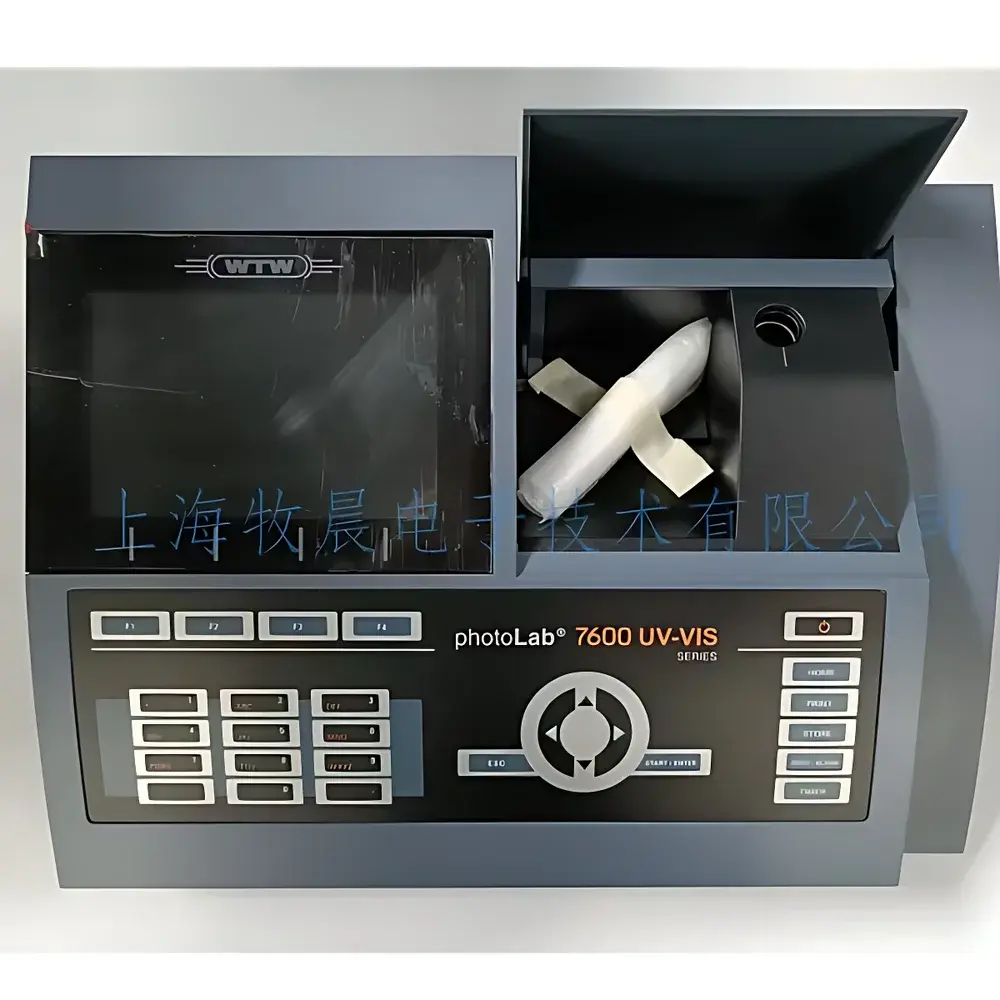
WTW photoLab 7600 UV-VIS Benchtop Ultraviolet-Visible Spectrophotometer
| Brand | WTW |
|---|---|
| Origin | Germany |
| Model | photoLab 7600 UV-VIS |
| Optical Design | Single-beam |
| Detector | CCD (Charge-Coupled Device) |
| Wavelength Range | 190–1100 nm |
| Wavelength Accuracy | ±1 nm |
| Wavelength Repeatability | ±1 nm / <0.5 nm |
| Spectral Bandwidth | 4 nm |
| Stray Light | ≤0.01% T |
| Light Source | Xenon lamp (≥13,000 h operational lifetime) |
| Cuvette Recognition | Automatic barcode-based identification for 10 mm, 20 mm, and 50 mm rectangular cuvettes and 16 mm round cells |
| Data Storage Capacity | 5,000 measurement values, 500 spectra, 400 kinetic curves |
| Built-in Methods | >230 pre-programmed test routines (e.g., free chlorine, nitrate-N, COD, phosphate, SAC, color, CO₂, NH₃-N) |
| Custom Method Support | Up to 1,000 user-defined calibration curves |
| Reagent-Free Testing | Enabled for select parameters (e.g., total COD: 2–75 mg/L, soluble COD: 2–75 mg/L, NO₃-N: 0.1–3.0 mg/L, NO₂-N: 0.1–4.0 mg/L) |
| Software Compliance | Audit-trail enabled, GLP-compliant data handling, FDA 21 CFR Part 11 ready (with optional user authentication module) |
Overview
The WTW photoLab 7600 UV-VIS is a high-precision benchtop ultraviolet-visible spectrophotometer engineered for routine and advanced photometric analysis in regulated laboratory, industrial quality control, and R&D environments. Based on single-beam optical architecture with a pulsed xenon lamp and CCD array detector, it delivers full-spectrum acquisition across a broad 190–1100 nm range—encompassing deep UV, visible, and near-infrared regions. Its 4 nm spectral bandwidth ensures adequate resolution for standard absorbance quantification while maintaining high signal-to-noise ratio and photometric stability. The instrument operates under strict photometric principles defined in ISO 6059, ASTM E275, and USP <857>, supporting quantitative analysis via Beer-Lambert law compliance across diverse sample matrices. Designed for robustness and long-term metrological integrity, the xenon light source provides over 13,000 hours of stable output without intensity drift or warm-up delay—eliminating lamp aging-related recalibration cycles common in tungsten-halogen or deuterium-based systems.
Key Features
- Automated optical self-diagnostic routine verifying lamp status, detector linearity, wavelength accuracy, and baseline stability prior to each measurement sequence
- Barcode-driven cuvette recognition system supporting 10 mm, 20 mm, and 50 mm rectangular quartz/glass cells and 16 mm round cells—automatically selecting pathlength-corrected calibration algorithms
- Integrated reagent-free photometric assays for key water quality parameters including total and soluble COD, nitrate-N, and nitrite-N—reducing consumable dependency, waste generation, and operator exposure
- Dual-mode operation: fixed-wavelength photometry for rapid compliance testing and full-spectrum scanning (1 nm increments) for spectral fingerprinting, peak identification, and derivative analysis
- Onboard kinetic measurement capability with configurable time intervals (0.1 s to 60 min), enabling real-time monitoring of enzymatic reactions, oxidation kinetics, and ligand-binding events at ambient temperature
- GLP-compliant data management with timestamped, operator-identified records, electronic signatures (optional), and immutable audit trails meeting FDA 21 CFR Part 11 requirements
Sample Compatibility & Compliance
The photoLab 7600 UV-VIS accommodates aqueous, organic, and mildly acidic/alkaline solutions in standard spectrophotometric cuvettes. Its low stray light performance (≤0.01% T at 220 nm) ensures accurate quantification of highly absorbing samples—critical for trace-level nutrient analysis (e.g., NO₂⁻-N down to 0.1 mg/L) and high-concentration COD determinations. The system complies with ISO/IEC 17025 method validation guidelines and supports verification per EN ISO 15203 (COD), DIN 38405-31 (nitrate), and EPA Method 352.1 (UV-VIS absorbance). All built-in methods are validated against certified reference materials (CRMs) traceable to NIST and BAM standards. Optional IQ Sensor Net integration enables hybrid sensor-spectrophotometric workflows for continuous process monitoring correlation studies.
Software & Data Management
Operating firmware includes WTW’s proprietary photoLab Control Software v4.x, featuring intuitive touchscreen navigation, multilingual UI (EN/DE/FR/ES), and hierarchical user permission levels (Operator, Supervisor, Administrator). Data export supports CSV, PDF, and XML formats compatible with LIMS and ELN platforms. Spectral data can be exported as ASCII files for third-party chemometric processing (e.g., PCA, PLS regression). The software implements automatic calibration curve validation (linearity R² ≥0.999, residual analysis), forced zero-point correction, and multi-point baseline subtraction. All method edits, calibration updates, and firmware upgrades are logged with digital signatures and version control—ensuring full traceability during internal audits or regulatory inspections.
Applications
This spectrophotometer serves core analytical functions across environmental laboratories (drinking water, wastewater, surface water), pharmaceutical QC (excipient purity, dissolution testing), food & beverage (colorimetric additives, Maillard reaction monitoring), and academic research (enzyme kinetics, nanoparticle characterization, polymer degradation studies). Its reagent-free protocols align with green chemistry principles outlined in ACS GCI metrics, while its spectral flexibility supports emerging applications such as dissolved organic carbon (DOC) estimation via SUVA₂₅₄, microplastic suspension turbidity profiling, and UV-vis quantification of nanomolar-range metal-ligand complexes.
FAQ
Does the photoLab 7600 UV-VIS support compliance with FDA 21 CFR Part 11?
Yes—when configured with password-protected user roles, electronic signature activation, and audit-trail logging enabled, the system meets foundational requirements for electronic records and signatures in regulated environments.
Can I import custom calibration curves from external laboratories?
Yes—up to 1,000 user-defined curves may be loaded via USB or network interface in .csv format, with slope/intercept, polynomial order, and concentration unit specification.
What is the recommended maintenance interval for optical alignment?
No routine optical realignment is required; the monolithic optical bench and thermally stabilized CCD detector ensure long-term wavelength fidelity without scheduled recalibration beyond annual performance verification.
Is the xenon lamp field-replaceable without service technician support?
Yes—the lamp module is user-swappable using standard Torx tools and requires no post-installation calibration; the instrument automatically detects and validates new lamp output during startup.
How does the reagent-free testing achieve accuracy without chemical reagents?
By leveraging high-fidelity UV absorbance signatures at characteristic wavelengths (e.g., 254 nm for aromatic COD precursors, 220 nm for nitrate), combined with multivariate correction for turbidity and background interference—validated against standard wet-chemistry methods per ISO 15705.




