
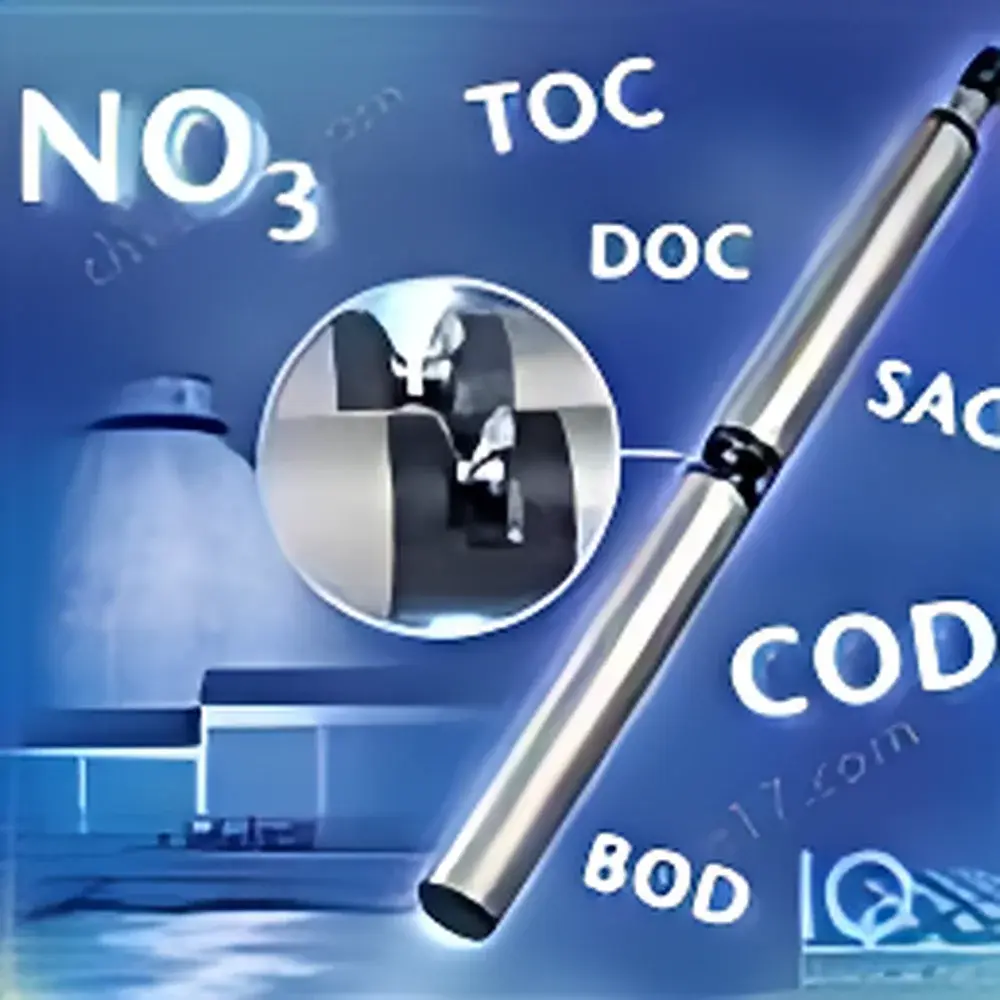
WTW SENSORNET Online UV-VIS Spectral Water Quality Analyzer for Nitrate, Nitrite, COD, BOD, TOC, DOC & TSS
| Brand | WTW |
|---|---|
| Origin | Germany |
| Distribution Status | Authorized Distributor |
| Import Status | Imported |
| Model | SENSORNET Online |
| Price Range | USD 25,000 – 125,000 |
Overview
The WTW SENSORNET Online UV-VIS Spectral Water Quality Analyzer is an industrial-grade, multi-parameter in-situ spectrophotometric sensor engineered for continuous, reagent-free monitoring of key nitrogen and carbon parameters—including nitrate (NO₃⁻), nitrite (NO₂⁻), chemical oxygen demand (COD), biochemical oxygen demand (BOD) surrogates, total organic carbon (TOC), dissolved organic carbon (DOC), and total suspended solids (TSS)—in aqueous environments. Unlike single-wavelength absorbance sensors, the SENSORNET platform employs full-spectrum UV-VIS detection using a 256-channel diode array covering either 200–720 nm (UV-VIS probe) or 200–390 nm (UV-only probe). This high-resolution spectral acquisition enables multivariate calibration modeling to resolve overlapping absorption signatures—particularly critical for discriminating between nitrate and nitrite in complex matrices, and for quantifying organic carbon fractions amid variable turbidity and background absorbance. The system operates on the principle of quantitative spectral deconvolution, where proprietary chemometric algorithms translate raw absorbance spectra into concentration values validated against standard laboratory methods (e.g., ISO 15705 for COD, ISO 11923 for TOC, EPA Method 353.2 for nitrate/nitrite). Designed for permanent submersion in raw influent, aerobic zones, and final effluent streams, it delivers real-time data with second-level response time and long-term baseline stability without manual zeroing.
Key Features
- 256-channel diode array spectrometer with automatic spectral drift compensation across full UV-VIS range
- Integrated ultrasonic cleaning system for sapphire optical window—prevents biofouling and scaling during continuous operation
- Optional compressed-air purge accessory for high-fouling or high-sediment applications
- Corrosion-resistant probe housing constructed from titanium alloy and PEEK polymer; IP68-rated, explosion-safe design (ATEX/IECEx optional)
- Triple-sealed, monolithic probe architecture—no moving parts, no consumables, no wet chemistry required
- Auto-adaptive light path optimization: dynamically adjusts number of active LEDs based on sample absorbance to prevent signal saturation or under-range detection
- Simultaneous dual-beam optical design: identical emitter/detector geometry, matched path length, and synchronized intensity control ensure measurement repeatability < ±1.5% RSD over 30 days
- Turbidity-insensitive quantification via real-time spectral correction using water matrix-specific baseline subtraction
Sample Compatibility & Compliance
The SENSORNET Online is validated for use in municipal and industrial wastewater streams, surface water intakes, and tertiary treatment effluents. It complies with international regulatory frameworks including ISO 5667-22 (water quality sampling), ISO 7027 (turbidity measurement), and EN 14181 (QAL3 performance verification for automated analyzers). Its algorithm suite supports configuration per process zone—influent (peak load detection), aeration basin (DO-nutrient coupling), and final discharge (compliance reporting)—with method-specific calibration traceable to NIST-traceable reference standards. Data integrity meets FDA 21 CFR Part 11 requirements when integrated with WTW’s certified software platforms, enabling audit trails, electronic signatures, and secure user access control for GLP/GMP environments.
Software & Data Management
Data acquisition and interpretation are managed via WTW’s SENSORNET Control Center—a web-based SCADA interface supporting Modbus TCP, Profibus DP, and OPC UA protocols. The system stores full spectral datasets (256 × wavelength × time) locally for retrospective reprocessing using updated calibration models. All measurements include embedded metadata: temperature-compensated absorbance spectra, cleaning event logs, signal-to-noise ratios, and diagnostic flags for optical degradation or flow interruption. Historical trends can be exported in CSV or XML format compliant with LIMS integration. Remote firmware updates and algorithm upgrades are delivered via encrypted OTA channels, ensuring continuous alignment with evolving regulatory guidance (e.g., EU Urban Wastewater Treatment Directive Annex I updates).
Applications
- Real-time nitrate/nitrite ratio monitoring for denitrification process control in activated sludge systems
- Early-warning detection of organic shock loads at wastewater plant influent using COD/TOC spectral surrogates
- Optimization of aeration energy consumption through dynamic BOD surrogate feedback
- Compliance-driven effluent monitoring for TOC, TSS, and nitrogen species under EU Water Framework Directive reporting
- Source water quality assessment in reservoirs and river intakes where conventional grab sampling lacks temporal resolution
- Industrial pretreatment verification for food processing, pharmaceutical, and pulp & paper facilities subject to local discharge permits
FAQ
Does the SENSORNET Online require routine recalibration?
No—its self-referencing optical architecture and full-spectrum drift correction eliminate scheduled zero/span adjustments. Calibration validation is performed quarterly using field-check standards per EN 14181 QAL3.
Can it replace laboratory COD analysis entirely?
It provides robust, real-time COD surrogates correlated to standard dichromate digestion (ISO 15705), but regulatory submission may still require periodic lab confirmation per jurisdictional requirements.
What maintenance intervals apply?
Zero scheduled maintenance: ultrasonic cleaning operates continuously; only annual visual inspection of the sapphire window and cable gland seal is recommended.
Is the probe suitable for seawater or brackish applications?
Yes—titanium construction and PEEK wetted materials provide full resistance to chloride-induced corrosion up to 35 g/L salinity.
How is turbidity interference mitigated?
Through simultaneous acquisition of reference and sample spectra across all 256 wavelengths, followed by multivariate scatter correction using Mie theory–based algorithms embedded in the chemometric model.
Related Products







