
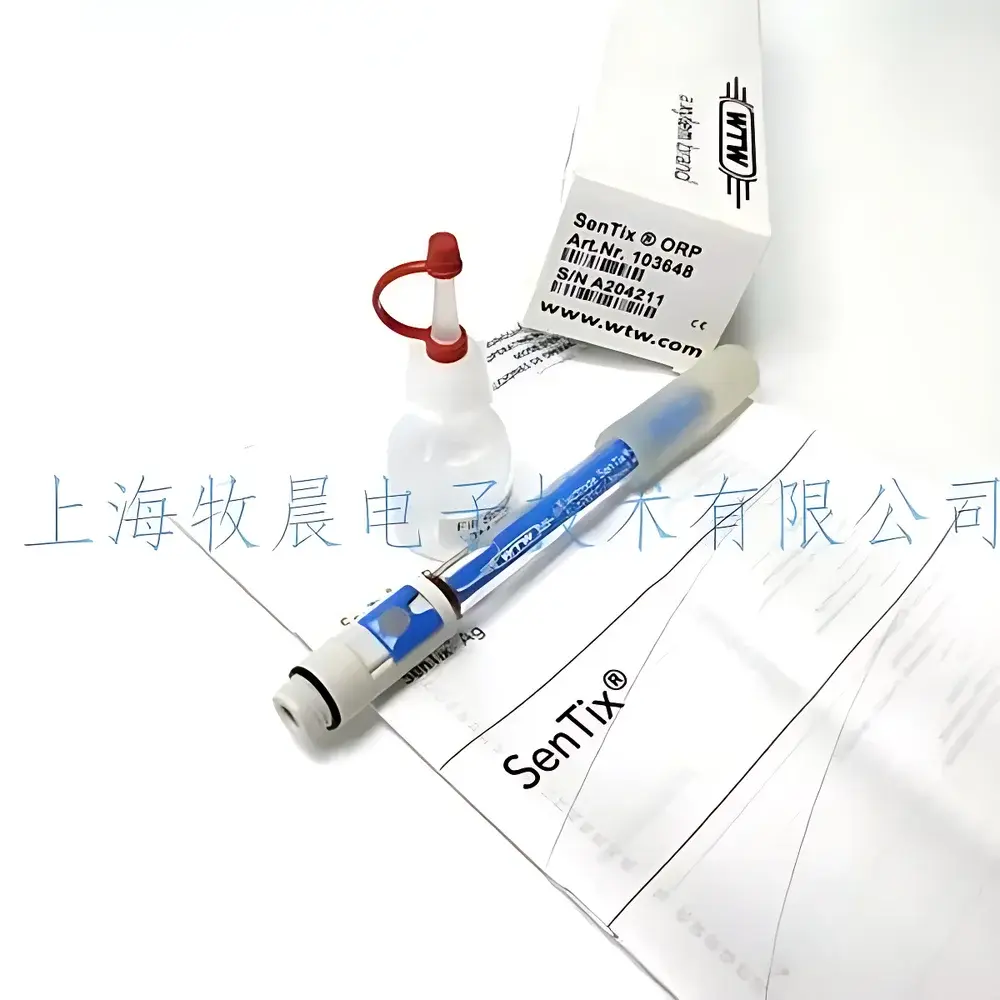
WTW SenTix ORP Electrode
| Brand | WTW |
|---|---|
| Origin | Germany |
| Model | SenTix ORP |
| Type | Laboratory ORP Electrode |
| Reference Electrolyte | 3 M KCl |
| Operating Temperature Range | 0–100 °C |
| Sensor Material | Platinum |
| Junction Type | Ceramic (S7 thread) |
| Connector | S7 (cable required separately: AS DIN, AS DIN-3, or AS BNC) |
| Compliance | Designed for ISO/IEC 17025-compliant labs, compatible with GLP/GMP data integrity workflows |
Overview
The WTW SenTix ORP Electrode is a precision-engineered redox potential sensor designed for reliable, traceable, and temperature-stable measurements in laboratory and quality control environments. Based on the fundamental principle of potentiometric measurement—where the electrode generates a voltage proportional to the logarithm of the ratio of oxidized to reduced species in solution—the SenTix ORP delivers high reproducibility across diverse aqueous matrices. Its platinum sensing element operates in conjunction with a stable Ag/AgCl reference system filled with 3 mol/L potassium chloride electrolyte, ensuring minimal liquid junction potential drift and low thermal hysteresis. Unlike composite pH/ORP probes, this dedicated ORP electrode eliminates cross-sensitivity from pH-dependent glass membrane artifacts, enabling accurate redox assessment in disinfection validation (e.g., chlorine, ozone, peracetic acid), electroplating bath monitoring, wastewater oxidation-reduction control, and fermentation redox profiling.
Key Features
- Pt (platinum) working electrode with 4 mm circular active surface—optimized for rapid electron transfer kinetics and minimized polarization error
- Stable Ag/AgCl reference system with saturated 3 M KCl electrolyte—engineered for consistent junction potential and long-term drift < ±2 mV/month under routine calibration
- Ceramic diaphragm junction (S7 threaded interface)—resistant to clogging in suspensions and viscous samples; maintains steady electrolyte outflow at 15–25 µL/h
- Temperature range of 0–100 °C—validated per IEC 60746-3 for thermal coefficient stability (< 0.2 mV/°C deviation)
- Chemically inert borosilicate glass body—resistant to hydrofluoric acid traces, strong oxidizers, and alkaline corrosion up to pH 14
- S7 standardized mechanical interface—ensures interchangeability with WTW multi-parameter meters (e.g., Multi 3630 IDS, inoLab®系列) and third-party analyzers supporting DIN 19265-compliant connectors
Sample Compatibility & Compliance
The SenTix ORP electrode is validated for use in drinking water, municipal wastewater, pharmaceutical process streams, food-grade sanitizing solutions, and electrochemical synthesis reactors. It meets functional requirements outlined in ASTM D1129 (Standard Terminology Relating to Water), ISO 5814:2012 (Water quality — Determination of redox potential), and USP Annex for environmental monitoring of cleanroom disinfectants. Its construction avoids silver ion leaching—critical for compliance with EU REACH Annex XVII restrictions on Ag⁺ in contact with biological or potable systems. The absence of gelified electrolyte ensures unrestricted ionic mobility during extended immersion, satisfying GLP audit criteria for continuous monitoring applications requiring ≥72-hour unattended operation.
Software & Data Management
When paired with WTW’s IDS-enabled instruments (e.g., Multi 3630 IDS), the SenTix ORP supports full digital traceability: automatic sensor recognition, embedded calibration history (up to 10 points), timestamped measurement logs with operator ID, and encrypted export to CSV or PDF via USB or Ethernet. Firmware-level support for FDA 21 CFR Part 11 compliance includes electronic signatures, audit trails with immutable timestamps, and role-based access control—enabling integration into LIMS and QMS platforms without middleware. Raw mV output is linearized per Nernst equation (E = E⁰ − (RT/nF)·lnQ), with built-in temperature compensation using integrated NTC thermistors (30 kΩ nominal at 25 °C).
Applications
- Validation of oxidative disinfectant efficacy (free chlorine, ClO₂, H₂O₂) in pharmaceutical water-for-injection (WFI) systems
- Real-time redox control in anaerobic digesters and denitrification basins
- Monitoring of passivation potential in stainless steel cleaning cycles (ASTM A967)
- Redox titration endpoint detection in volumetric analysis (e.g., cerimetric, iodometric assays)
- Electrochemical characterization of catalysts in R&D laboratories
- Quality assurance of electroplating baths (Ni, Cr, Cu) per IPC-4552A specifications
FAQ
What is the recommended calibration frequency for the SenTix ORP electrode?
Calibration is performed against certified redox buffer solutions (e.g., Zobell’s solution: +225 mV vs. SHE at 25 °C; Light’s solution: +470 mV). For routine QC, daily verification is advised; for regulatory submissions, calibration before each analytical batch is required.
Can the SenTix ORP be used in non-aqueous solvents?
No—it is strictly validated for aqueous-phase measurements. Organic solvents disrupt the KCl junction potential and may dissolve the glass body sealant.
Is the S7 connector compatible with non-WTW meters?
Yes—if the instrument accepts S7-threaded electrodes and provides 3 M KCl-compatible reference input impedance (>10¹² Ω), though analog signal conditioning and temperature compensation must be verified per manufacturer specifications.
How should the electrode be stored when not in use?
Immerse the tip in 3 M KCl storage solution; never store dry or in deionized water, which causes reference electrolyte depletion and junction crystallization.
Does the SenTix ORP require periodic refilling?
No—the 3 M KCl electrolyte is sealed and non-refillable; lifetime expectancy exceeds 18 months under typical lab usage (≤4 hrs/day immersion).




