
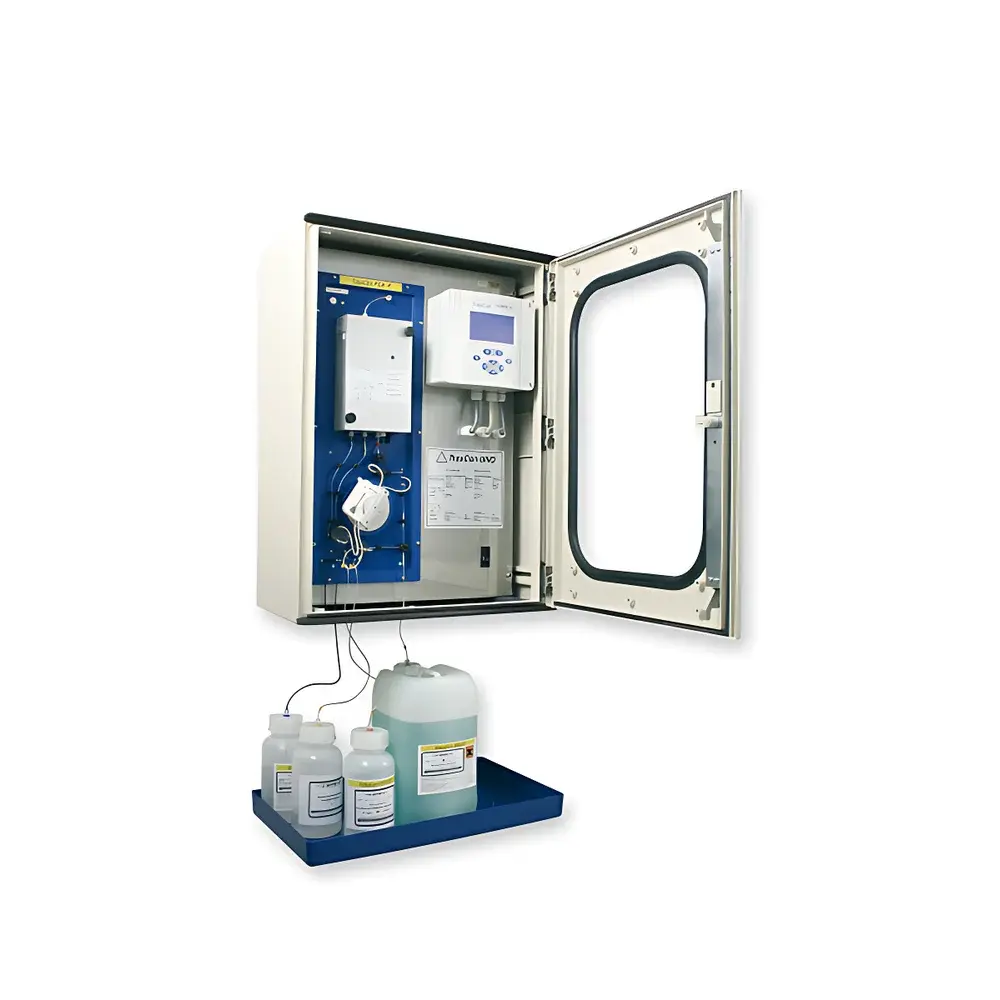
WTW TCU/A111 Ammonia Nitrogen Online Analyzer
| Brand | WTW |
|---|---|
| Origin | Germany |
| Model | TCU/A111 |
| Instrument Type | Online Analyzer |
| Measurement Principle | Ammonia Gas-Sensing Electrode |
| Measurement Range | 0.1–1000 mg/L NH₃–N |
| Accuracy | ≤ ±5% FS |
| Detection Limit | 0.1 mg/L NH₃–N |
| Analysis Time | 3 minutes per sample |
| Sample Throughput | 1 sample per cycle |
| Compliance | Certified per China EPA Environmental Protection Product Certification (HJ 758–2015) |
Overview
The WTW TCU/A111 Ammonia Nitrogen Online Analyzer is an industrial-grade, continuous-monitoring instrument engineered for reliable, real-time quantification of total ammonia nitrogen (NH₃–N) in aqueous matrices. It operates on the well-established gas-sensing electrode principle—specifically, the ammonia-selective ion-sensitive electrode (ISE) coupled with controlled alkaline distillation. In the measurement cell, a precisely dosed aliquot of sample is mixed with strong alkali (e.g., NaOH), converting all ammonium ions (NH₄⁺) and dissolved NH₃ into volatile gaseous ammonia. This vapor diffuses across a hydrophobic, gas-permeable membrane into an internal electrolyte solution, inducing a pH shift proportional to the ammonia partial pressure. The resulting potential change is measured potentiometrically and converted to NH₃–N concentration via Nernstian calibration. Designed for unattended operation in demanding environments—including municipal wastewater treatment plants, surface water monitoring stations, drinking water distribution systems, and industrial effluent discharge points—the TCU/A111 delivers high reproducibility and long-term stability without optical interference from color, turbidity, or suspended solids.
Key Features
- Gas-diffusion electrochemical detection ensures immunity to optical interferences (e.g., colored organics, suspended particles, iron/manganese complexes)
- Integrated automatic calibration and self-cleaning cycles reduce operator dependency and extend maintenance intervals to six months
- Modular architecture: compact controller unit with embedded analysis module and reagent carousel—supports wall-mount or freestanding installation
- Robust chemical handling system with peristaltic pumps, precision valves, and corrosion-resistant fluidic pathways compliant with ISO 9001 manufacturing standards
- Real-time diagnostics including electrode response slope monitoring, membrane integrity checks, and reagent level tracking
- Compliance-ready firmware supporting audit trails, user access levels, and data logging aligned with GLP and basic GMP documentation requirements
Sample Compatibility & Compliance
The TCU/A111 is validated for use with raw and treated wastewater, river/lake water, seawater (with salinity compensation), potable water, and complex industrial discharges containing surfactants, chloramines, or moderate levels of sulfide. It meets the performance criteria defined in HJ 758–2015 (China’s Technical Requirements for Online Ammonia Nitrogen Analyzers) and has received official Environmental Protection Product Certification (EPA Certification No. CEP-XXXXX). While not inherently 21 CFR Part 11 compliant out-of-the-box, its data export protocols (Modbus TCP, RS485, 4–20 mA analog output) enable integration into validated SCADA or LIMS platforms that implement electronic signature and audit trail functionality. All wetted materials conform to USP Class VI and FDA-compliant polymer standards.
Software & Data Management
The embedded controller runs WTW’s proprietary AquaSoft™ firmware, offering intuitive web-based configuration via HTTPS-enabled HTML5 interface (accessible on desktop and tablet browsers). Measurement data—including raw mV signals, calibrated concentrations, temperature, pH drift, and system status flags—are logged at user-defined intervals (1–60 min) and stored locally for ≥30 days. Export formats include CSV and XML; optional cloud synchronization supports MQTT protocol for Industry 4.0 integration. Alarm thresholds are configurable per parameter (e.g., high/low NH₃–N, calibration failure, reagent depletion), with relay outputs and email/SMS notifications via external gateway. All data records include timestamp, operator ID (if authenticated), and method version identifier—supporting traceability in regulatory reporting.
Applications
- Continuous compliance monitoring at WWTP influent, bioreactor zones, and final effluent discharge points
- Early-warning detection of nitrification/denitrification upsets in activated sludge systems
- Source water quality surveillance for drinking water intakes subject to agricultural runoff
- Process control in aquaculture facilities where sub-ppm NH₃ fluctuations impact fish health
- Industrial pretreatment verification for textile, food processing, and semiconductor fabs discharging nitrogen-rich effluents
- Research-grade longitudinal studies requiring stable baseline data across seasonal temperature and pH variations
FAQ
What sample types require pre-filtration prior to analysis?
Samples with >50 mg/L total suspended solids (TSS) or fibrous particulates (e.g., pulp mill effluents) should be filtered through a 40-µm sieve to prevent clogging of the sampling line and gas-diffusion membrane.
How often must the ammonia electrode be replaced?
Under normal operation (≤25 °C, pH 12–13 during measurement), the gas-sensing electrode maintains stable response for ≥12 months; WTW recommends annual replacement as a preventive maintenance practice.
Does the analyzer support remote calibration verification?
Yes—via built-in standard addition function using certified NH₄Cl reference solutions; results are logged with full metadata and can be reviewed remotely through the web interface.
Can the TCU/A111 operate in seawater with high chloride content?
Yes—the electrode membrane and internal electrolyte are formulated for chloride tolerance up to 35 g/L; salinity compensation is applied automatically using integrated conductivity measurement.
Is there a requirement for hazardous reagent storage on-site?
No—only non-hazardous, low-concentration NaOH (≤1 mol/L) and ionic strength adjuster solutions are used; all reagents are supplied in UN-certified, leak-proof cartridges compliant with IATA transport regulations.







