
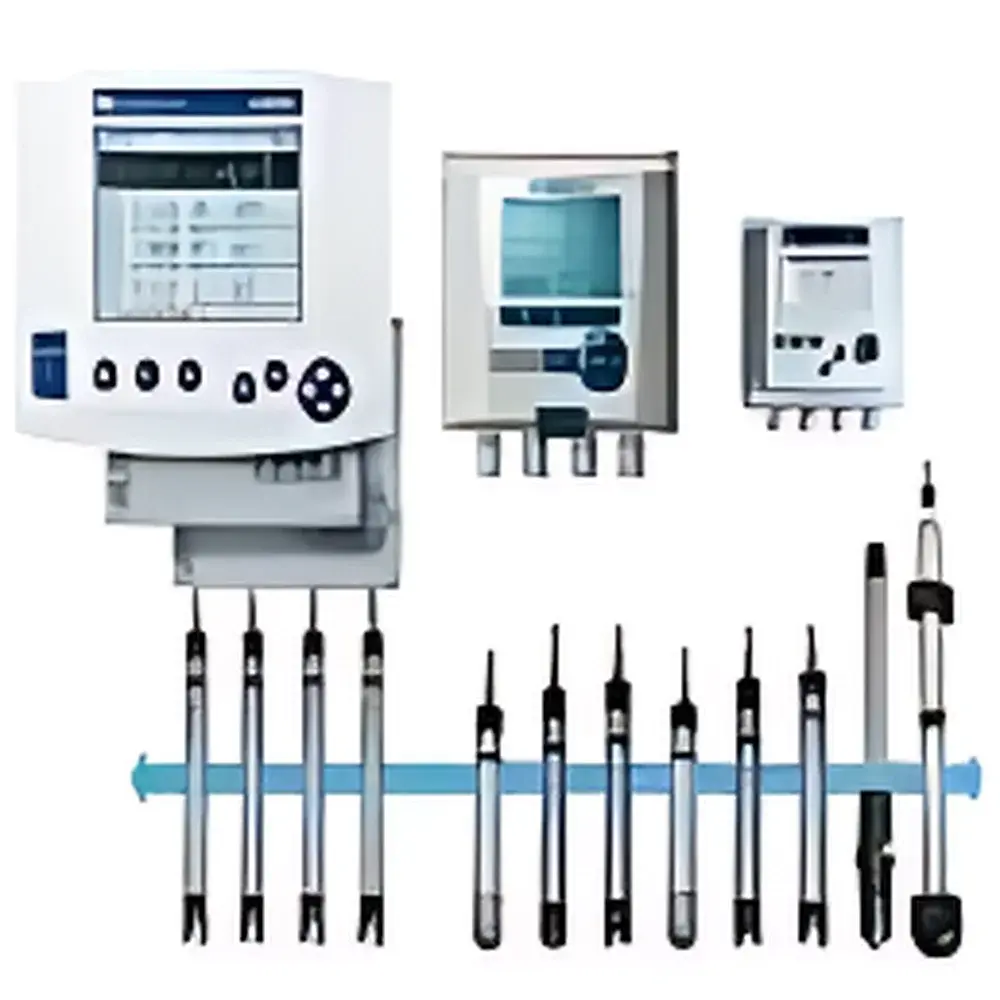
WTW TetraCon 700IQ Four-Electrode Conductivity Sensor
| Brand | WTW |
|---|---|
| Origin | Germany |
| Model | TetraCon 700IQ |
| Electrode Configuration | Four-electrode (tetrapolar) |
| Measurement Principle | AC-driven four-pole conductivity measurement with automatic temperature compensation (ATC) |
| Conductivity Range | 0.01 µS/cm to 2 S/cm (typical, dependent on cell constant) |
| Temperature Range | 0–60 °C |
| Cell Constant | 0.475 cm⁻¹ (standard) |
| Output Signal | Analog 4–20 mA or digital Modbus RTU / SDI-12 (configurable) |
| Housing Material | PEEK + stainless steel 316L |
| IP Rating | IP68 |
| Compliance | EN ISO 7888, ASTM D1125, USP <645>, GLP-compliant data logging |
Overview
The WTW TetraCon 700IQ is a high-performance, four-electrode (tetrapolar) conductivity sensor engineered for long-term stability and accuracy in demanding aqueous environments. Unlike two-electrode sensors, the tetrapolar design separates current-driving and voltage-sensing electrodes—eliminating polarization effects, electrode fouling artifacts, and contact resistance errors. This architecture ensures high reproducibility across wide dynamic ranges and enables reliable operation in turbid, high-fouling, or low-conductivity media. The sensor operates on an AC excitation principle (typically 1–10 kHz), minimizing electrolysis and surface passivation. Its integrated Pt1000 temperature sensor provides real-time, traceable temperature compensation per EN ISO 7888 and ASTM D1125 standards. Designed for permanent immersion or inline installation, the TetraCon 700IQ delivers stable calibration retention over extended deployment cycles—critical for unattended online monitoring in municipal, industrial, and ecological applications.
Key Features
- Four-electrode (tetrapolar) measurement principle for immunity to electrode coating, polarization, and cable resistance effects
- Robust housing constructed from chemically inert PEEK polymer and corrosion-resistant stainless steel 316L
- IP68-rated submersible design certified for continuous operation at depths up to 10 m
- Standard cell constant of 0.475 cm⁻¹ optimized for broad-range measurements—from ultrapure water (0.01 µS/cm) to seawater-strength solutions (up to 2 S/cm)
- Integrated Pt1000 RTD with ±0.1 °C accuracy for automatic temperature compensation (ATC) aligned with IEC 60751
- Configurable output options: isolated 4–20 mA analog signal or digital communication via Modbus RTU (RS-485) and SDI-12 protocols
- Self-diagnostic capability including electrode integrity check and temperature plausibility verification
Sample Compatibility & Compliance
The TetraCon 700IQ is validated for use in heterogeneous and aggressive matrices, including activated sludge effluents, reverse osmosis permeate, brackish estuarine waters, recirculating aquaculture systems (RAS), boiler feedwater, and pharmaceutical process water. It meets regulatory requirements for routine environmental monitoring under EU Water Framework Directive (2000/60/EC) and EPA Method 120.1. For GMP-regulated environments, its digital output supports audit-trail-enabled data acquisition compliant with FDA 21 CFR Part 11 when paired with WTW IQ SensorBox or compatible SCADA platforms. Calibration traceability follows DIN EN ISO/IEC 17025 guidelines, and factory calibration certificates include uncertainty budgets referenced to NIST-traceable standards.
Software & Data Management
When interfaced with WTW’s IQ Sensor Software or third-party SCADA/HMI systems (e.g., Ignition, Siemens Desigo, or Schneider EcoStruxure), the TetraCon 700IQ supports remote configuration, real-time diagnostics, and automated drift detection. Data logging includes timestamped conductivity, temperature, and sensor health status—exportable in CSV or XML formats for LIMS integration. Firmware updates are performed over Modbus or via USB adapter, ensuring alignment with evolving metrological best practices. All configuration changes are recorded with user ID and timestamp, fulfilling GLP documentation requirements for quality-controlled laboratories and operational technology (OT) environments.
Applications
- Municipal wastewater treatment: influent screening, secondary clarifier monitoring, and final effluent compliance reporting
- Drinking water production: raw water intake assessment, coagulation control, and distribution system integrity verification
- Industrial process water: cooling tower conductivity control, boiler blowdown optimization, and rinse water recycling validation
- Aquaculture and marine research: salinity profiling in hatcheries, tidal monitoring stations, and coral reef restoration projects
- Pharmaceutical manufacturing: conductivity verification during purified water (PW) and water-for-injection (WFI) generation per USP
- Power generation: demineralized water loop surveillance and condensate purity assurance
FAQ
What is the difference between two-electrode and four-electrode conductivity sensors?
Four-electrode sensors eliminate errors caused by electrode polarization and cable resistance by separating current injection and voltage sensing functions—making them essential for fouling-prone or low-conductivity applications.
Does the TetraCon 700IQ require regular recalibration?
While designed for long-term stability, periodic verification against certified KCl standards (e.g., 0.01 mol/kg or 0.1 mol/kg) is recommended every 3–6 months depending on exposure conditions and regulatory requirements.
Can it be used in seawater or hypersaline environments?
Yes—the 0.475 cm⁻¹ cell constant and robust electrode geometry enable accurate measurement up to 2 S/cm; for higher salinities (>50 g/kg), optional high-range cell constants (e.g., 1.0 cm⁻¹) are available.
Is temperature compensation automatic and standardized?
Yes—integrated Pt1000 provides continuous ATC per the nonlinear CaCl₂-based algorithm defined in EN ISO 7888, with manual override capability for custom media.
How is sensor fouling detected and mitigated?
The sensor continuously monitors electrode impedance and signal-to-noise ratio; deviations beyond configurable thresholds trigger maintenance alerts in connected control systems.







