
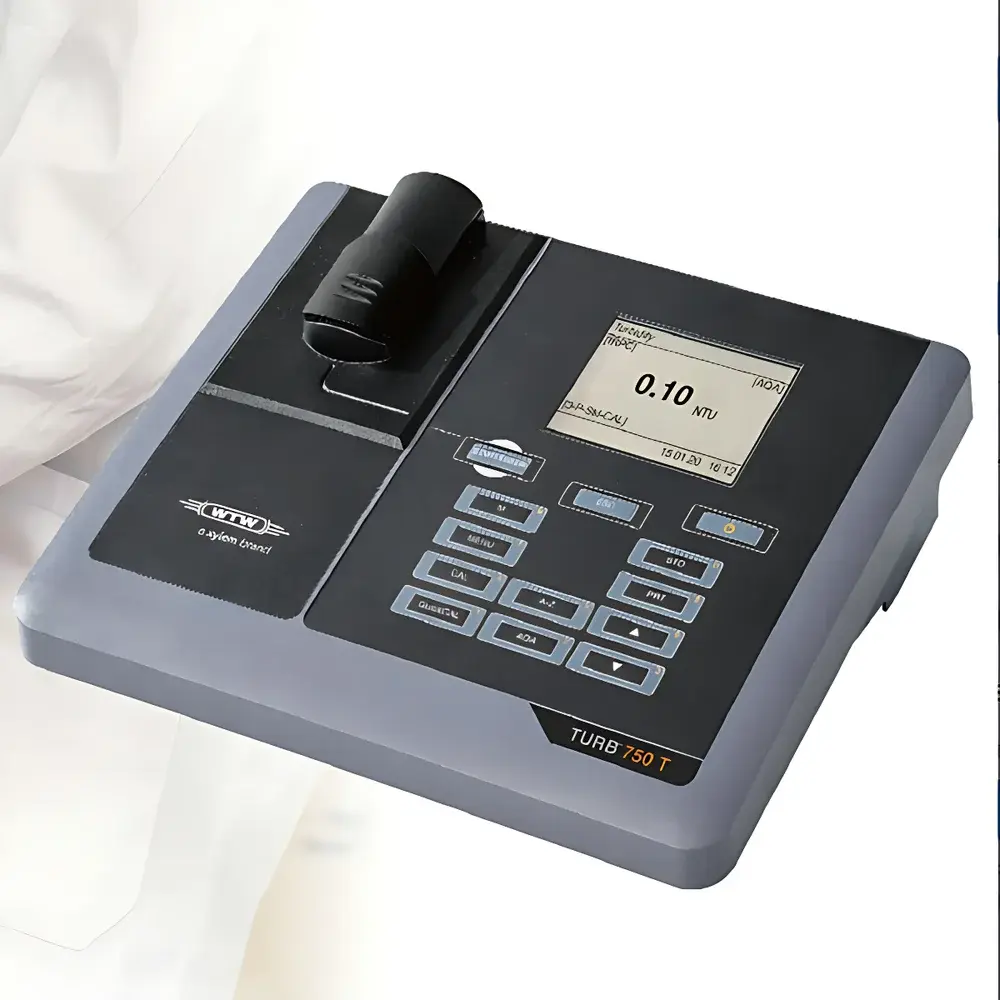
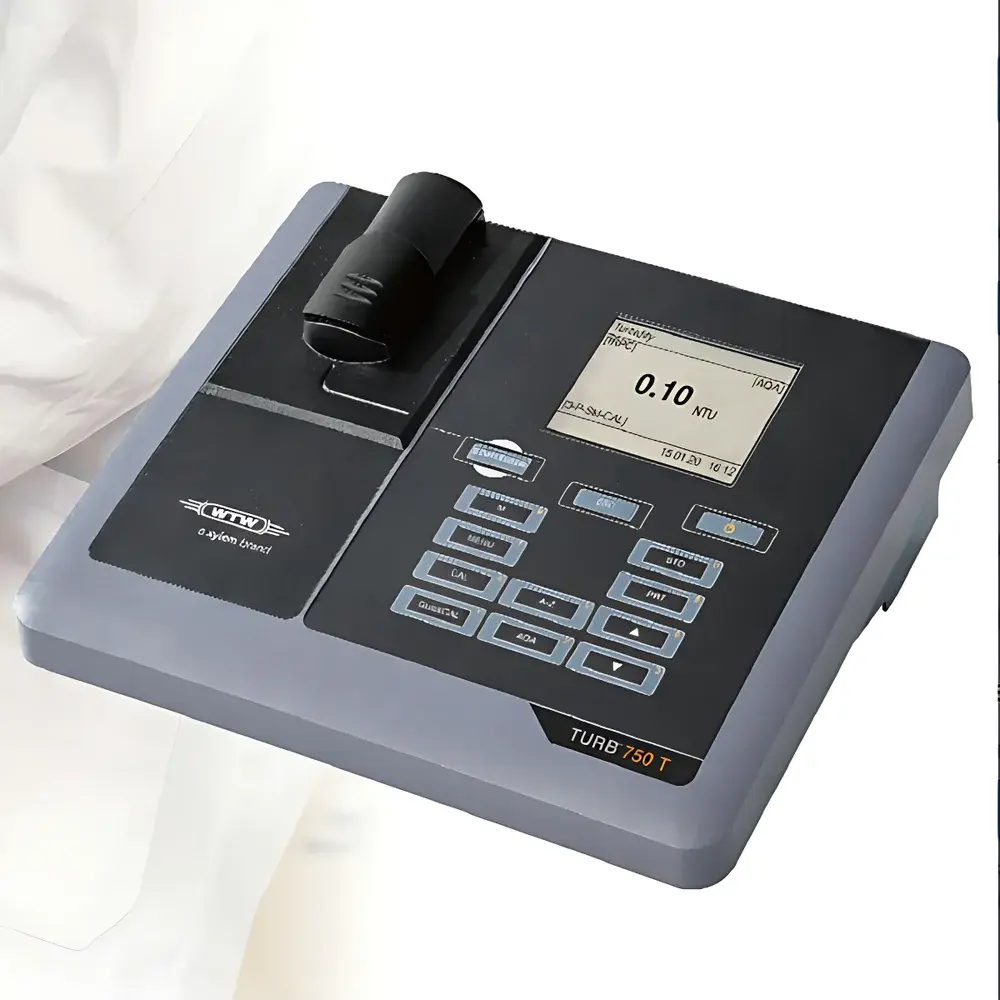
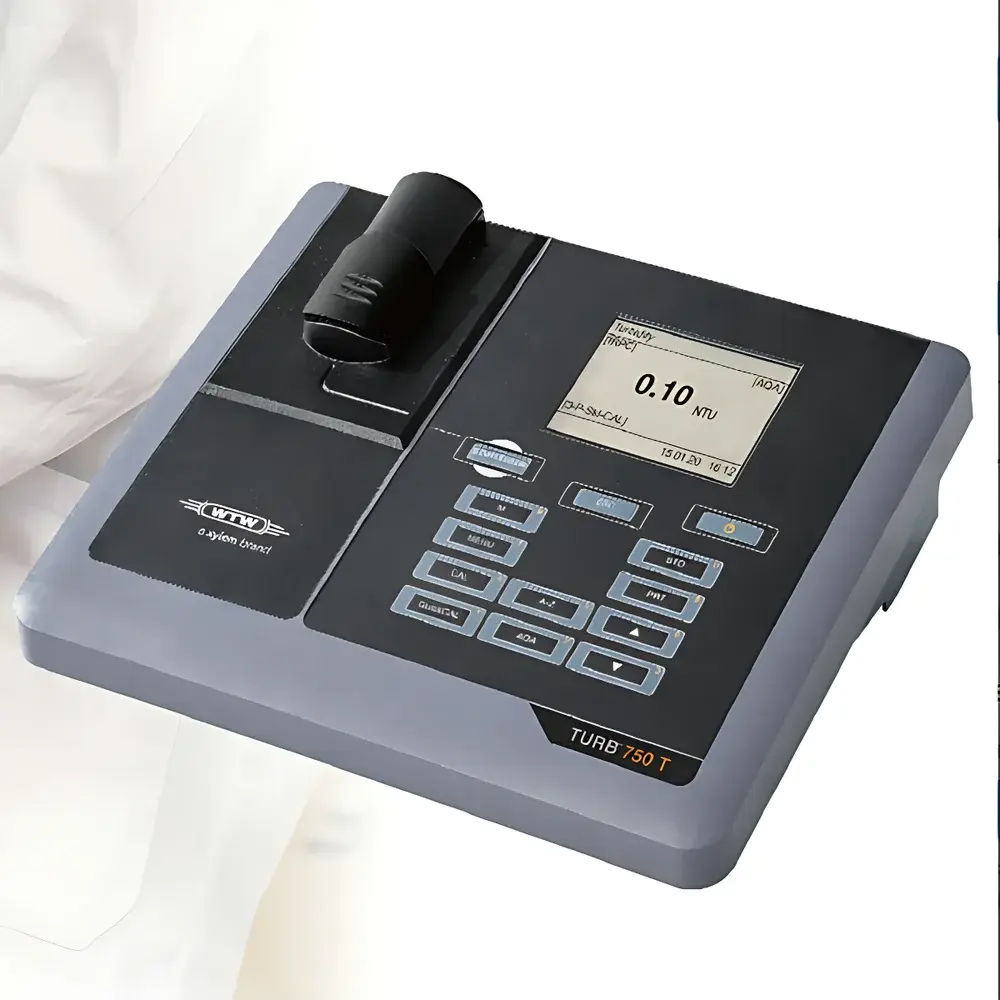
WTW Turb 750 IR/T Benchtop Turbidimeter
| Brand | WTW |
|---|---|
| Origin | Germany |
| Model | 750 |
| Instrument Type | Benchtop Laboratory Turbidimeter |
| Measurement Range | 0–1100 FNU/NTU |
| Resolution | 0.01 FNU/NTU (0.00–9.99), 0.1 FNU/NTU (10–99.99), 1 FNU/NTU (100–1100) |
| Operating Temperature | +5 to +55 °C (41–131 °F) |
| Accuracy | ±0.01 FNU/NTU or ±2% of reading (±3% at 500–1100 NTU for Turb 750T) |
| Compliance Standards | DIN EN ISO 7027-1 (Turb 750IR), US EPA Method 180.1 (Turb 750T) |
| Data Storage | 2500 datasets with calibration protocols and AQA flags |
| Interface | USB, RS-232, printer port |
| GLP-Compliant Software | Turb Data PC software (CSV export, LIMS import, user authentication, audit trail) |
Overview
The WTW Turb 750 IR/T is a high-precision benchtop turbidimeter engineered for regulatory-grade water quality analysis in laboratories subject to stringent compliance requirements—including drinking water monitoring (DIN EN ISO 7027-1), wastewater discharge verification, pharmaceutical process water control, and beverage quality assurance (e.g., wine, beer, dairy). It operates on the principle of nephelometric measurement: detecting 90° scattered light intensity from suspended particles in a sample under controlled illumination. The Turb 750IR utilizes an infrared LED source to minimize color interference—critical for yellow- or brown-tinted samples—while the Turb 750T employs a tungsten white-light lamp compliant with US EPA Method 180.1. Both variants feature a fixed optical path geometry with a 28 mm round cuvette format, optimized for reproducible alignment and minimal stray-light contribution. The instrument’s core architecture integrates photodiode detection, temperature-compensated signal processing, and real-time self-diagnostic routines—including Intelligent Response and Precision Check (IRPC)—to ensure measurement integrity across dynamic sample matrices, including rapidly settling suspensions.
Key Features
- Two metrologically distinct configurations: Turb 750IR (infrared LED, ISO 7027-1 compliant) and Turb 750T (tungsten lamp, US EPA 180.1 compliant)
- Triple-range resolution switching: 0.01 FNU/NTU (0–9.99), 0.1 FNU/NTU (10–99.99), and 1 FNU/NTU (100–1100) — automatically applied based on measured value
- AMCO Clear polymer-based calibration standards (0.02, 10.0, 1000 FNU/NTU) supplied with traceability to formazin, offering long-term stability (<0.5% drift/year), inter-batch consistency (±1%), and non-toxic handling
- Guided calibration workflow: default 3-point, flexible 2–5 point user-defined, rapid 1-point, configurable calibration interval, and embedded protocol storage
- GLP-compliant AQA (Analytical Quality Assurance) framework: includes tolerance limits, automatic AQA flagging per measurement, calibration status indicators, and sample ID tagging
- Backlit graphical display (160 × 104 pixels) with alphanumeric foil keyboard designed for glove-compatible operation and easy decontamination
Sample Compatibility & Compliance
The Turb 750 accommodates standard 28 mm borosilicate glass vials (≥15 mL volume), compatible with routine labware handling and autoclavable preparation. Sample temperature must remain below 70 °C to prevent thermal lensing effects or seal degradation. The instrument meets CE marking requirements and supports full auditability under GLP and GMP environments. Calibration protocols, AQA metadata, and measurement timestamps are embedded within each stored dataset—enabling full traceability per FDA 21 CFR Part 11 principles when used with Turb Data software. It fulfills mandatory testing criteria for EU Drinking Water Directive (2020/2184), US EPA Clean Water Act reporting, and ISO/IEC 17025-accredited laboratory workflows.
Software & Data Management
Turb Data PC software provides validated, GLP-compliant data handling: instrument identification via serial number, multi-user login with role-based access, timestamped electronic signatures, and CSV-formatted export for Excel or LIMS integration. All measurements retain associated calibration history, AQA status, operator ID, and sample identifier. Data filtering options allow exclusion of out-of-tolerance results prior to reporting. Firmware updates are performed via USB interface; historical datasets remain intact during version upgrades. Raw data output supports direct printing via RS-232 or USB-connected thermal printers—no proprietary drivers required.
Applications
- Drinking water treatment plants verifying compliance with maximum allowable turbidity thresholds (e.g., ≤0.3 NTU post-filtration per US EPA)
- Wastewater facilities performing effluent discharge monitoring per NPDES permits
- Pharmaceutical manufacturers assessing purified water (PW) and water-for-injection (WFI) per USP <738> and EP 2.2.21
- Beverage producers controlling colloidal stability in beer, wine, and fruit juices
- Aquaculture and livestock operations monitoring feed suspension homogeneity and pond clarity
- Academic and contract research labs conducting method validation studies per ISO 5725 and ASTM D6505
FAQ
What is the difference between Turb 750IR and Turb 750T?
The Turb 750IR uses an infrared LED and complies with DIN EN ISO 7027-1, minimizing interference from sample color. The Turb 750T uses a tungsten lamp and meets US EPA Method 180.1 requirements for regulatory reporting in North America.
Can I use formazin standards with the Turb 750?
While formazin remains a reference material, WTW recommends AMCO Clear standards for routine calibration due to superior stability, safety, and batch-to-batch reproducibility. Formazin is not required—and not supported—for automated calibration routines.
Is the Turb 750 suitable for field use?
No—it is a benchtop laboratory instrument rated for indoor operation only (+5 to +55 °C). For portable applications, consider the WTW Turb 430 series.
How does IRPC improve measurement reliability?
Intelligent Response and Precision Check (IRPC) dynamically adjusts integration time and validates signal stability before finalizing readings—especially critical for low-turbidity samples or rapidly settling particulates.
Does Turb Data software support 21 CFR Part 11 compliance?
Yes—when configured with user authentication, electronic signatures, and audit-trail logging enabled, Turb Data satisfies key technical controls for electronic records and signatures in regulated environments.




