
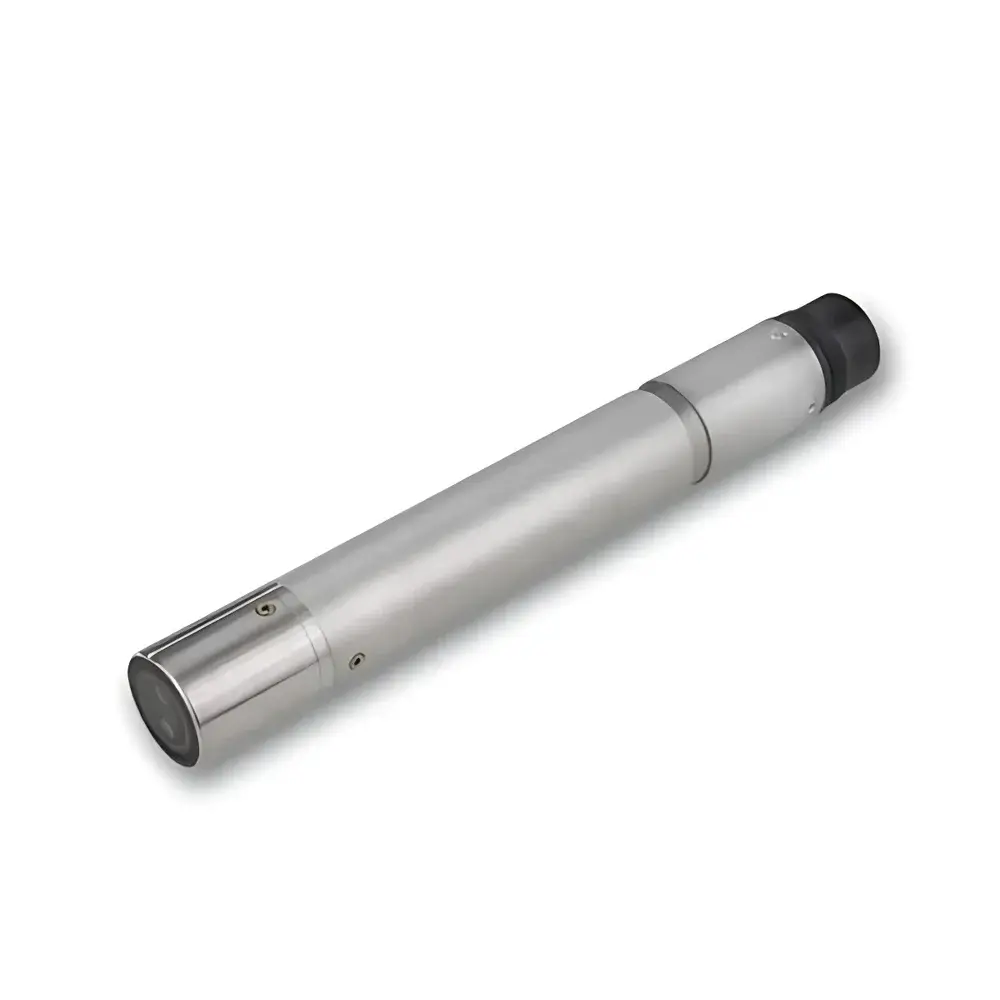
WTW VisoTurb In-Line Turbidity Sensor
| Brand | WTW |
|---|---|
| Origin | Germany |
| Model | VisoTurb |
| Instrument Type | Online Water Quality Analyzer |
| Measured Parameter | Turbidity |
| Measurement Principle | 90° Scattered Light (ISO 7027 / EN 27027) |
| Light Source | 860 nm IR LED |
| Range | 0.05–4000 FNU (0.001–1 FNU resolution) |
| Equivalent Ranges | 0.1–4000 mg/L SiO₂ |
| Calibration | Factory-calibrated with Formazin (FNU), SiO₂, and user-configurable TSS per DIN 38414 |
| Repeatability | <0.015% or ≥0.006 FNU (per DIN ISO 5725 / DIN 1319) |
| Self-Diagnostic Function | SensCheck® for optical window fouling, cleaning system status, and fault detection |
| Cleaning Mechanism | Integrated ultrasonic self-cleaning |
| Operating Temperature | 0–60 °C (ultrasonic cleaning active up to 40 °C) |
| Pressure Rating | 10 bar (standard), 1 bar (F-version) |
| Enclosure Rating | IP68 |
| Sensor Housing Material | V4A stainless steel 1.4571, POM + titanium (SW) |
| Optical Window | Sapphire |
| Power Consumption | 1.5 W |
| Response Time | ≤2 s |
Overview
The WTW VisoTurb is an industrial-grade in-line turbidity sensor engineered for continuous, high-reliability monitoring of suspended solids in water and wastewater streams. It operates on the principle of 90° scattered light detection, fully compliant with ISO 7027 and DIN EN 27027 standards. By employing a stable 860 nm infrared LED light source, the VisoTurb eliminates interference from sample coloration—ensuring accurate turbidity quantification even in yellowish or humic-rich waters commonly encountered in surface water intakes or tertiary treatment effluents. The sensor delivers measurements in Formazin Nephelometric Units (FNU), traceable to certified Formazin calibration standards, and supports parallel interpretation in equivalent SiO₂ (mg/L) and Total Suspended Solids (TSS, g/L) units via configurable scaling. Its solid-state optical architecture—featuring a sapphire viewing window and corrosion-resistant V4A stainless steel (1.4571) wetted parts—ensures long-term stability under aggressive chemical and mechanical conditions typical of municipal and industrial water infrastructure.
Key Features
- Compliance-certified optical design: 860 nm IR LED and 90° scatter geometry per ISO 7027/EN 27027 for metrologically traceable FNU output
- Integrated ultrasonic self-cleaning system: Active cleaning without moving parts, consumables, or process interruption; effective across full operating temperature range (0–40 °C)
- SensCheck® diagnostic suite: Real-time monitoring of optical window fouling, transducer integrity, and cleaning cycle performance—enabling predictive maintenance and data validity flagging
- Ruggedized construction: IP68-rated housing, 10 bar pressure tolerance (standard version), sapphire optical window, and chemically inert wetted materials (V4A stainless steel, POM, titanium)
- Fast dynamic response: ≤2 second signal stabilization enables detection of rapid turbidity transients during filter breakthrough, stormwater surges, or coagulation upsets
- Multi-parameter scalability: Simultaneous FNU, SiO₂-equivalent (mg/L), and user-defined TSS (g/L) outputs—calibration options include factory Formazin (FNU), SiO₂ reference, and field-configurable TSS per DIN 38414
Sample Compatibility & Compliance
The VisoTurb is validated for use across diverse aqueous matrices including potable water distribution systems, raw surface water abstraction points, activated sludge aeration basins (up to 3 g/L TSS), and final effluent discharge monitoring. Its IR-based optical method inherently rejects chromatic interference, making it suitable for colored waters where white-light turbidimeters exhibit drift. Regulatory alignment includes full support for EU Drinking Water Directive (DWD 98/83/EC) reporting requirements, US EPA Method 180.1 equivalency, and GLP-compliant data acquisition when integrated with IQ or Lunatrac controllers. All factory calibrations are documented per ISO/IEC 17025-accredited procedures, and instrument firmware maintains audit trails for calibration events, cleaning cycles, and diagnostic alerts in accordance with FDA 21 CFR Part 11 data integrity expectations.
Software & Data Management
When deployed with WTW’s IQ SensorNet platform or compatible SCADA/HMI systems, the VisoTurb provides digital output via Modbus RTU/ASCII or analog 4–20 mA signals with HART protocol support. Configuration, diagnostics, and historical trend review are managed through WTW’s MultiLine software or cloud-enabled IQ Link interface. Data logging includes timestamped measurement values, SensCheck® status flags (e.g., “Window Contamination Detected”, “Ultrasonic Pulse Failure”), and cleaning event metadata—enabling automated QA/QC workflows and regulatory report generation. Firmware updates preserve calibration coefficients and user-defined TSS curves, ensuring continuity across maintenance intervals without recalibration.
Applications
- Real-time turbidity monitoring at drinking water treatment plant filtration outlets to verify compliance with <1.0 NTU/FNU limits per WHO and local regulatory thresholds
- Early warning detection of sediment resuspension in reservoirs and intake channels using low-range sensitivity (0.001 FNU resolution)
- Process control feedback for coagulant dosing optimization in clarification stages based on upstream turbidity dynamics
- Effluent quality assurance in municipal wastewater plants prior to UV disinfection or chlorine contact tanks
- Long-term trend analysis of suspended solids loading in combined sewer overflows (CSOs) and stormwater retention basins
- Validation of membrane integrity in MF/UF pilot systems through sub-0.01 FNU detection capability
FAQ
What is the difference between FNU and NTU?
FNU (Formazin Nephelometric Unit) is defined under ISO 7027 and uses an 860 nm infrared light source to minimize color interference; NTU (Nephelometric Turbidity Unit) follows US EPA Method 180.1 and employs white light. While numerically comparable for clear samples, FNU provides superior accuracy in colored waters.
Can the VisoTurb be used in seawater applications?
Yes—the V4A stainless steel (1.4571) body and sapphire window resist chloride-induced pitting and biofouling. However, TSS calibration must be performed with marine sediment standards, as SiO₂ equivalence is not applicable in saline matrices.
Is ultrasonic cleaning safe for optical integrity over time?
Extensive accelerated lifetime testing confirms no measurable degradation of sapphire transmission or LED output after >10,000 cleaning cycles. The ultrasonic frequency is tuned to avoid resonant coupling with the optical assembly.
How often does the sensor require manual intervention?
Under typical municipal water conditions, scheduled maintenance is recommended annually. SensCheck® diagnostics identify fouling progression, allowing maintenance to be triggered by actual need rather than fixed intervals—reducing OPEX and downtime.







