
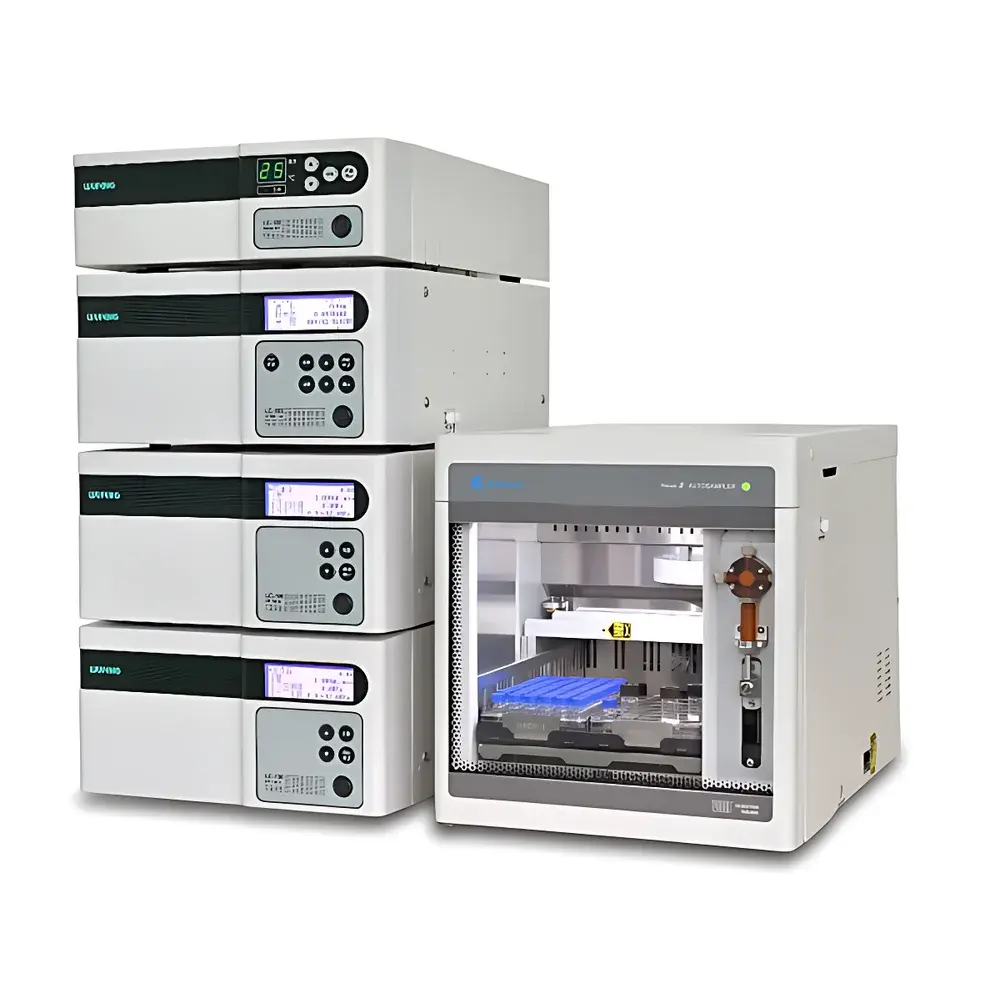
Wufeng LC-100 Gradient High-Performance Liquid Chromatography System
| Brand | Wufeng |
|---|---|
| Origin | Shanghai, China |
| Model | LC-100 (Gradient Configuration) |
| Instrument Type | Conventional HPLC System |
| Flow Rate Range | 0.001–9.999 mL/min |
| Maximum Pressure | 42 MPa |
| Autosampler Capacity | 108 positions (2 mL vials) / 70 positions (4 mL vials) / 20 positions (10 mL vials) |
| Injection Volume Range | 0.1–200 µL (with interchangeable sample loops) |
| Column Oven Temperature Range | (Ambient + 5 °C) to 80 °C |
| UV-Vis Wavelength Range | 190–800 nm |
| Data Acquisition Rate | 10 Hz |
Overview
The Wufeng LC-100 Gradient High-Performance Liquid Chromatography System is a fully integrated, domestically engineered HPLC platform designed for routine and method-development applications in pharmaceutical quality control, environmental analysis, food safety testing, and academic research laboratories. Based on classical reversed-phase and normal-phase chromatographic principles, the LC-100 employs high-pressure liquid delivery, UV-Vis absorbance detection, and precise column temperature control to deliver reproducible retention times, accurate peak integration, and robust baseline stability. Its modular architecture—comprising the LC-P100 dual-piston reciprocating pump, LC-UV100 variable-wavelength UV-Vis detector, WS-100 chromatographic workstation, and optional LC-CO100 column oven—enables flexible configuration while maintaining system coherence and inter-unit synchronization. All core hardware components and firmware are developed and manufactured in-house by Wufeng Instruments, ensuring full intellectual property ownership and long-term serviceability.
Key Features
- LC-P100 High-Pressure Pump: Dual-piston parallel design with <0.3% flow rate stability (Sr) and ±2% flow accuracy (Ss); pressure pulsation <0.1 MPa at 1 mL/min and 5–10 MPa; automatic plunger retraction for seal replacement without chassis disassembly.
- LC-UV100 UV-Vis Detector: Full digital signal path eliminating analog-to-digital conversion artifacts; patented dual-conical flow cell (8 µL volume, 8 mm path length) enhancing signal-to-noise ratio; D2 lamp rated for 2000 h; optional tungsten lamp for extended visible-range detection (up to 800 nm).
- WS-100 Chromatography Workstation: Fully bidirectional instrument control with gradient programming, spectral scanning (180–680 nm, 1 nm step), wavelength calibration verification (486.6 nm & 656.1 nm reference lines), and time-programmable relay events for valve switching or fraction collection.
- Modular Expandability: Supports optional refractive index (RI) and diode array (DAD) detectors; compatible with semi-preparative pump modules and quaternary low-pressure gradient systems.
- Mechanical Precision: CNC-machined chassis with corrosion-resistant solvent-contact surfaces; Japanese industrial design language applied to front-panel ergonomics and visual interface clarity.
Sample Compatibility & Compliance
The LC-100 accommodates standard 3.0–4.6 mm I.D. analytical columns (up to 250 mm length) and supports common mobile phases including aqueous buffers (e.g., phosphate, acetate), organic modifiers (acetonitrile, methanol), and ion-pairing reagents. Its pressure rating of 42 MPa permits use with sub-3 µm particle-packed columns under optimized flow conditions. The system meets essential functional requirements for GLP-compliant environments: audit-trail-capable software logging (via WS-100), user-access-level permissions, and electronic signature support. While not pre-certified to FDA 21 CFR Part 11 out-of-the-box, the WS-100 software architecture allows validation documentation and procedural controls required for regulated QC labs. It aligns with ISO/IEC 17025 method validation expectations for precision (retention time RSD <0.1%, peak area RSD <0.3%), detection sensitivity (≤5 × 10⁻⁹ g/mL for naphthalene), and wavelength accuracy (±2 nm).
Software & Data Management
The WS-100 workstation operates on Windows-based platforms and provides native .cdf (NetCDF) data export for third-party processing (e.g., Chromeleon, OpenLab CDS). Raw chromatograms are stored with full metadata—including instrument parameters, method files, calibration logs, and operator IDs—ensuring traceability per ALCOA+ principles. Spectral scanning functionality enables real-time lamp health assessment and wavelength calibration verification. Gradient editor includes graphical preview of solvent composition vs. time, facilitating method transfer and troubleshooting. All hardware modules report status flags (e.g., lamp energy, pressure deviation, temperature drift) directly into the acquisition timeline, supporting predictive maintenance scheduling. Data backups can be configured for network-attached storage or encrypted local drives, satisfying institutional IT security policies.
Applications
The LC-100 is routinely deployed in small-to-midsize laboratories requiring validated, cost-effective separation solutions. Typical use cases include assay quantification of active pharmaceutical ingredients (APIs) per USP , residual solvent analysis in polymers (ICH Q3C), pesticide residue screening in agricultural commodities (AOAC 2007.01), and organic acid profiling in fermented foods. Its wide wavelength range (190–800 nm) supports both UV-absorbing compounds (e.g., aromatics, conjugated carbonyls) and visible chromophores (e.g., dyes, metal complexes). When paired with the LC-CO100 column oven, it achieves improved retention time reproducibility for temperature-sensitive separations such as chiral resolution or polymer molecular weight distribution analysis.
FAQ
Does the LC-100 support GLP/GMP-compliant operation?
Yes—when configured with WS-100 audit trail logging, user role management, and electronic signature protocols, the system supports laboratory compliance frameworks aligned with ISO/IEC 17025 and internal QA procedures.
Can the UV detector operate across the full 190–800 nm range simultaneously?
No—the LC-UV100 uses a single-lamp (D2) configuration for 190–680 nm; the 680–800 nm extension requires optional tungsten lamp installation and manual source switching.
What is the minimum injection volume accuracy at 0.1 µL?
The autosampler achieves ±1% precision at volumes ≥1 µL; at 0.1 µL, accuracy depends on loop selection and syringe calibration—recommended use is ≥0.5 µL for quantitative work.
Is remote monitoring or control supported?
The WS-100 workstation supports LAN-based instrument control and real-time status viewing via TCP/IP; secure remote desktop access may be enabled through site-specific IT infrastructure.
Are spare parts and technical documentation available internationally?
Wufeng maintains an English-language technical library (user manuals, schematics, firmware updates) and distributes consumables—including pump seals, flow cells, and lamps—through authorized regional partners in APAC, EMEA, and LATAM.
Related Products






