
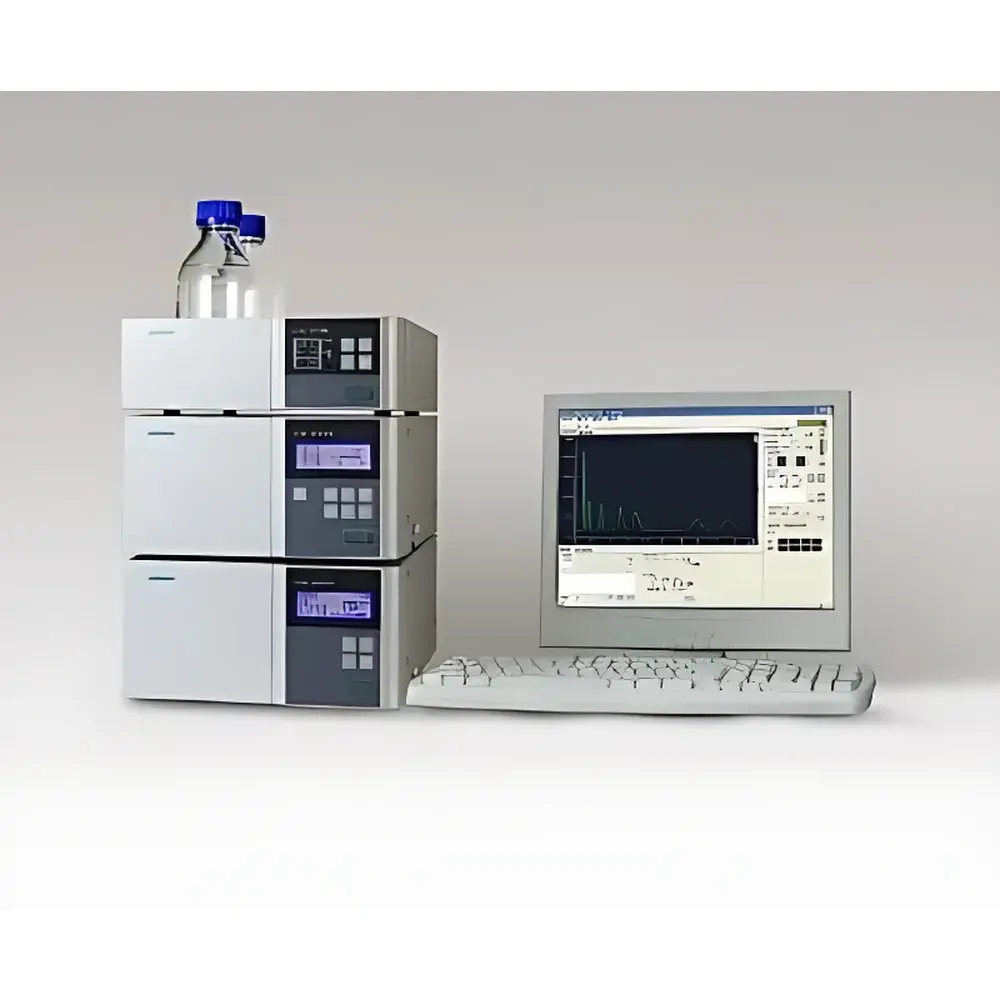
Wufeng LC-100 Intelligent Digital HPLC System
| Origin | Shanghai, China |
|---|---|
| Manufacturer Type | Authorized Distributor |
| Origin Category | Domestic (PRC) |
| Model | LC-100 Isocratic Configuration |
| Instrument Type | Conventional High-Performance Liquid Chromatograph |
| Flow Rate Range | 0.001–9.999 mL/min |
| Maximum Pressure | 42 MPa |
| Sample Tray Capacity | 54 positions × 2 mL vials / 35 positions × 4 mL vials |
| Injection Volume Range | 0.1–120 µL |
| Column Oven Temperature Range | 5 °C above ambient to 80 °C |
| UV-Vis Wavelength Range | 190–900 nm |
| Data Acquisition Frequency | 50 Hz |
Overview
The Wufeng LC-100 Intelligent Digital HPLC System is a fully integrated, isocratic high-performance liquid chromatograph engineered for precision, long-term stability, and regulatory-compliant operation in QC laboratories, academic research facilities, and contract analytical service providers. Based on over two decades of indigenous development since 1999, the LC-100 platform employs classical reversed-phase chromatography principles—utilizing high-pressure solvent delivery, UV-Vis absorbance detection, and thermally stabilized column environments—to deliver reproducible retention time and peak area performance under ISO 17025, USP , and ICH Q2(R2) method validation frameworks. Its architecture adheres to fundamental HPLC design tenets: dual-plunger parallel reciprocating pump mechanics for low pulsation flow generation; a fixed-wavelength or scanning UV-Vis detector with digitally sampled analog signals to preserve chromatographic fidelity; and a modular, software-synchronized control topology enabling full bidirectional communication between hardware modules and workstation.
Key Features
- Precision Pumping System: LC-P100 high-pressure isocratic pump features a dual-plunger parallel configuration with ±0.3% flow rate stability (Sr) and ±2% flow accuracy (Ss) across the full 0.001–9.999 mL/min range; integrated automatic plunger retraction simplifies seal replacement without chassis disassembly.
- Optimized UV-Vis Detection: LC-UV100 detector incorporates a patented dual-conical flow cell (8 µL volume, 8 mm path length), 2000-hour imported deuterium lamp, optional tungsten lamp for extended visible-range detection (up to 900 nm), and fully digital signal processing eliminating analog-to-digital conversion artifacts.
- Intelligent Software Control: WS-100 chromatography workstation supports real-time bidirectional instrument control—including gradient programming, spectral scanning (180–680 nm, 1 nm step), wavelength calibration verification at 486.6 nm and 656.0 nm hydrogen emission lines, and time-programmable relay events for valve switching or fraction collection.
- Thermal Management: Optional LC-CO100 column oven maintains temperature from 5 °C above ambient to 80 °C with ±0.1 °C stability, supporting dual-column configurations for serial coupling or method development flexibility.
- Robust Fluidic Architecture: All wetted components utilize internationally standardized fittings and PEEK/316 stainless steel tubing; dual-seal pump head variants are available for extended operation with buffered mobile phases.
Sample Compatibility & Compliance
The LC-100 system accommodates standard 2–4 mL autosampler vials (54-position or 35-position trays), supports injection volumes from 0.1 µL to 120 µL with programmable needle wash cycles, and interfaces seamlessly with common reversed-phase C18, phenyl-hexyl, and HILIC columns (2.1–4.6 mm ID, up to 250 mm length). It meets core functional requirements for GLP and GMP environments through audit-trail-enabled software logging, user-access-level permissions, and electronic signature support in WS-100. While not pre-certified to FDA 21 CFR Part 11 out-of-the-box, the system architecture permits validation documentation packages—including IQ/OQ/PQ protocols, traceable calibration records, and change control logs—to be implemented per laboratory SOPs aligned with ISO/IEC 17025:2017 Annex A.2 and EU Annex 11 guidelines.
Software & Data Management
WS-100 is a Windows-based, single-platform chromatography data system (CDS) designed for operational transparency and method lifecycle integrity. It stores raw detector signals, pump pressure traces, and temperature logs in vendor-neutral .CDF-compatible binary format, enabling third-party integration via Open Chromatography Interface (OCI) or ASCII export for statistical analysis. The software enforces method versioning, includes built-in system suitability testing (SST) templates compliant with USP criteria (e.g., tailing factor, resolution, %RSD of replicate injections), and generates PDF reports with embedded chromatograms, integration tables, and metadata timestamps. Audit trail functionality captures all user actions—including parameter edits, sequence modifications, and report exports—with immutable timestamps and operator IDs, satisfying ALCOA+ data integrity principles.
Applications
The LC-100 serves as a foundational analytical tool across pharmaceutical quality control (assay, related substances, dissolution testing), food safety (mycotoxin quantification, pesticide residue screening), environmental monitoring (PAHs, phenolic compounds in water), and natural product chemistry (flavonoid profiling, alkaloid isolation verification). Its 42 MPa pressure rating supports sub-2 µm particle-packed columns for enhanced resolution and throughput, while the 50 Hz acquisition rate ensures accurate peak shape capture for fast-eluting analytes. The system’s configurable detection modes—fixed-wavelength UV, time-scan UV, or dual-lamp UV-Vis—enable method transfer from legacy instruments and facilitate multi-analyte assays requiring wavelength optimization.
FAQ
Is the LC-100 compatible with gradient elution methods?
Yes—while the base configuration is isocratic, optional four-channel low-pressure gradient modules (LC-G100) and semi-preparative pump variants are available to support linear, step, or multi-step gradient methods.
Does the system support 21 CFR Part 11 compliance?
The WS-100 software provides foundational elements (audit trail, electronic signatures, role-based access), but formal Part 11 validation requires site-specific implementation, including documented risk assessment, configuration management, and periodic review per internal validation master plan.
What maintenance intervals are recommended for critical consumables?
Deuterium lamp replacement is advised every 2000 hours or when spectral output at 486.6 nm drops below 80% of initial intensity; pump seals should be inspected every 6 months under continuous use with aqueous buffers, or annually with organic-rich mobile phases.
Can the LC-100 interface with third-party mass spectrometers?
Yes—the system outputs analog voltage signals (0–1 V DC) synchronized to detector absorbance, compatible with most LC-MS analog input interfaces; digital communication requires custom API integration via RS-232 or Ethernet.
Is column oven temperature uniformity validated across the entire operating range?
Factory calibration verifies ±0.1 °C stability at setpoints of 25 °C, 40 °C, and 80 °C; users are advised to perform in-house thermal mapping using NIST-traceable PT100 probes during qualification.




