
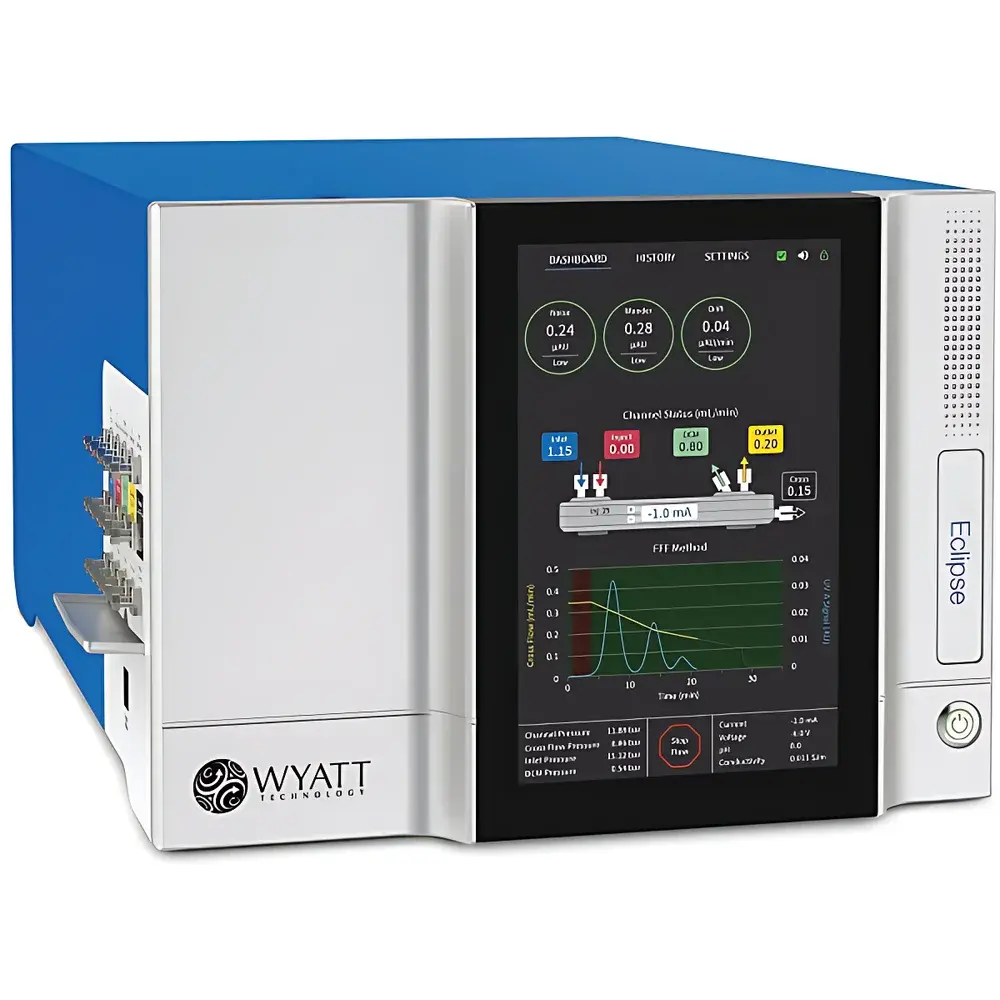
Wyatt Eclipse AF4 Asymmetric Flow Field Flow Fractionation System
| Brand | Wyatt |
|---|---|
| Origin | USA |
| Manufacturer | Wyatt Technology Corp. |
| Type | Asymmetric Flow FFF (AF4) |
| Model | Eclipse AF4 |
| Separation Range | 2 nm – 20 µm |
| Crossflow Rate | 0–8.3 mL/min (up to 10 mL/min total with detector flow) |
| Channel Pressure Limit | 30 bar (auto-shutdown at 33 bar) |
| Spacer Thickness Options | 125, 190, 250, 350, 490 µm |
| Membrane Cutoffs | Regenerated cellulose (10 kDa, 30 kDa) |
| pH Compatibility | 1–14 |
| Materials | PEEK base, aluminum housing with polycarbonate inner membrane, stainless steel frit, Buna-N O-rings (Kalrez® optional for organics) |
| Solvent Compatibility | Aqueous and organic (with glass membrane & Kalrez® seals) |
| Pressure Sensor Range | 0–100 bar |
| LiquiFlow Inlet Flow Measurement | 0–1 mL/min |
| LiquiFlow Crossflow Control/Measurement | 0–8.3 mL/min |
Overview
The Wyatt Eclipse AF4 Asymmetric Flow Field Flow Fractionation (AF4) System is a high-precision, modular separation platform engineered for the orthogonal characterization of macromolecules, nanoparticles, colloids, and complex aggregates across an unprecedented size range—from 2 nanometers to 20 micrometers. Unlike size-exclusion chromatography (SEC/GPC), which relies on porous stationary phases and introduces shear-induced degradation or pore exclusion artifacts, AF4 operates in an open, wall-less channel where separation is governed by differential diffusion under a perpendicular crossflow field. This principle—rooted in laminar flow hydrodynamics and Brownian motion—ensures gentle, non-destructive fractionation without column clogging, surface adsorption, or shear stress. The Eclipse AF4 serves as the foundational separation engine in multi-detector analytical workflows, particularly when coupled with Wyatt’s DAWN MALS, QELS, ViscoStar, and rEX refractive index detectors. Its design reflects over three decades of field-flow fractionation innovation, delivering reproducible, scalable, and physicochemically faithful separations essential for regulatory-compliant biopharmaceutical analysis, nanomaterial safety assessment, and environmental colloid research.
Key Features
- Ultra-broad dynamic separation range (2 nm – 20 µm), validated for proteins, liposomes, viruses, antibody aggregates, synthetic polymers, quantum dots, exosomes, and humic substances
- Shear-free separation mechanism preserves native conformation and aggregation state—critical for structural integrity in biologics characterization
- Modular, chemically inert flow path constructed from PEEK, aluminum, polycarbonate, and stainless steel frit; compatible with pH 1–14 and aggressive solvents (with optional glass membrane and Kalrez® seals)
- Precision dual-motor needle valves enable real-time, software-controlled crossflow modulation (0–8.3 mL/min) with <±0.02 mL/min repeatability
- Integrated LiquiFlow sensors provide simultaneous inlet and crossflow rate monitoring and closed-loop control
- Automated pressure management: programmable shutdown at 30 bar, mechanical relief valve activation at 33 bar
- Interchangeable spacers (125–490 µm) and certified ultrafiltration membranes (2–30 kDa) allow method optimization for sample viscosity, loading capacity, and resolution requirements
- Front-panel LCD and Ethernet interface support remote operation, system diagnostics, and integration into automated lab environments
Sample Compatibility & Compliance
The Eclipse AF4 accommodates diverse sample matrices—including aqueous buffers, organic solvents (e.g., THF, DMF, chloroform), and mixed-phase systems—without compromising channel integrity or detection fidelity. Its metal-free fluidic path eliminates catalytic degradation risks for redox-sensitive biomolecules and avoids leaching artifacts common in stainless-steel-based systems. Regulatory readiness is embedded in its architecture: full audit trail logging, user-access controls, electronic signatures, and instrument-state verification align with FDA 21 CFR Part 11, ISO/IEC 17025, and ICH Q5E guidelines. Method validation protocols—including system suitability testing, repeatability assessment (RSD <2% for retention time), and robustness evaluation per ICH Q2(R2)—are fully supported within ASTRA software. The system meets ASTM D8287-20 standards for nanoparticle size distribution analysis by AF4-MALS and complies with EPA Method 8082A for environmental colloidal characterization.
Software & Data Management
Controlled exclusively via Wyatt’s ASTRA 8 software, the Eclipse AF4 enables end-to-end method development, execution, and reporting. ASTRA provides synchronized acquisition across all connected detectors (MALS, QELS, viscometry, dN/dC), automatic peak deconvolution, absolute molar mass and size distribution calculation (via Zimm, Berry, or Debye analysis), and intrinsic viscosity mapping. All raw data—including pressure traces, flow profiles, temperature logs, and valve positions—are timestamped and stored in HDF5 format for long-term archival and third-party interoperability. The software supports GLP-compliant electronic notebooks, PDF report generation with digital signatures, and secure cloud backup via optional Wyatt Connect. Batch processing, script-driven automation, and API access facilitate integration into LIMS and enterprise QA/QC workflows.
Applications
- Biopharmaceutical characterization: subvisible particle analysis of monoclonal antibodies, ADC stability profiling, PEGylated protein heterogeneity, and viral vector purity assessment
- Nanomedicine R&D: size distribution and aggregation kinetics of lipid nanoparticles (LNPs), polymeric micelles, and dendrimers under physiological conditions
- Environmental science: fractionation and speciation of natural organic matter (NOM), humic/fulvic acids, and engineered nanomaterials in soil/water extracts
- Materials science: dispersion homogeneity of quantum dots, carbon nanotubes, and metal-organic frameworks (MOFs) in formulation screening
- Academic research: conformational analysis of intrinsically disordered proteins (IDPs), extracellular vesicle subpopulations, and amyloid oligomer staging
FAQ
What distinguishes AF4 from SEC/GPC in macromolecular analysis?
AF4 separates analytes based on hydrodynamic size in an open channel using laminar flow and crossflow-induced diffusion—eliminating stationary-phase interactions, shear degradation, and calibration dependency. SEC relies on pore penetration, introducing bias toward globular standards and limiting resolution for branched, aggregated, or rigid structures.
Can the Eclipse AF4 be used with organic solvents?
Yes—when configured with the optional glass membrane insert and Kalrez® O-rings, the system supports THF, DMF, chloroform, and other common organics while maintaining pressure integrity up to 30 bar.
Is method transfer between different spacer thicknesses straightforward?
ASTRA includes built-in retention time normalization algorithms and predictive elution modeling, enabling rapid method scaling across spacer heights (125–490 µm) without re-optimization of crossflow gradients.
How does the system ensure data integrity for regulated submissions?
ASTRA enforces role-based access, immutable audit trails, electronic signatures, and 21 CFR Part 11–compliant archive packaging—fully traceable from injection to final report.
What maintenance is required for routine operation?
Daily rinsing with appropriate solvent, weekly inspection of O-rings and membranes, and quarterly calibration of LiquiFlow sensors and pressure transducers—documented via ASTRA’s preventive maintenance scheduler.




