
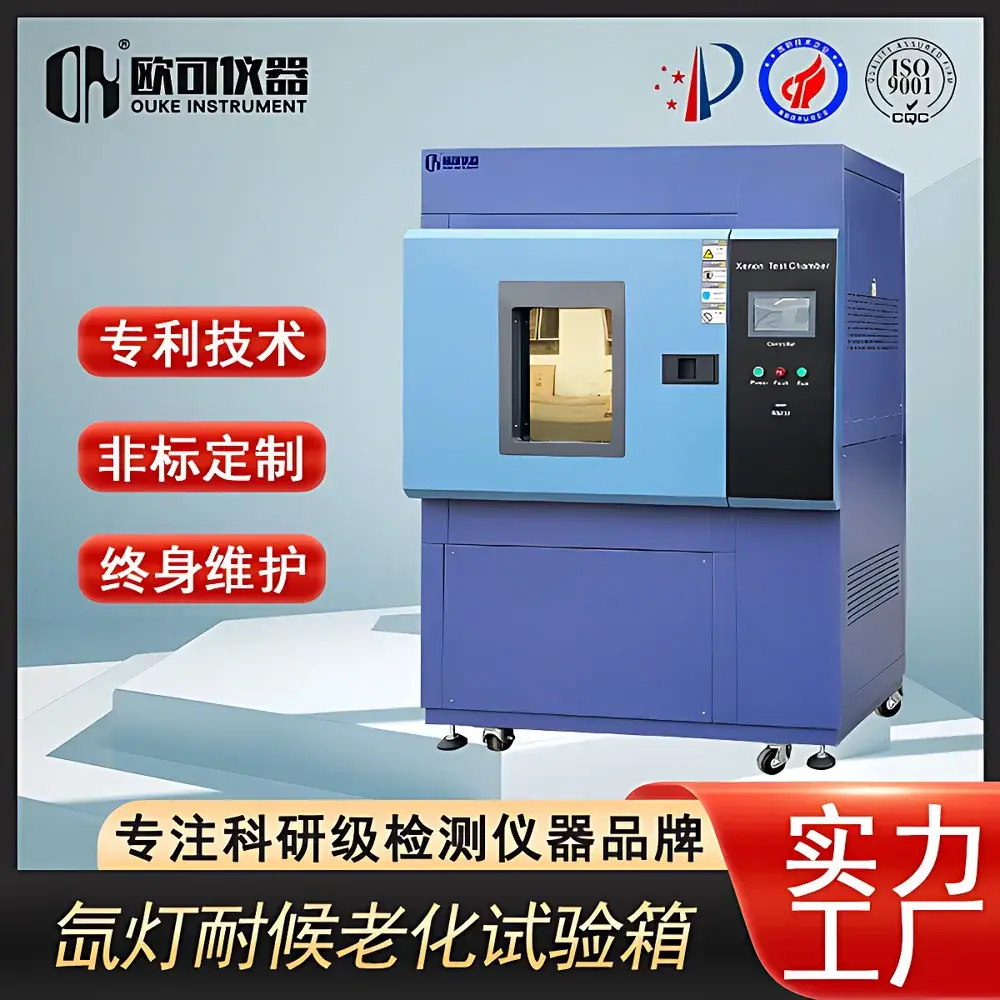
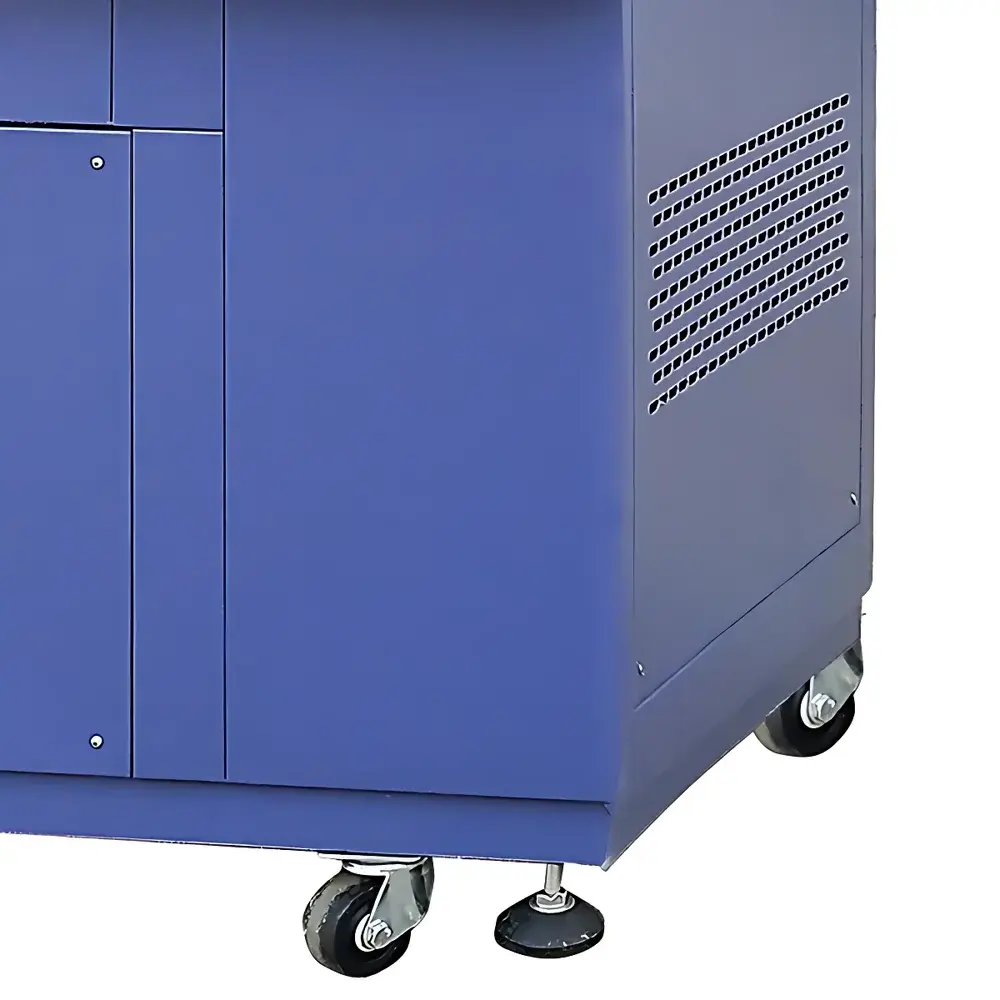

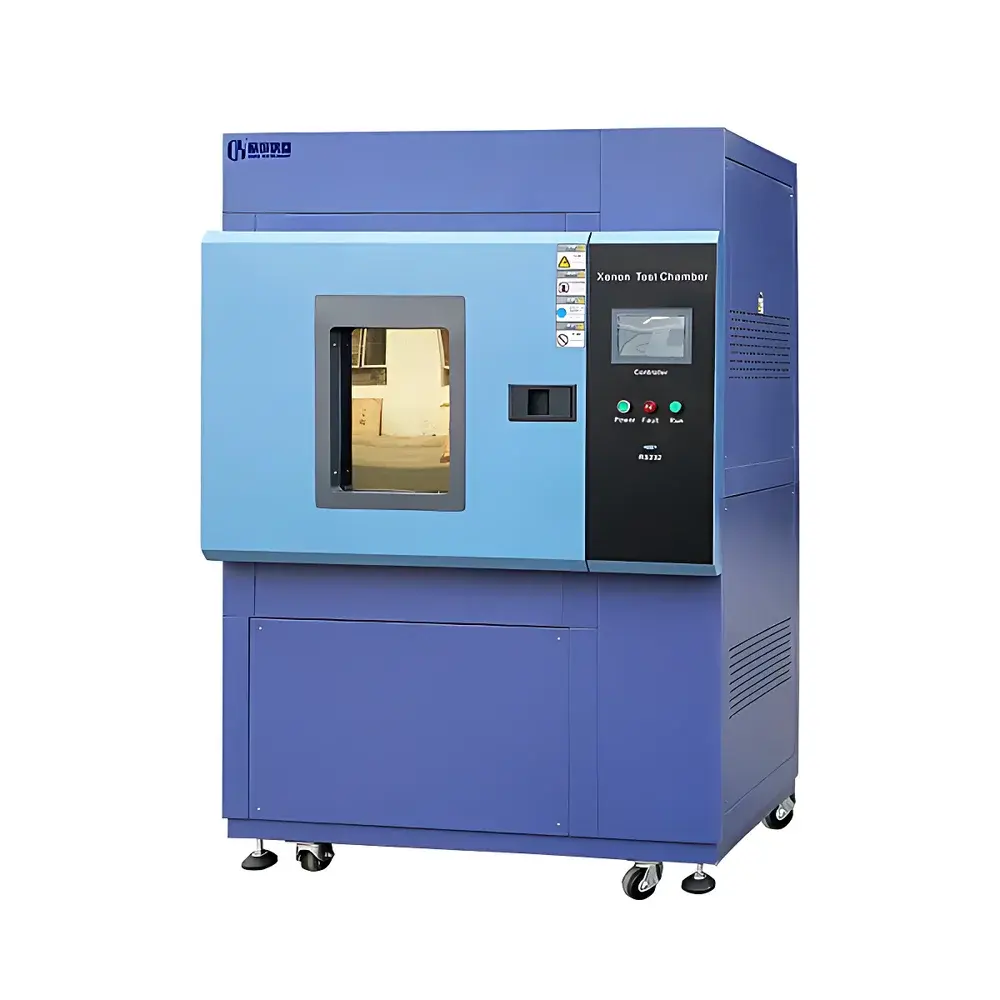
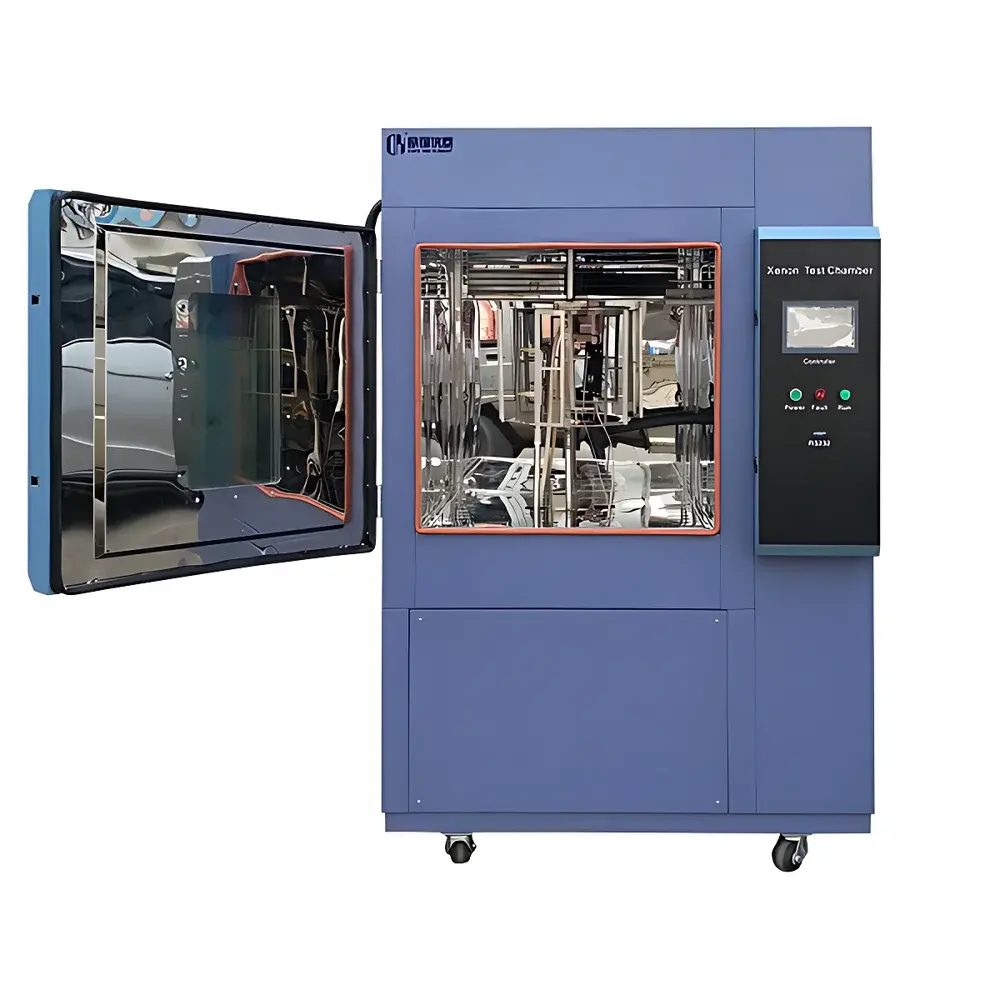
OK-XD-100 Xenon Arc Weathering Test Chamber
| Brand | OK Instruments |
|---|---|
| Origin | Guangdong, China |
| Manufacturer Type | Direct Manufacturer |
| Model | OK-XD-100 |
| Xenon Lamp Power | 1.8 kW |
| Spectral Irradiance Range | 300–800 nm |
| Nominal Irradiance | 550 W/m² ±10% (broadband, 300–800 nm) |
| Light Cycle Duration | 1–999 h/min/sec (programmable) |
| Humidity Range (Light Cycle) | 20–75% RH |
| Cooling Method | Water-cooled lamp system |
| Filter Options | Daylight, Window Glass, Extended UV |
Overview
The OK-XD-100 Xenon Arc Weathering Test Chamber is an engineered environmental simulation system designed to replicate the synergistic effects of solar radiation, temperature, humidity, and water exposure under controlled laboratory conditions. It employs a high-intensity, water-cooled xenon arc lamp whose spectral power distribution closely matches natural sunlight—particularly across the critical 300–800 nm range encompassing UV-A, UV-B, visible, and near-infrared wavelengths. This spectral fidelity enables accurate acceleration of photochemical degradation mechanisms such as polymer chain scission, pigment bleaching, surface oxidation, and hydrolytic breakdown. Unlike UV fluorescent or metal halide sources, xenon arc technology provides full-spectrum irradiation essential for evaluating real-world material behavior—including spectral sensitivity mismatches that may arise with narrow-band UV sources. The chamber integrates precision climate control to maintain defined black panel temperature (BPT), air temperature, relative humidity, and programmable spray/cold-condensation cycles—enabling compliance with internationally recognized weathering protocols.
Key Features
- Water-cooled 1.8 kW xenon lamp assembly with integrated quartz envelope and stable arc ignition—ensuring long-term spectral stability and reduced thermal drift.
- Interchangeable optical filter systems: daylight-filtered (ISO 4892-2), window-glass-filtered (SAE J2527, ISO 4892-3), and extended-UV-filtered configurations for application-specific spectral tailoring.
- Digital irradiance control via broadband (300–800 nm) radiometric sensor with closed-loop feedback—maintaining ±10% irradiance tolerance over time and across test area.
- Programmable multi-segment test profiles: independent control of light/dark phases, irradiance setpoints, BPT (30–110°C), chamber air temperature (10–80°C), RH (20–75% RH during light cycle), and spray duration/frequency.
- Rotating sample drum (standard) or flat-bed sample holder options—guaranteeing uniform irradiance distribution (±5% spatial uniformity per ASTM G155 Annex A1).
- Touchscreen HMI with embedded data logging (min. 10,000 data points), USB export, and optional Ethernet interface for remote monitoring and audit-trail generation.
Sample Compatibility & Compliance
The OK-XD-100 accommodates rigid and flexible specimens up to 100 mm in thickness and 500 mm × 500 mm in planar dimension. Compatible substrates include thermoplastics, thermosets, elastomers, coatings, textiles, composites, adhesives, and photovoltaic encapsulants. Its operational parameters align with key international standards governing accelerated weathering, including ISO 4892-2 (plastics), ISO 16474-2 (paints and varnishes), ASTM G155 (non-metallic materials), ASTM D7869 (automotive exterior components), AATCC TM16 (textiles), GB/T 16422.2 (China), and GB/T 1865 (coatings). For regulated industries, the system supports GLP-compliant operation through user-access-level controls, electronic signature capability (optional), and full parameter traceability—facilitating FDA 21 CFR Part 11 readiness when paired with validated software.
Software & Data Management
The embedded controller records time-stamped values for irradiance, BPT, chamber temperature, RH, and spray status at user-defined intervals (1–600 sec). Data exports directly to CSV format for post-test analysis in Excel or statistical software. Optional PC-based OK-WeatherLink software provides advanced features: multi-chamber fleet monitoring, automated report generation (PDF/Excel), deviation alerting, calibration certificate management, and secure user role assignment (Administrator, Operator, Reviewer). All logged events—including parameter changes, alarm triggers, and maintenance logs—are retained with timestamps and operator IDs to support internal audits and regulatory inspections.
Applications
- Automotive: Validation of instrument panel films, door trims, headlamp lenses, and exterior paint systems against OEM specifications (e.g., VW PV 3929, GMW 14124).
- Coatings & Inks: Quantification of gloss retention, color shift (ΔE*cmc), chalking, cracking, and blistering per ISO 11341 and ASTM D4587.
- Polymers & Elastomers: Monitoring tensile strength loss, elongation-at-break reduction, and surface microcracking in polyolefins, PVC, TPEs, and EPDM seals.
- Textiles & Leather: Assessment of colorfastness to light per ISO 105-B02 and AATCC TM16, including wet/dry crocking correlation studies.
- Building Materials: Durability testing of roofing membranes, sealants, cladding panels, and outdoor flooring under cyclic UV/humidity stress.
- Photovoltaics: Evaluation of backsheet yellowing, adhesive delamination, and EVA discoloration per IEC 61215-2 MQT10.
FAQ
What spectral filters are included standard with the OK-XD-100?
The system ships with a daylight filter (CIE No. 1) compliant with ISO 4892-2. Window glass and extended UV filters are available as optional accessories.
Is irradiance calibrated at a specific wavelength (e.g., 340 nm) or broadband?
Standard configuration uses broadband (300–800 nm) irradiance control. Single-wavelength monitoring (e.g., 340 nm or 420 nm) is available as an upgrade with calibrated UV sensors and corresponding filter sets.
Can the chamber operate without water spray during dark cycles?
Yes. Spray function is fully decoupled from light/dark sequencing—allowing independent activation during light, dark, or cold-condensation phases.
What is the typical service life of the xenon lamp under continuous operation?
Rated lamp life is ≥1,500 hours at nominal power; actual lifespan depends on operating irradiance setpoint, cooling efficiency, and cycling frequency.
Does the OK-XD-100 support automatic recalibration of irradiance sensors?
No—radiometric sensors require periodic verification using NIST-traceable reference meters. The system logs all calibration dates and allows manual entry of verification reports.



