
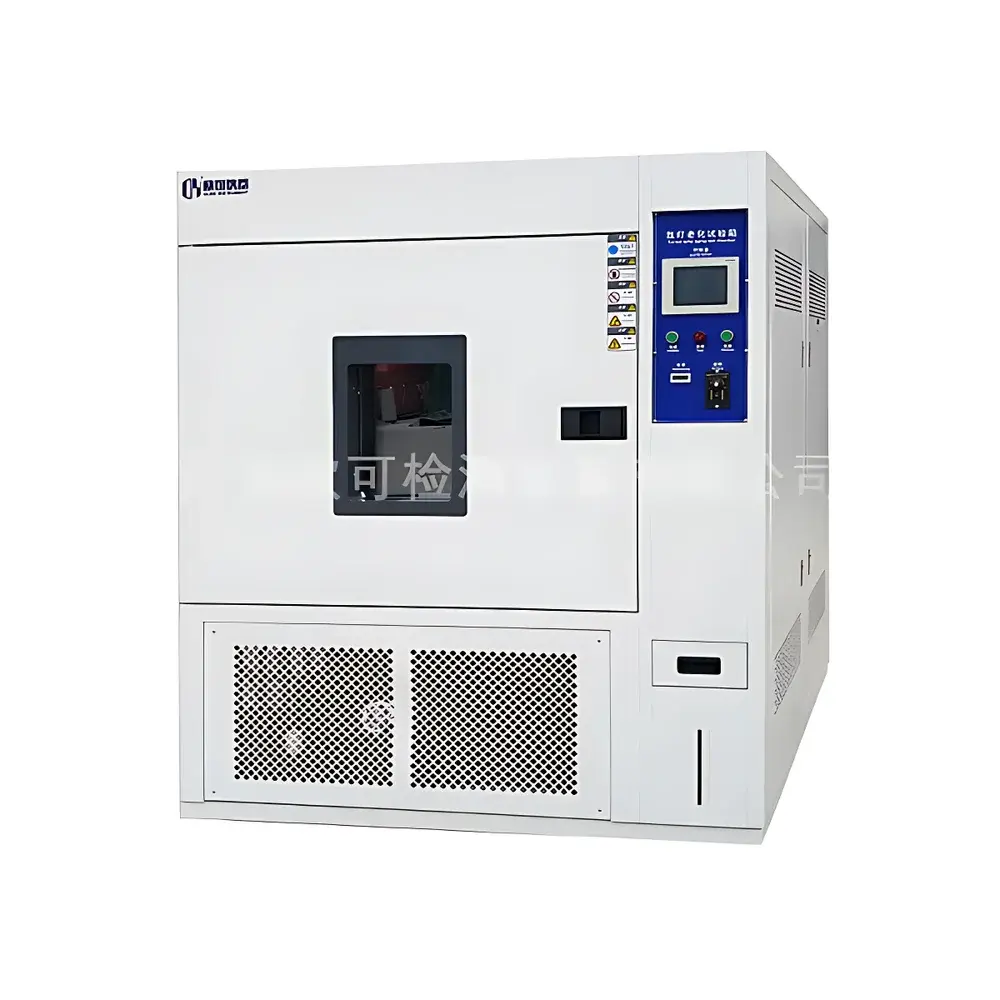
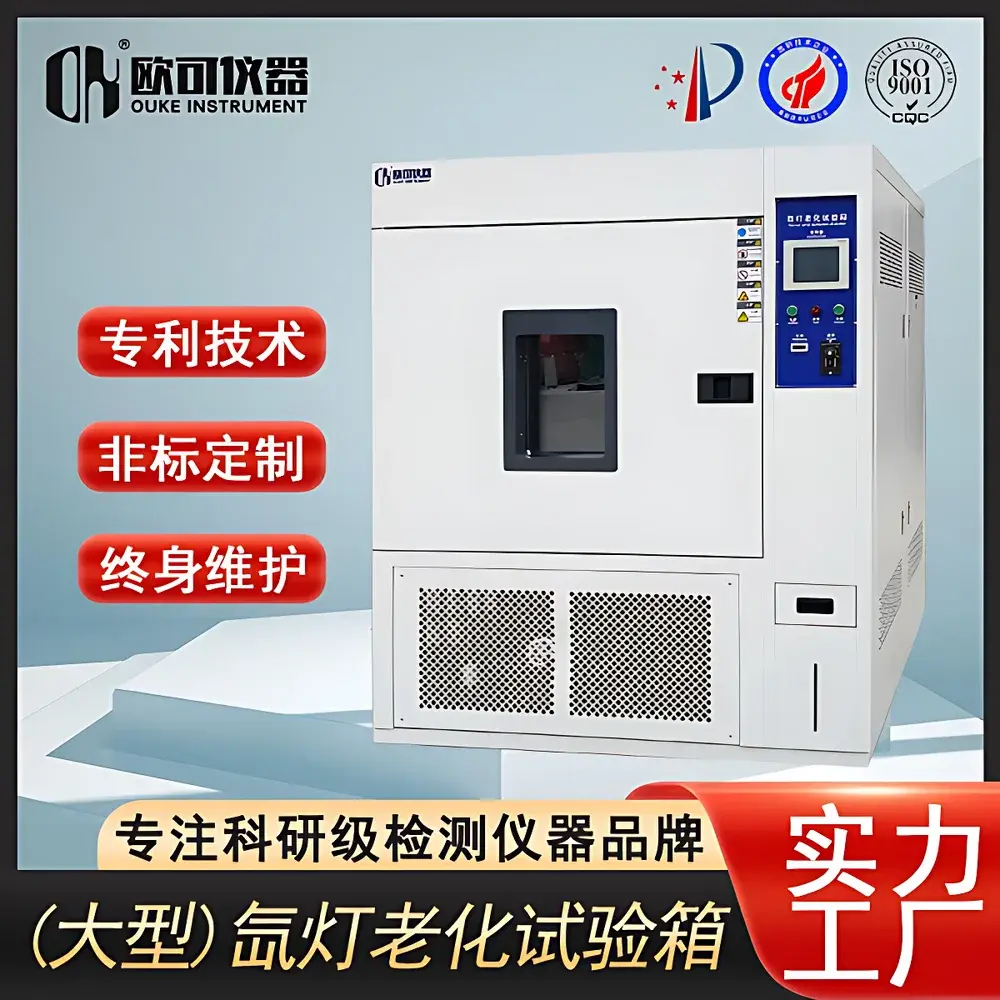
OK-XD-1000.00 Xenon Arc Weathering Test Chamber
| Brand | OK Instruments |
|---|---|
| Origin | Guangdong, China |
| Manufacturer Type | OEM/ODM Manufacturer |
| Model | OK-XD-1000.00 |
| Xenon Lamp Power | 6 kW |
| Irradiance Range | ≤1200 W/m² |
| Light Cycle Programmability | 1–999 h/min/sec (continuous adjustable) |
| Humidity Range (Light Cycle) | 20–75 %RH |
| Compliance | ISO 4892-2, ASTM G155, GB/T 16422.2, ISO 11341, ASTM D6695 |
Overview
The OK-XD-1000.00 Xenon Arc Weathering Test Chamber is an engineered environmental simulation system designed to replicate the complex, synergistic effects of natural outdoor exposure—primarily solar radiation, thermal cycling, humidity, and moisture ingress—in a controlled laboratory setting. At its core, the chamber utilizes a 6 kW water-cooled xenon arc lamp as the primary light source, generating a continuous spectrum closely approximating terrestrial sunlight (290–2500 nm), including biologically and photochemically active UV-B, UV-A, visible, and near-infrared wavelengths. Unlike narrowband UV sources, xenon arc technology enables physiologically relevant photodegradation pathways—such as polymer chain scission, chromophore bleaching, and hydrolytic degradation—by delivering both radiant energy and thermal load in proportion to real-world conditions. This makes the OK-XD-1000.00 particularly suitable for evaluating color stability, gloss retention, surface cracking, chalking, tensile strength loss, and adhesion failure across diverse material classes under accelerated yet metrologically traceable conditions.
Key Features
- High-fidelity spectral output via calibrated quartz envelope xenon lamp and interchangeable optical filters (e.g., Daylight-Q, Window Glass-Q) to match target irradiance profiles per ISO 4892-2 and ASTM G155.
- Integrated black panel thermometer (BPT) and air temperature control system, maintaining specimen surface temperatures within ±2 °C accuracy during irradiation cycles.
- Programmable humidity control (20–75 %RH during light phase) with precision capacitive RH sensors and steam-based humidification—fully decoupled from cooling demand.
- Automated spray and condensation modules compliant with ISO 4892-2 cycle definitions: intermittent deionized water spraying simulates rainfall; controlled condensation periods replicate nocturnal dew formation.
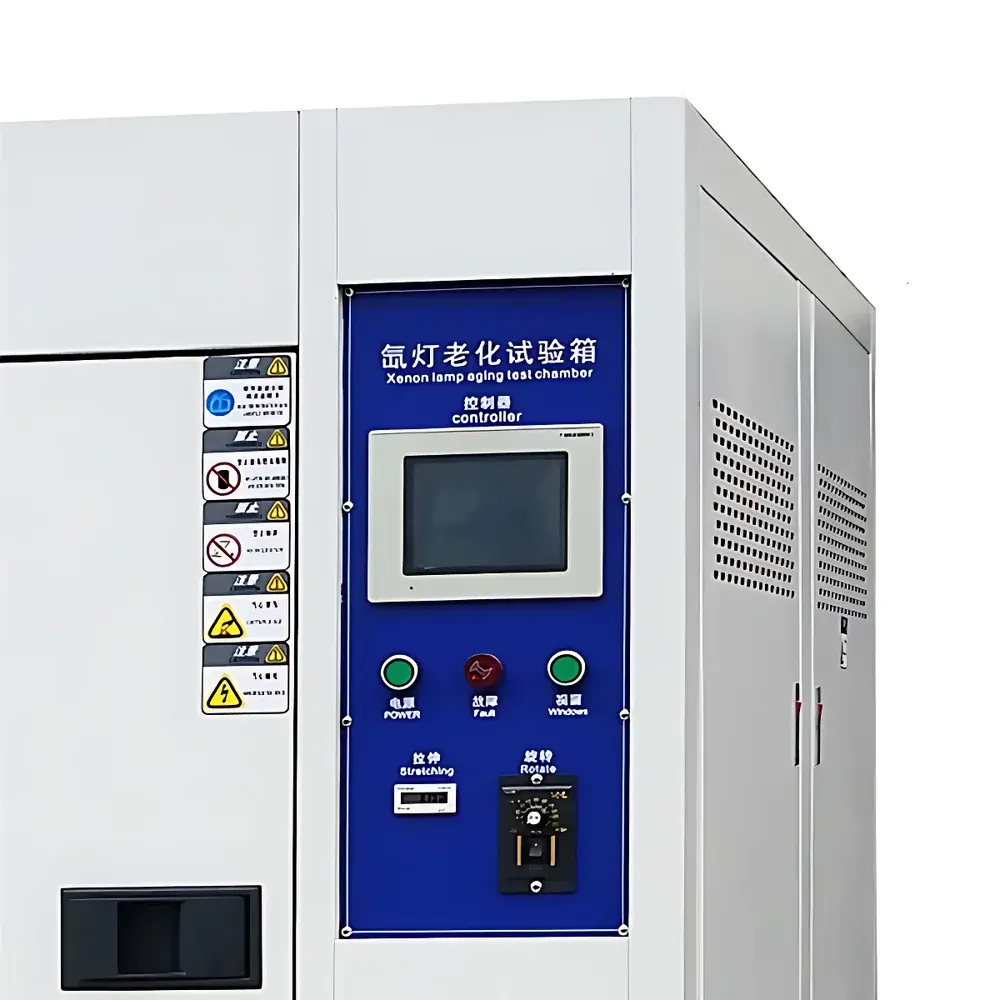
- 7-inch industrial-grade touchscreen controller supporting multi-step test profiles—including simultaneous or sequential modulation of irradiance, temperature, humidity, and spray—with real-time data logging at 1-second intervals.
- Rotating sample carousel (360° continuous rotation) ensuring uniform irradiance distribution (±5 % spatial uniformity across 1200 cm² exposure area) and minimizing edge-shadowing artifacts.
Sample Compatibility & Compliance
The OK-XD-1000.00 accommodates flat-panel specimens up to 100 × 100 mm (standard configuration), with optional fixtures for 3D automotive trim, textile swatches, or extruded profiles. All operational parameters adhere strictly to internationally recognized weathering standards: ISO 4892-2 (plastics), ISO 11341 (coatings), ASTM G155 (non-metallic materials), ASTM D6695 (automotive coatings), GB/T 16422.2 (Chinese national standard for plastics), and GB/T 1865 (paints and varnishes). The system supports full audit trails and calibration records aligned with GLP requirements. Optional irradiance monitoring via NIST-traceable broadband radiometer enables compliance with ASTM G177 spectral power distribution verification protocols.
Software & Data Management
The embedded control firmware supports export of time-stamped CSV datasets containing irradiance (W/m²), BPT temperature (°C), chamber air temperature (°C), RH (%), spray status, and elapsed cycle time. Data integrity is preserved through internal non-volatile memory with battery backup. For integration into enterprise QA/QC workflows, optional Ethernet/IP connectivity enables remote monitoring and data ingestion into LIMS platforms. While the base system does not include FDA 21 CFR Part 11-compliant electronic signature functionality, it provides the foundational data structure—user access logs, parameter change history, and immutable timestamped records—required for validation under GMP/GLP environments when deployed with validated third-party software layers.
Applications
This chamber serves critical roles across R&D, quality assurance, and regulatory submission pathways. In automotive engineering, it validates exterior trim durability per SAE J2412 and interior material fade resistance per ISO 105-B02. In architectural coatings, it quantifies chalk resistance per ASTM D4214 and gloss retention per ASTM D523. Polymer compounders use it to rank stabilizer package efficacy under cyclic UV/heat/humidity stress. Photovoltaic manufacturers assess backsheet yellowing and delamination kinetics per IEC 61215. Textile labs apply it for ISO 105-B02 colorfastness-to-light testing. Its ability to reproduce spectral, thermal, and hygric synergies makes it indispensable where UV-only testing fails to predict field performance—especially for pigmented thermoplastics, silicone sealants, and fluoropolymer membranes.
FAQ
What spectral filter options are available for this model?
Standard configurations include Daylight-Q (for open-sky simulation) and Window Glass-Q (for indoor/behind-glass exposure); custom filters can be integrated upon request.
Does the system support automatic irradiance compensation?
Yes—the controller continuously monitors lamp output via internal reference sensor and dynamically adjusts power supply to maintain setpoint irradiance within ±5 % over lamp lifetime.
Is calibration documentation provided with shipment?
Each unit ships with factory calibration certificates for temperature, humidity, and irradiance sensors, traceable to national metrology institutes.
Can the chamber operate unattended for extended cycles?
Fully—equipped with safety interlocks, lamp overheat protection, water-level monitoring, and email/SMS alert capability via optional IoT module.
What maintenance intervals are recommended for optimal performance?
Xenon lamp replacement every 1500 hours; quartz filter cleaning weekly; full optical alignment and radiometric recalibration annually or after lamp/filter replacement.



