
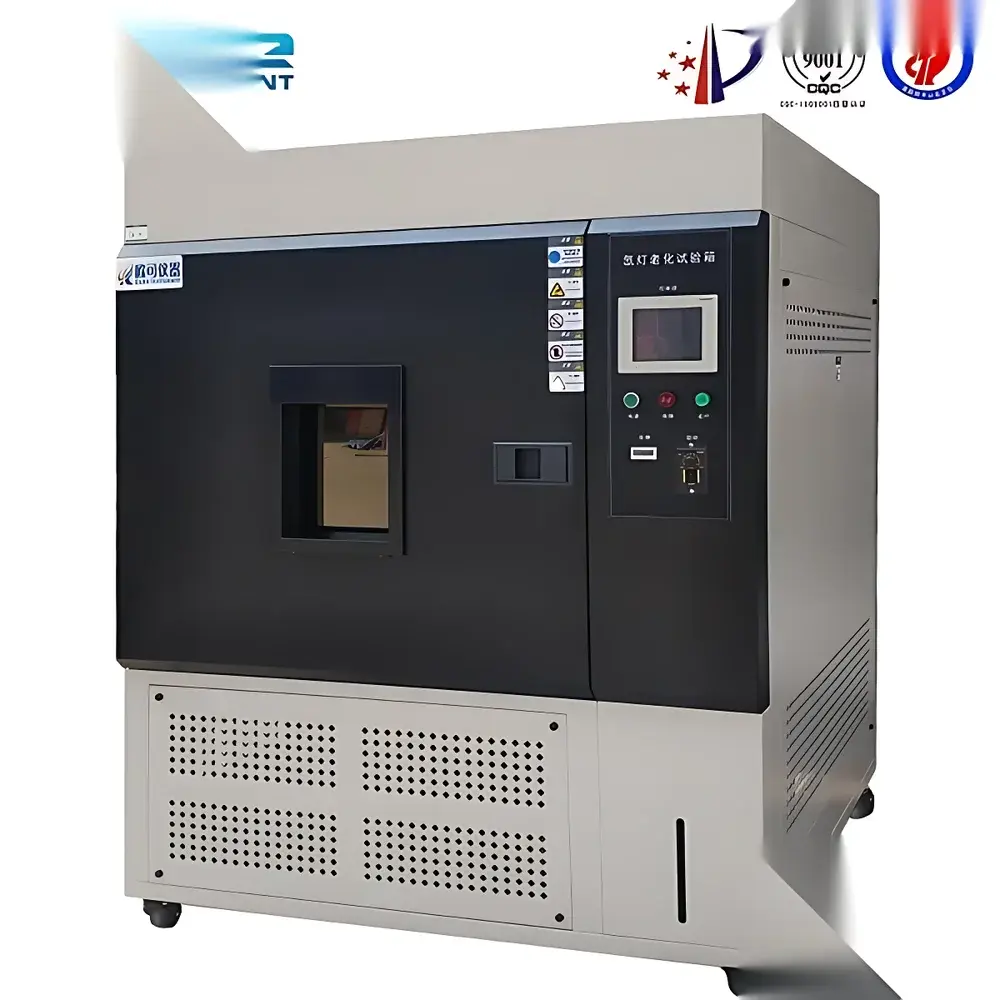
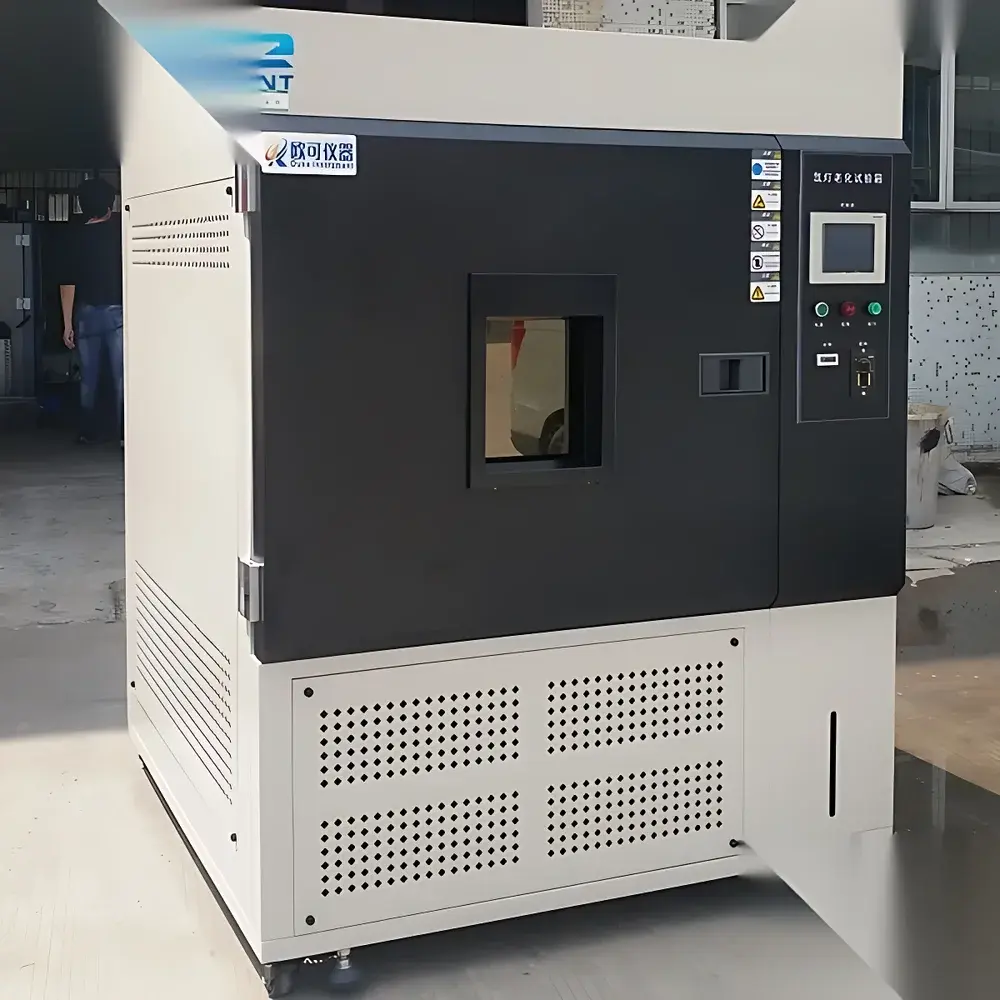
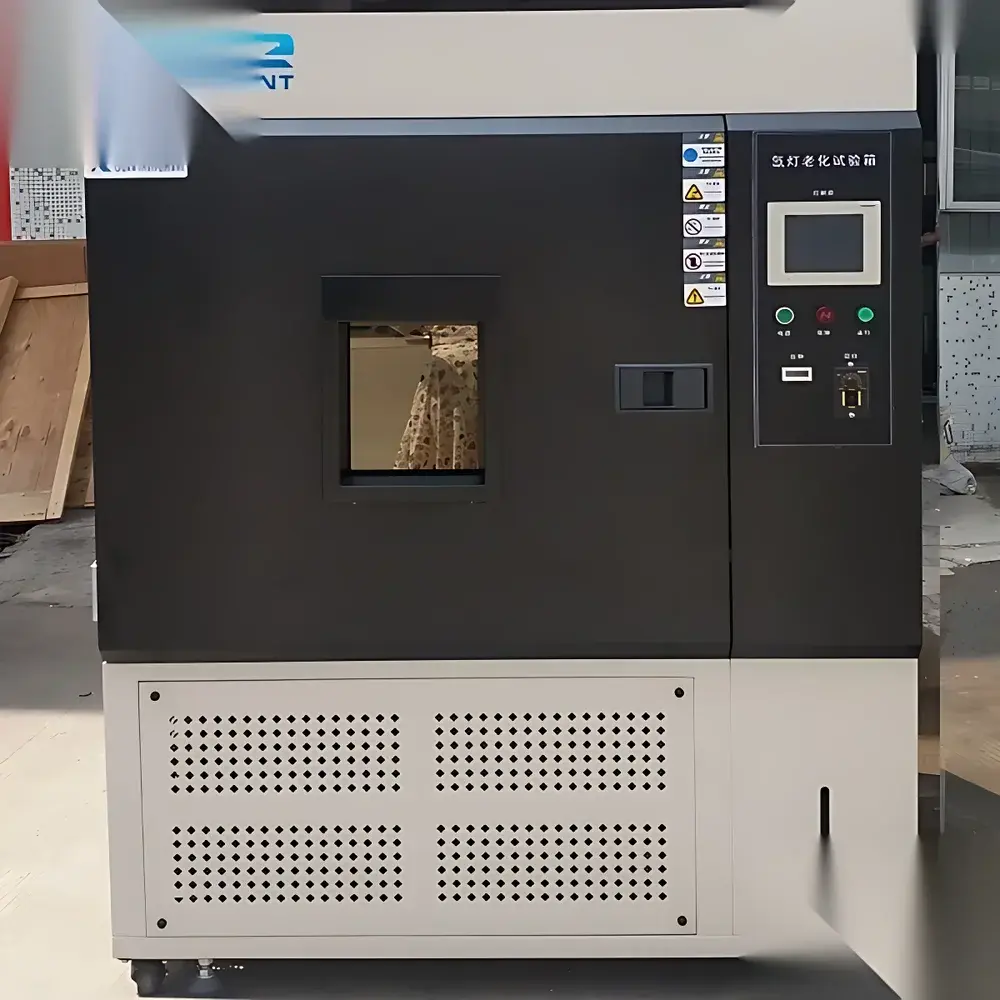
OK-XD-1000 Xenon Arc Weathering Test Chamber
| Brand | OEM / Custom Brand |
|---|---|
| Origin | Imported |
| Manufacturer Type | Authorized Distributor |
| Price | USD 5,200 (Reference Only) |
| Internal Dimensions (W×D×H) | 1000 × 1000 × 1000 mm |
| Sample Tray Size | 530 × 730 mm |
| Temperature Range | 40–80 °C (adjustable) |
| Humidity Range | 40–95 %RH (adjustable) |
| Black Panel Temperature | 40–100 °C ±3 °C |
| Temp. Uniformity | ±2.0 °C |
| Temp. Stability | ±0.5 °C |
| Xenon Lamp | 2 kW single-lamp configuration |
| Lamp Life | 1000 h |
| Irradiance Spectrum | 290–800 nm |
| Sample-to-Lamp Distance | 230–280 mm |
| Rain Cycle Time | 0–9999 min (continuous) |
| Intermittent Rain Interval | 0–240 min |
| Water Spray Cycle | 18 min ON / 102 min OFF or 12 min ON / 48 min OFF |
| Spray Pressure | 0.12–0.15 MPa |
| Nozzle Orifice | Ø0.8 mm |
| Heating Power | 2 kW |
| Humidification Power | 1.2 kW |
Overview
The OK-XD-1000 Xenon Arc Weathering Test Chamber is an engineered environmental simulation system designed to replicate the combined effects of solar radiation, temperature, and moisture on polymeric materials—particularly elastomers such as natural rubber, SBR, EPDM, and silicone compounds. Based on ISO 4892-2, ASTM G155, and SAE J2527 standards, it employs a stabilized 2 kW air-cooled xenon arc lamp with spectral output filtered to match terrestrial sunlight (290–800 nm), enabling accelerated aging assessments under controlled irradiance, thermal, and hygrothermal stress conditions. Its robust chamber architecture ensures high reproducibility across test cycles, supporting comparative durability studies during material formulation, quality control, and regulatory compliance validation.
Key Features
- Single-lamp 2 kW xenon arc source with calibrated UV-visible spectral output (290–800 nm), compliant with CIE 85:2014 spectral irradiance requirements for weathering simulation
- Precisely regulated black panel temperature control (40–100 °C ±3 °C) and chamber air temperature (40–80 °C ±0.5 °C), monitored via dual Pt100 sensors
- Dynamic humidity control (40–95 %RH) using steam-based humidification with independent condensate management
- Programmable water spray system featuring two configurable cycles (18/102 min or 12/48 min) and adjustable intermittent rain intervals (0–240 min)
- Stainless steel 316L inner chamber with insulated double-wall construction, minimizing thermal gradients (uniformity ±2.0 °C)
- Sample tray (530 × 730 mm) mounted on a rotating carousel (optional) or fixed platform, adjustable distance from lamp (230–280 mm) to optimize irradiance exposure
- Integrated safety interlocks including lamp overheat protection, door-open shutdown, and water-level monitoring
Sample Compatibility & Compliance
The OK-XD-1000 accommodates flat-sheet specimens up to 530 × 730 mm and thickness ≤25 mm, suitable for vulcanized rubber strips, molded seals, hose sections, and coated substrates. It supports standardized specimen mounting per ISO 3696 (Grade 3 water for spray), ASTM D4329 (specimen orientation), and GB/T 16422.2 (Chinese national standard for xenon testing). The chamber meets essential requirements for GLP-compliant laboratories—including audit-ready calibration traceability, documented maintenance logs, and user-accessible sensor verification protocols. While not pre-certified to FDA 21 CFR Part 11, its data logging architecture supports integration with validated LIMS environments requiring electronic signature and change control capabilities.
Software & Data Management
The system operates via an embedded industrial-grade controller with a 7-inch TFT touchscreen interface, supporting multi-step test programs with up to 99 segments. Real-time parameters—including irradiance (measured via integrated broadband sensor), black panel temperature, chamber RH, and spray status—are logged at user-defined intervals (1–60 sec) and exportable in CSV format. Optional Ethernet connectivity enables remote monitoring and centralized data aggregation via Modbus TCP or OPC UA protocols. All operational events (lamp ignition, cycle transitions, alarms) are timestamped with UTC synchronization, fulfilling basic ALCOA+ principles for raw data integrity in QC/QA workflows.
Applications
- Evaluation of UV resistance and surface degradation (chalking, cracking, discoloration) in automotive rubber components exposed to roadside ozone and solar flux
- Accelerated service-life prediction for roofing membranes, conveyor belts, and railway suspension bushings under cyclic wet/dry conditions
- Comparative analysis of antioxidant package efficacy across synthetic rubber formulations (e.g., NBR vs. HNBR under elevated black panel temperature)
- Prequalification of rubber-to-metal bonded assemblies prior to outdoor exposure per ASTM D4145
- Supporting ISO 1431-1 ozone resistance correlation studies when combined with post-test tensile retention measurements
FAQ
What standards does the OK-XD-1000 comply with for rubber weathering testing?
It is configured to meet core requirements of ISO 4892-2, ASTM G155, and GB/T 16422.2; users must validate irradiance calibration annually using a NIST-traceable spectroradiometer.
Can the chamber accommodate non-flat rubber specimens, such as O-rings or extrusions?
Yes—custom sample holders (e.g., vertical racks or tensioned mandrels) can be installed within the 1000 mm³ workspace, provided total projected area remains within irradiance uniformity limits.
Is lamp spectral output stable over its 1000-hour service life?
Output degrades gradually; irradiance compensation mode is available to maintain setpoint intensity by increasing lamp power, subject to manufacturer-specified maximum voltage limits.
Does the system include humidity calibration documentation?
A factory-issued humidity calibration certificate (per ISO/IEC 17025) is provided; field recalibration requires chilled-mirror hygrometer verification.
How is water quality managed for the spray system?
Deionized water (resistivity ≥1 MΩ·cm) is required; optional built-in DI water recirculation module reduces consumable usage and minimizes nozzle clogging.



