
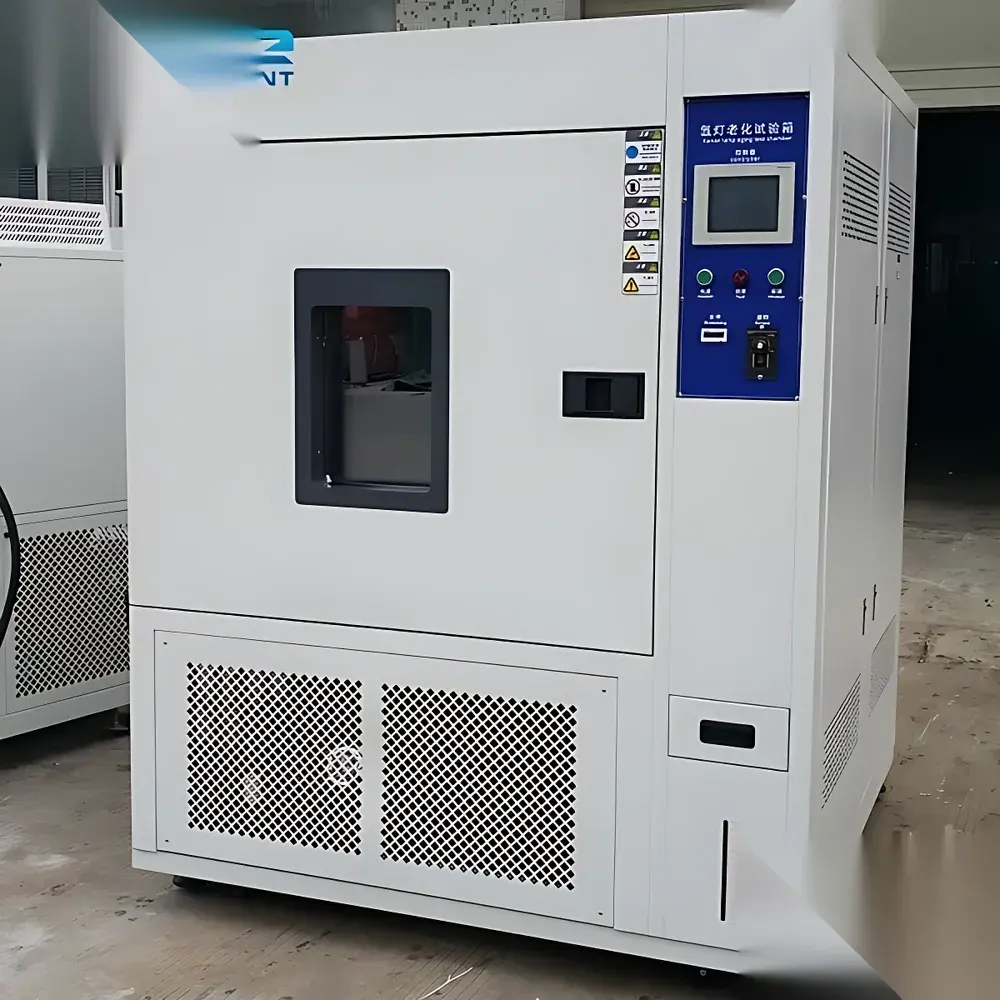
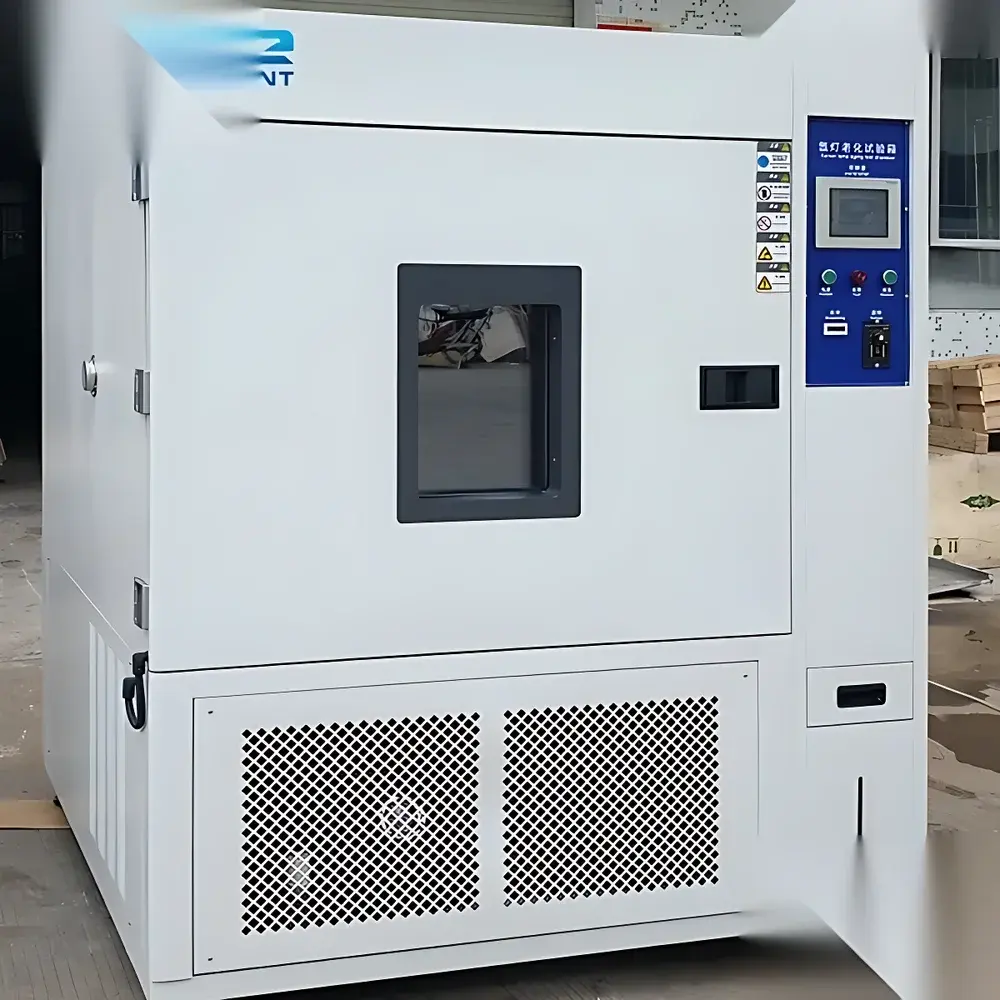
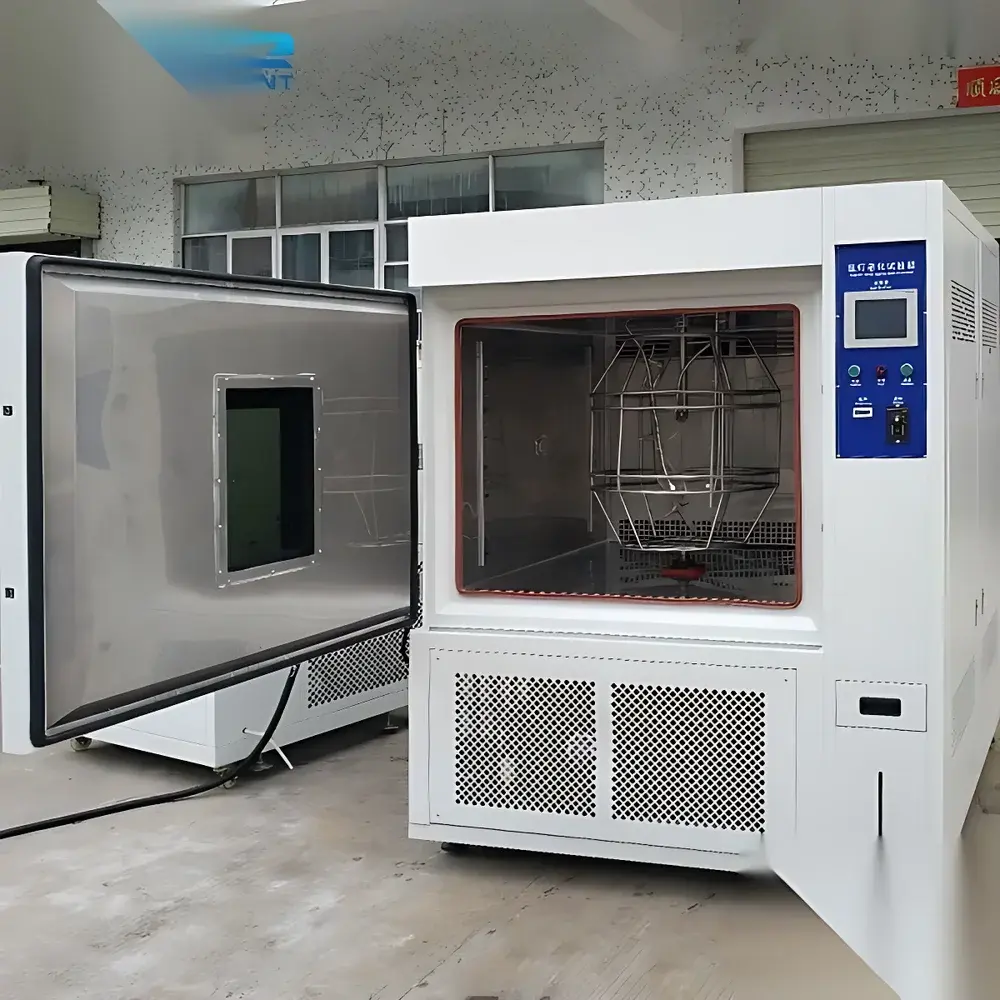
OK-XD-200 Air-Cooled Xenon Arc Weathering Test Chamber
| Brand | OEM / Third-Party Manufacturer |
|---|---|
| Origin | Imported |
| Supplier Type | Authorized Distributor |
| Price Reference | USD 5,200 (excl. tax & freight |
| Effective Irradiation Area | 900 × 210 mm (W × H) |
| Standard Specimen Size | 75 × 150 mm or 75 × 300 mm |
| UV Irradiance | UVB-313: 0.55 W/m² |
| UVA-340 | 0.68 W/m² |
| Temperature Resolution | 0.1 °C |
| Light Cycle Temperature Range | 50–70 °C (±3 °C tolerance) |
| Condensation Temperature Range | 40–60 °C (±3 °C tolerance) |
| Black Panel Thermometer Range | 30–80 °C (±1 °C tolerance) |
| Water Tray Depth | Auto-controlled |
| External Dimensions | Approx. H1550 × W1350 × D510 mm |
| Lamp Center-to-Center Spacing | 70 mm |
| Minimum Specimen-to-Lamp Distance | ~50 mm |
| Spectral Range (UV-A) | 315–400 nm |
| Humidity Range | 30–80 %RH (light cycle) |
| Humidification Method | Steam generation via SUS304 stainless steel heater and reservoir |
| Humidity Sensor Type | Dry/Wet Bulb |
Overview
The OK-XD-200 Air-Cooled Xenon Arc Weathering Test Chamber is engineered for precise simulation of terrestrial solar radiation, thermal cycling, humidity, rain, and dark condensation—key environmental stressors affecting material durability. It employs a stabilized 2.5 kW air-cooled xenon arc lamp as its spectral source, filtered through borosilicate outer and quartz inner filters to replicate the global solar spectrum (290–800 nm) with high fidelity. Unlike water-cooled systems, this design eliminates dependency on external cooling water infrastructure, reducing installation complexity while maintaining stable irradiance output and lamp lifetime. The chamber operates under closed-loop microprocessor control (PID algorithm), enabling reproducible exposure profiles compliant with international accelerated weathering protocols. Its primary function is to quantify degradation mechanisms—including color shift (ΔE), gloss loss, chalking, cracking, embrittlement, and polymer oxidation—in polymeric, coated, textile, and composite materials subjected to long-term outdoor service.
Key Features
- Stainless steel 304 construction for both inner and outer chambers, ensuring corrosion resistance and long-term structural integrity in high-humidity and UV-rich environments.
- Microprocessor-based digital temperature controller with PID tuning, delivering ±0.1 °C resolution and ±3 °C uniformity across the irradiation zone during light cycles.
- Adjustable specimen rack system fabricated from stainless steel and aluminum alloy, supporting standardized sample dimensions (75 × 150 mm or 75 × 300 mm) and facilitating rapid loading/unloading without tooling.
- Integrated black panel thermometer (BPT) with ±1 °C accuracy, mounted adjacent to test specimens to monitor surface-relevant thermal exposure—critical for correlating lab data with real-world performance.
- Steam-based humidification system featuring SUS304 stainless steel heating elements and reservoir, coupled with dry/wet bulb humidity sensing for reliable RH control between 30–90 %RH across light/dark phases.
- Automated water level management in the condensation tray, eliminating manual refilling and minimizing operator intervention during extended test sequences.
Sample Compatibility & Compliance
The OK-XD-200 accommodates flat, rigid, or semi-flexible specimens up to 300 mm in length, with standard mounting configurations compatible with ISO, ASTM, and GB specimen holders. Its optical geometry—defined by 70 mm lamp center spacing and ~50 mm minimum specimen-to-lamp distance—ensures uniform irradiance distribution within the 900 × 210 mm active exposure area. The system meets full regulatory alignment with ASTM D4329, D4587, D499, D5208, G154, and G53; ISO 4892-3 and ISO 11507; EN 534 and prEN 1062-4; JIS D0205; SAE J2020; and Chinese national standards GB/T 14522, GB/T 16422.2, GB/T 1865, GB/T 8427, GB/T 8430, and GB/T 2423.24. All exposure cycles—including irradiance setpoints, temperature ramps, humidity transitions, and spray/condensation intervals—are programmable to match specific test method requirements without hardware modification.
Software & Data Management
While the base configuration utilizes embedded digital controllers with local parameter setting and real-time monitoring, optional RS485/Modbus RTU interface enables integration into centralized laboratory data acquisition networks. Logged parameters—including irradiance (W/m²), black panel temperature (°C), chamber air temperature (°C), relative humidity (%RH), and elapsed exposure time—are timestamped and exportable via USB or serial connection. The system supports audit-trail-capable operation when paired with validated third-party LIMS or ELN platforms, satisfying GLP and GMP documentation prerequisites per FDA 21 CFR Part 11 where electronic records are required. Calibration certificates for irradiance sensors and temperature/humidity transducers are traceable to NIST or equivalent national metrology institutes.
Applications
This chamber serves R&D, QC, and regulatory testing laboratories across industries requiring quantitative assessment of photochemical stability. Key application domains include automotive exterior trim and coatings (e.g., PP/TPO blends, acrylic urethanes), architectural coatings (acrylic-silicone hybrids, fluoropolymers), packaging films (PET, BOPP, metallized laminates), textile dye fastness evaluation, cosmetic packaging UV resistance validation, and aerospace sealant aging studies. It is routinely deployed for comparative benchmarking against reference materials (e.g., blue wool standards), qualification of new pigment systems, and failure analysis of field-failed components where solar exposure is suspected as a root cause.
FAQ
What spectral filters are included with the OK-XD-200?
Standard configuration includes borosilicate outer filter (Daylight-Q) and fused quartz inner filter, delivering a solar-spectrum match optimized for ISO 4892-3 and ASTM G155 Class A exposure conditions.
Can the chamber perform cyclic tests involving rain simulation?
No—this is an air-cooled xenon chamber without integrated water spray nozzles. Rain simulation requires optional retrofit or selection of a water-cooled model with spray capability.
Is calibration documentation provided with shipment?
Yes—each unit ships with factory calibration reports for irradiance sensor, black panel thermometer, and humidity sensor, all traceable to accredited metrology standards.
What maintenance intervals are recommended for the xenon lamp and filters?
Lamp replacement is advised every 1,500 hours of operation; outer and inner filters require replacement every 500 hours or upon visible discoloration or transmission loss.
Does the system support remote monitoring or network connectivity?
RS485 Modbus RTU is standard; Ethernet/IP or OPC UA integration is available via optional gateway modules for enterprise-level SCADA or MES connectivity.



