
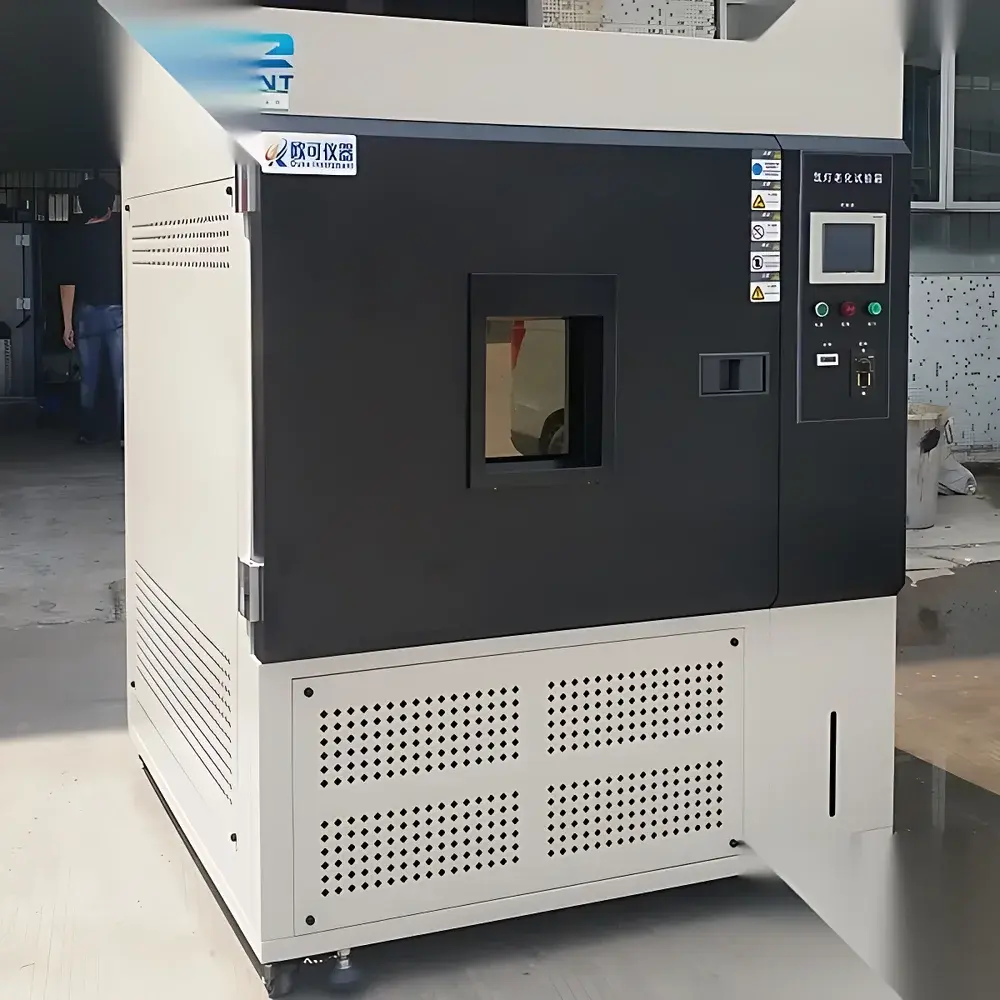
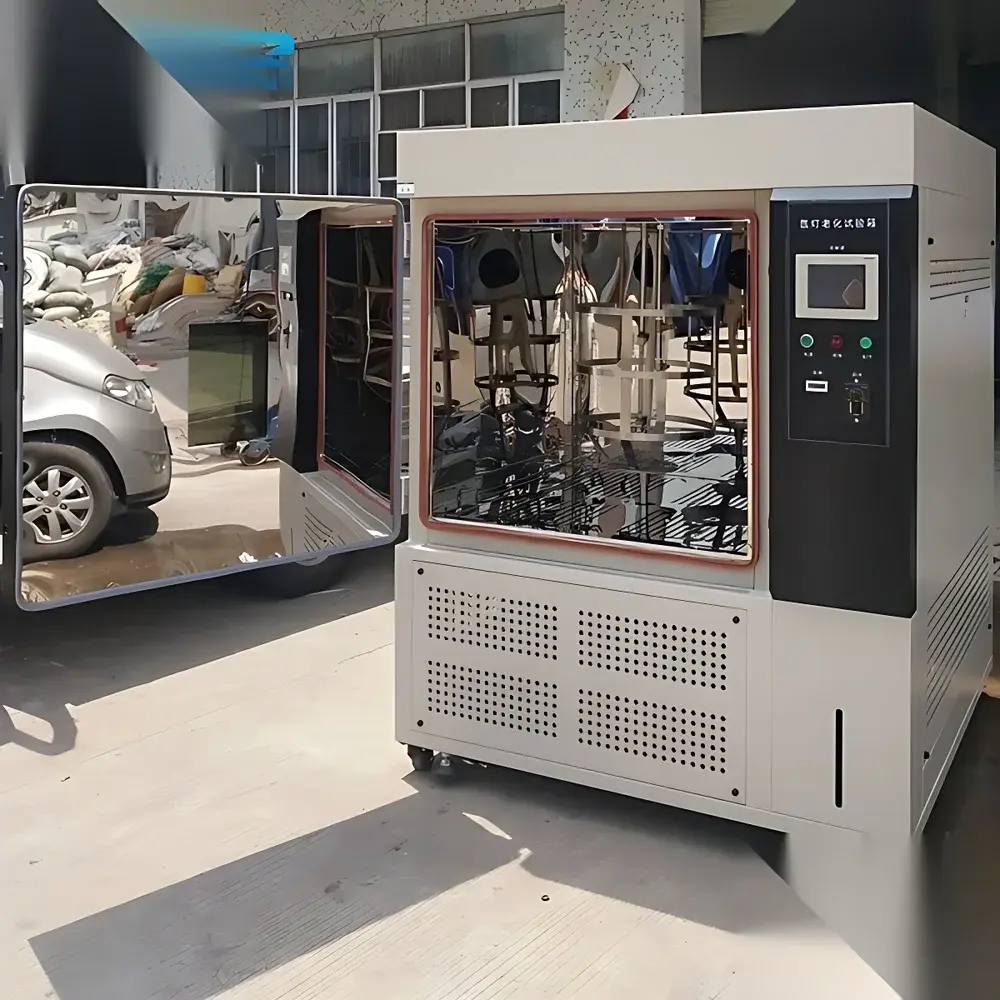
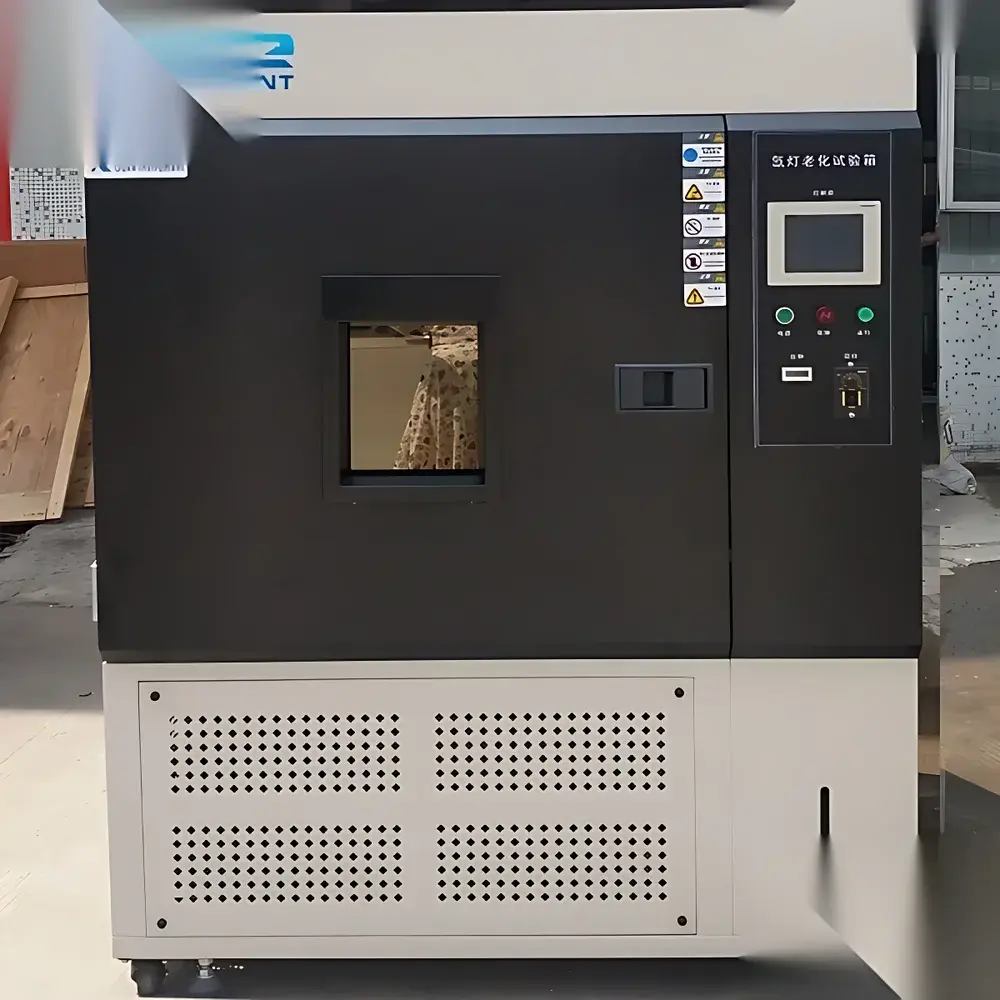
Xenon Arc Environmental Aging Test Chamber
| Key | Chamber Internal Dimensions: 400 × 1250 × 700 mm (D×W×H) |
|---|---|
| External Dimensions | 450 × 1350 × 1700 mm (D×W×H) |
| Temperature Range | RT+10°C to 70°C |
| Humidity Range | 65–95% RH |
| Sample-to-Lamp Distance | 240 mm |
| Spectral Range | 295–330 nm |
| Irradiance | 1000 µW/cm² @ 340 nm |
| Illumination & Condensation Cycle | Programmable |
| Lamp Configuration | 8 × 1200 mm, 40 W xenon arc lamps |
| Interior Material | SUS304 stainless steel |
| Control System | Fuji digital temperature controller (Japan) + programmable timer |
| Water Consumption | ~8 L/day (deionized or distilled water recommended) |
| Condensation Method | Gravity-fed, non-pressurized dew formation |
Overview
The Xenon Arc Environmental Aging Test Chamber is a precision-engineered accelerated weathering instrument designed to simulate the combined effects of solar radiation, temperature, and humidity—mimicking natural outdoor exposure in a controlled laboratory environment. It employs air-cooled or water-cooled xenon arc lamps as the irradiation source, delivering spectral output closely aligned with terrestrial sunlight (CIE 85, ISO 4892-2, ASTM G155). The chamber integrates real-time irradiance monitoring at critical wavelengths (e.g., 340 nm), programmable thermal-hygrometric cycling, and gravity-driven condensation to replicate dew formation—enabling reproducible assessment of material degradation mechanisms including photo-oxidation, chalking, color fading, gloss loss, cracking, and embrittlement. Engineered for long-term stability and operational consistency, it supports standardized qualification testing across automotive, aerospace, coatings, plastics, textiles, and building materials industries.
Key Features
- High-fidelity xenon arc irradiation system with spectral filtering to meet ISO 4892-2 and ASTM G155 Class A requirements
- Programmable irradiance control (1000 µW/cm² @ 340 nm, ±5% uniformity across test plane)
- Independent regulation of black panel temperature (BPT) and chamber air temperature (RT+10°C to 70°C)
- Relative humidity control (65–95% RH) via steam generator and precision hygrometer feedback
- Gravity-based condensation system replicating natural dew formation without pumps, nozzles, or deionized water dependency
- Uniform irradiance distribution achieved through optimized lamp array geometry (8 × 1200 mm lamps) and fixed 240 mm sample-to-lamp distance
- SUS304 stainless steel interior and exterior construction for corrosion resistance and cleanroom-compatible surface finish
- Digital Fuji temperature controller (Japan) with PID algorithm and 0.1°C resolution; integrated programmable timer for multi-stage cycle definition
Sample Compatibility & Compliance
The chamber accommodates flat-panel specimens up to 1200 mm wide and 700 mm high, with standardized mounting fixtures compliant with ISO 4892-2 specimen holders. It supports testing per major international standards including ISO 4892-2 (plastics), ISO 11341 (paints and varnishes), ASTM D4329 (plastics), ASTM D4587 (coatings), SAE J2527 (automotive interior), and AATCC TM16 (textiles). Its architecture enables full traceability under GLP and GMP frameworks, with optional audit trail logging compatible with FDA 21 CFR Part 11 requirements when paired with validated software extensions. All electrical and safety systems conform to IEC 61000-6-3 (EMC) and IEC 61010-1 (lab equipment safety).
Software & Data Management
While the base configuration utilizes embedded Fuji and timer hardware for manual operation, optional PC-based control software provides comprehensive data acquisition—including real-time irradiance, BPT, chamber RH, and elapsed cycle time—with CSV export, trend graphing, and alarm event logging. Data integrity safeguards include password-protected parameter modification, automatic timestamping, and electronic signature support for regulated environments. Firmware updates are delivered via USB interface, ensuring long-term compliance with evolving calibration and reporting protocols.
Applications
This chamber is routinely deployed for accelerated durability validation of polymer composites, automotive trim components, architectural sealants, UV-stabilized films, exterior signage, agricultural mulch films, and photovoltaic encapsulants. Its ability to decouple irradiance intensity from thermal load enables mechanistic studies on wavelength-dependent degradation pathways. In R&D labs, it supports comparative screening of UV absorbers, HALS stabilizers, and pigment systems; in QC settings, it serves as a pass/fail tool for batch release against pre-established colorimetric (ΔE*), mechanical (tensile retention), or surface morphology (SEM/AFM) endpoints.
FAQ
What spectral filters are used to match daylight exposure?
Standard configurations include Daylight-Q filter sets meeting ISO 4892-2 requirements; optional Extended UV and Window Glass filters are available for specialized applications.
Is deionized water mandatory for condensation operation?
While distilled or deionized water is recommended for extended lamp life and reduced scaling, the gravity-fed condensation system tolerates low-conductivity tap water in non-GxP environments.
How is irradiance uniformity verified and maintained?
Uniformity is validated during factory calibration using NIST-traceable radiometers; routine verification requires quarterly mapping per ASTM G197 protocol.
Can the chamber operate continuously for extended test durations (e.g., 1000+ hours)?
Yes—designed for unattended operation with dual-stage overtemperature protection, lamp end-of-life detection, and auto-shutdown on water depletion.
What maintenance intervals are recommended?
Lamp replacement every 1500–2000 hours; quartz filter cleaning weekly; chamber interior wipe-down after each test cycle; annual calibration of temperature/humidity sensors and irradiance meter.



