
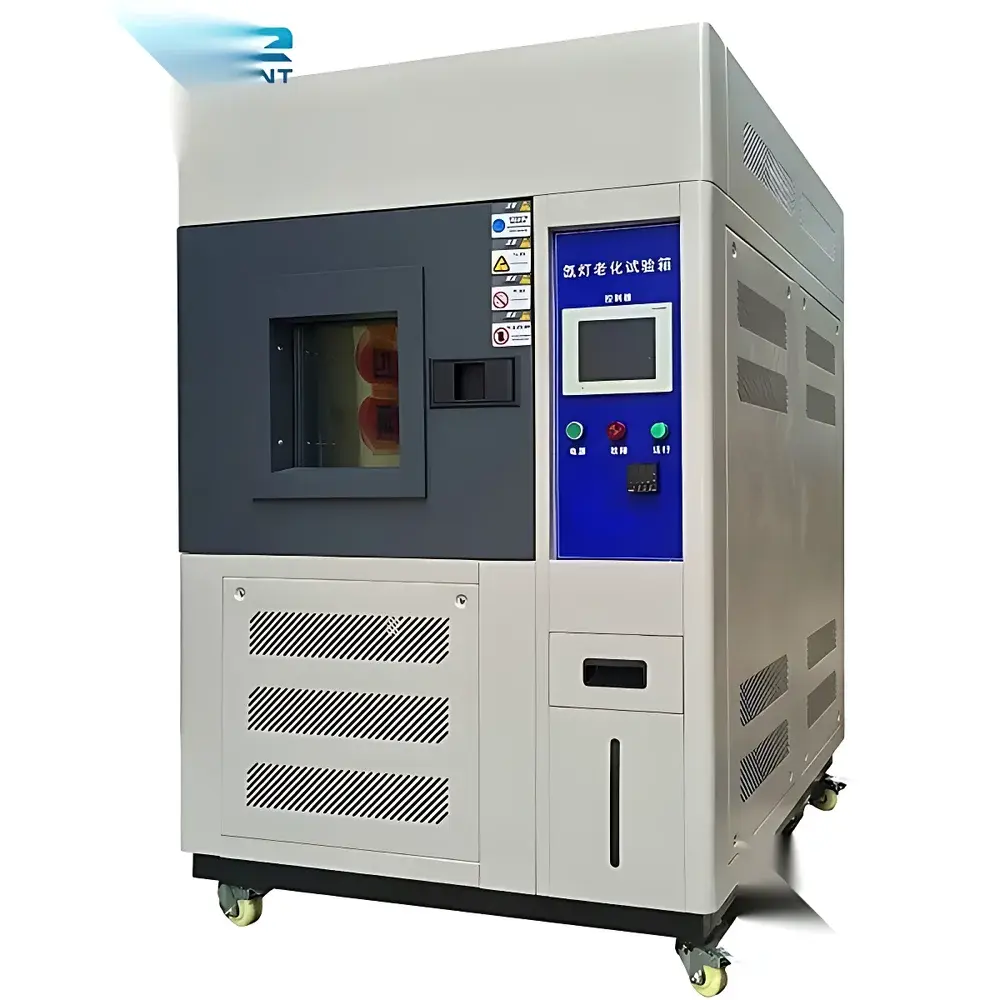
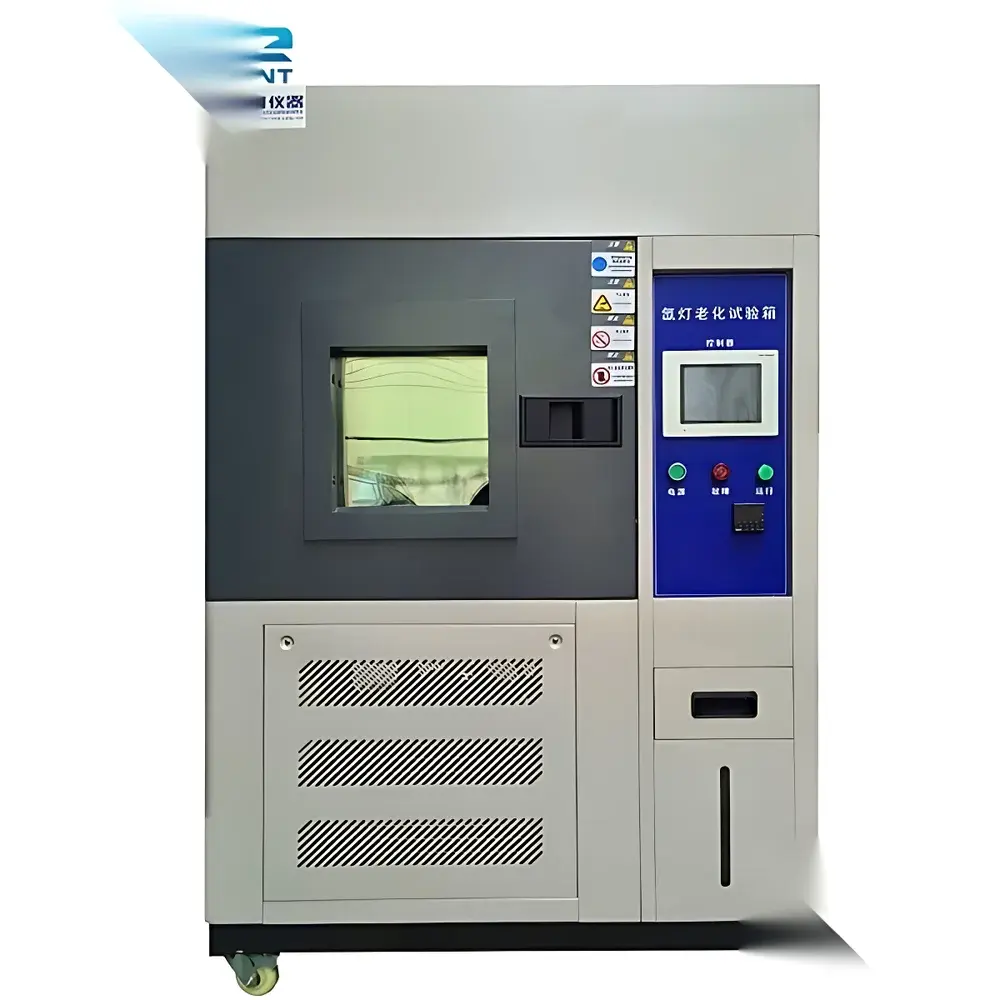
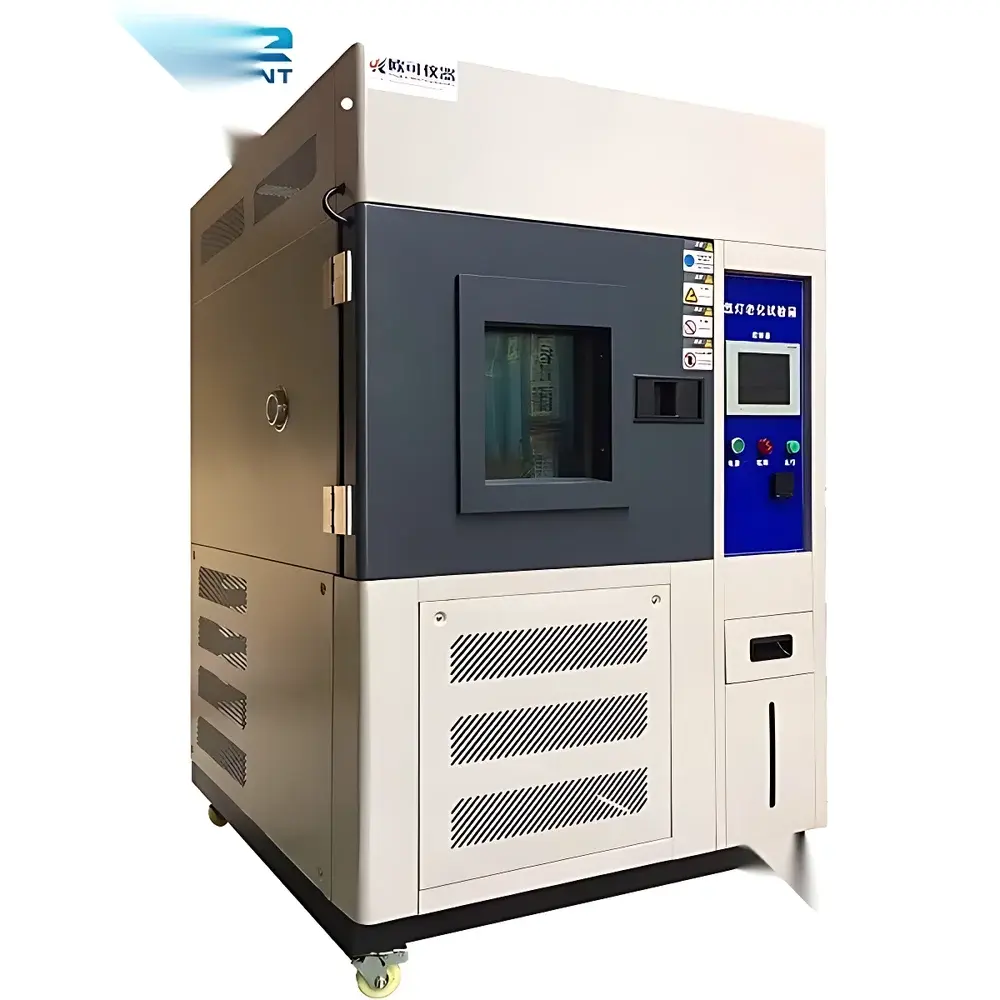
Xenon Arc Ozone-Resistant Aging Test Chamber
| Brand | Other Brands |
|---|---|
| Origin | Imported |
| Manufacturer Type | General Distributor |
| Price | USD 5,300 (approx.) |
| Internal Dimensions (mm) | 500×500×400 to 1000×1000×1000 |
| Temperature Range | 0–100°C (optional up to 150°C) |
| Black Panel Temperature | 40–85°C |
| Humidity Range (Light Cycle) | 20–75% RH |
| (Dark Cycle) | 20–98% RH |
| Temperature Uniformity | ±2.0°C |
| Temperature Stability | ±0.5°C |
| Humidity Uniformity | ±3.0% RH |
| Humidity Stability | ±2.0% RH |
| Irradiance | 550 W/m² ±10% (300–800 nm), 1120 W/m² ±10% (300–1200 nm or 300–3000 nm) |
| Xenon Lamp Power | 1.8 kW / 2.5 kW / 6 kW |
| Lamp Life | ~1500 h |
| Spray Duration | 1–999 min (intermittent or continuous) |
| Spray Pressure | 70–127 kPa |
| Sample Mounting | Dual-layer flat mesh rack or 500 mm diameter rotating turntable (0–3 rpm) |
| Construction | Interior – 1.2 mm SUS304 stainless steel |
| Safety Protections | Over-temperature, compressor high/low pressure, short-circuit, overload, oil-pressure, travel limit, and leakage current protection |
| Optional Accessories | Ø50 mm cable port, SUS316 sample trays, liquid nitrogen inlet |
Overview
The Xenon Arc Ozone-Resistant Aging Test Chamber is a precision-engineered environmental simulation system designed to evaluate the long-term durability of polymeric, textile, coating, and composite materials under accelerated exposure conditions that replicate real-world solar radiation, thermal cycling, humidity variation, rain, and oxidative stress—including ozone-mediated degradation pathways. Unlike standard UV-based weathering testers, this chamber employs a full-spectrum xenon arc lamp calibrated to match the spectral power distribution (SPD) of natural sunlight (CIE 85:2014, ISO 4892-2, ASTM G155). Its integrated ozone-resistant construction—using corrosion-inhibiting materials such as SUS304 stainless steel for internal wetted surfaces and ozone-stable gaskets—ensures operational integrity during extended cyclic testing where ambient ozone concentrations may rise due to lamp discharge byproducts. The system supports both light/dark cycles and simultaneous irradiation/humidity/temperature control, enabling compliance with multi-parameter aging protocols required for automotive exterior trim (SAE J2527), architectural coatings (ISO 11341), and textile colorfastness (ISO 105-B02).
Key Features
- Full-spectrum xenon arc lamp source with selectable spectral bandwidths (300–800 nm, 300–1200 nm, or 300–3000 nm), delivering irradiance levels traceable to NIST-calibrated reference cells.
- Programmable water spray system with adjustable duration (1–999 min) and regulated pressure (70–127 kPa), simulating natural rainfall intensity and droplet impact dynamics per ISO 20671-2.
- Independent dual-loop climate control: one for chamber air temperature/humidity, another for black panel temperature monitoring (40–85°C range) to quantify surface heating effects on specimens.
- Modular sample mounting options: dual-layer flat stainless steel mesh racks for static flat samples or a 500 mm diameter rotating turntable (0–3 rpm) to ensure uniform irradiance distribution across irregularly shaped components.
- Rugged mechanical architecture with 1.2 mm SUS304 interior lining and ozone-compatible seals; exterior housing in 1.5 mm galvanized steel with electrostatic powder coating or optional full SUS304 construction for aggressive chemical environments.
- Comprehensive safety architecture including over-temperature cutoff, compressor high/low pressure interlocks, motor overload protection, oil-pressure monitoring, mechanical travel limits, and Class I earth-leakage detection per IEC 61000-4-5.
Sample Compatibility & Compliance
This chamber accommodates diverse specimen geometries—from fabric swatches and painted panels to molded rubber gaskets and automotive headlamp lenses—without requiring custom fixtures. Its design conforms to international test standards governing photochemical degradation, including ISO 4892-2 (xenon arc methods), ASTM D4329 (plastics), ASTM D4459 (interior plastics), ISO 105-B02 (textile colorfastness to light), and SAE J2412/J2527 (automotive component weathering). All models support GLP-compliant operation when paired with optional data logging and audit trail modules compliant with FDA 21 CFR Part 11 requirements. The chamber’s ozone-resistant material selection and sealed optical path minimize internal ozone accumulation, ensuring reproducible photolysis kinetics without unintended oxidative interference—a critical factor for evaluating elastomer cracking resistance per ASTM D1149.
Software & Data Management
Equipped with an industrial-grade programmable logic controller (PLC) and 7-inch touchscreen HMI, the system enables precise definition of multi-step test profiles: irradiance ramping, temperature/humidity ramps, dark/light transitions, and synchronized spray events. Real-time data—including chamber air temperature, black panel temperature, relative humidity, irradiance output, and spray status—is logged at user-defined intervals (1 s to 60 min resolution) and exportable via USB or Ethernet to CSV or XML formats. Optional PC-based software provides graphical trend analysis, deviation alerts, calibration history tracking, and electronic signature capability for regulated environments. All firmware updates are digitally signed and validated to maintain integrity under ISO/IEC 17025 quality management frameworks.
Applications
- Evaluation of UV stabilizer efficacy in polyolefins, PVC, and thermoplastic elastomers used in outdoor infrastructure.
- Accelerated aging of automotive exterior materials (bumpers, seals, lighting housings) per OEM-specific specifications (e.g., Ford CETP, GMW14124).
- Colorfastness validation for architectural coatings exposed to subtropical climates (high UV + high humidity).
- Photostability assessment of medical device polymer housings subject to ISO 10993-12 biocompatibility requirements.
- Correlation studies between laboratory xenon exposure and field service life using Arrhenius-type acceleration models with spectral weighting functions (e.g., QUV vs. Xe-1).
FAQ
What spectral ranges are available, and how are they calibrated?
The chamber offers three standardized spectral configurations: 300–800 nm (for general daylight simulation), 300–1200 nm (for near-IR inclusive testing), and 300–3000 nm (full solar IR coverage). Each lamp is factory-calibrated against NIST-traceable reference radiometers and includes a built-in broadband irradiance sensor with automatic feedback compensation.
Is ozone generation actively suppressed or monitored?
While xenon lamps inherently produce low-level ozone as a plasma byproduct, the chamber’s sealed optical enclosure, ozone-resistant gasket materials (EPDM/FKM blends), and continuous internal air exchange (via filtered exhaust) maintain ozone concentrations below 0.05 ppm—well within occupational exposure limits (OSHA PEL) and below thresholds known to accelerate non-photochemical oxidation pathways.
Can the system operate unattended for extended cycles?
Yes. With integrated safety interlocks, redundant temperature sensors, and optional remote monitoring via Modbus TCP or SNMP, the chamber supports fully autonomous 720-hour (30-day) test sequences with automatic fault logging and email/SMS alerting upon deviation from setpoints.
What maintenance is required for long-term reliability?
Routine tasks include quarterly cleaning of lamp quartz sleeves and filter assemblies, annual verification of irradiance sensor linearity, and biannual inspection of spray nozzles and humidity sensor calibration. Lamp replacement (every ~1500 hours) is tool-free and requires less than 15 minutes.
Are third-party calibration certificates available?
Yes. Accredited calibration services per ISO/IEC 17025 are offered for irradiance (NIST-traceable), temperature (PT100 class A), and humidity (capacitive sensor) subsystems—with documented uncertainty budgets and certificate validity periods aligned with ISO 9001 internal audit schedules.



