
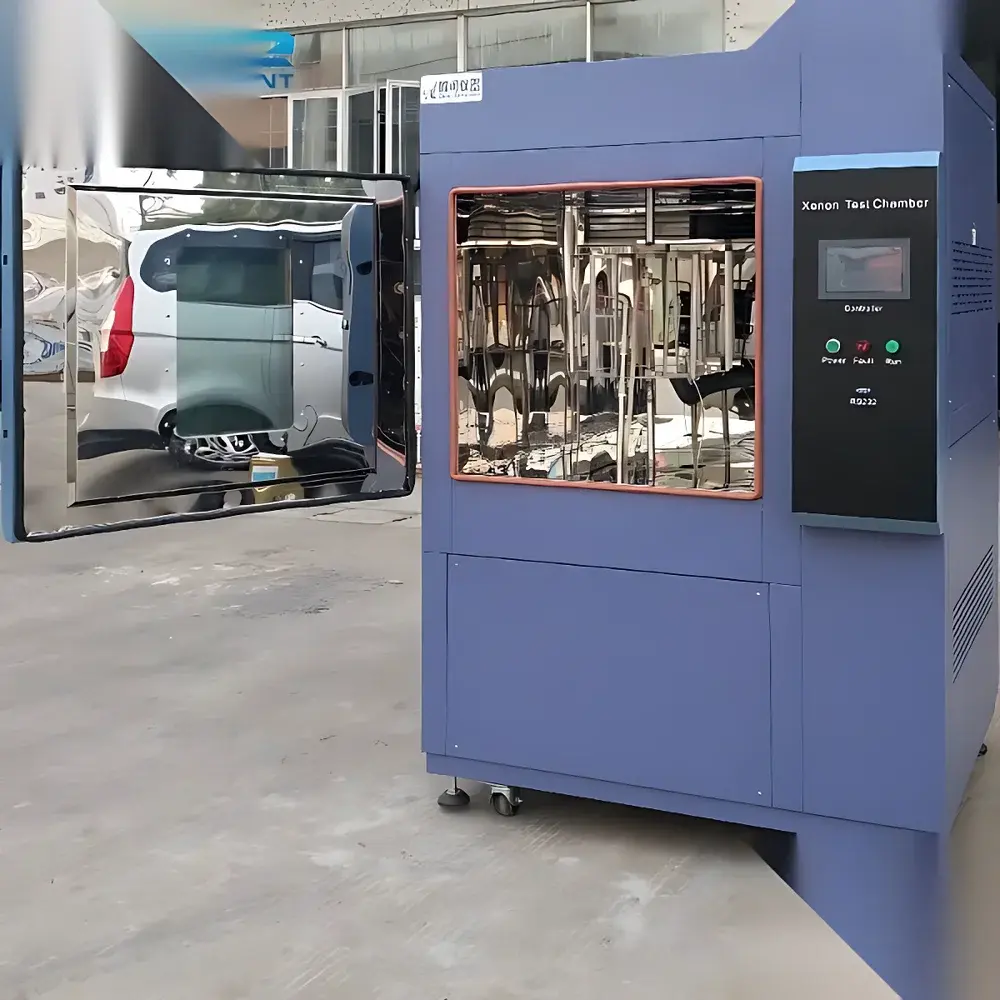
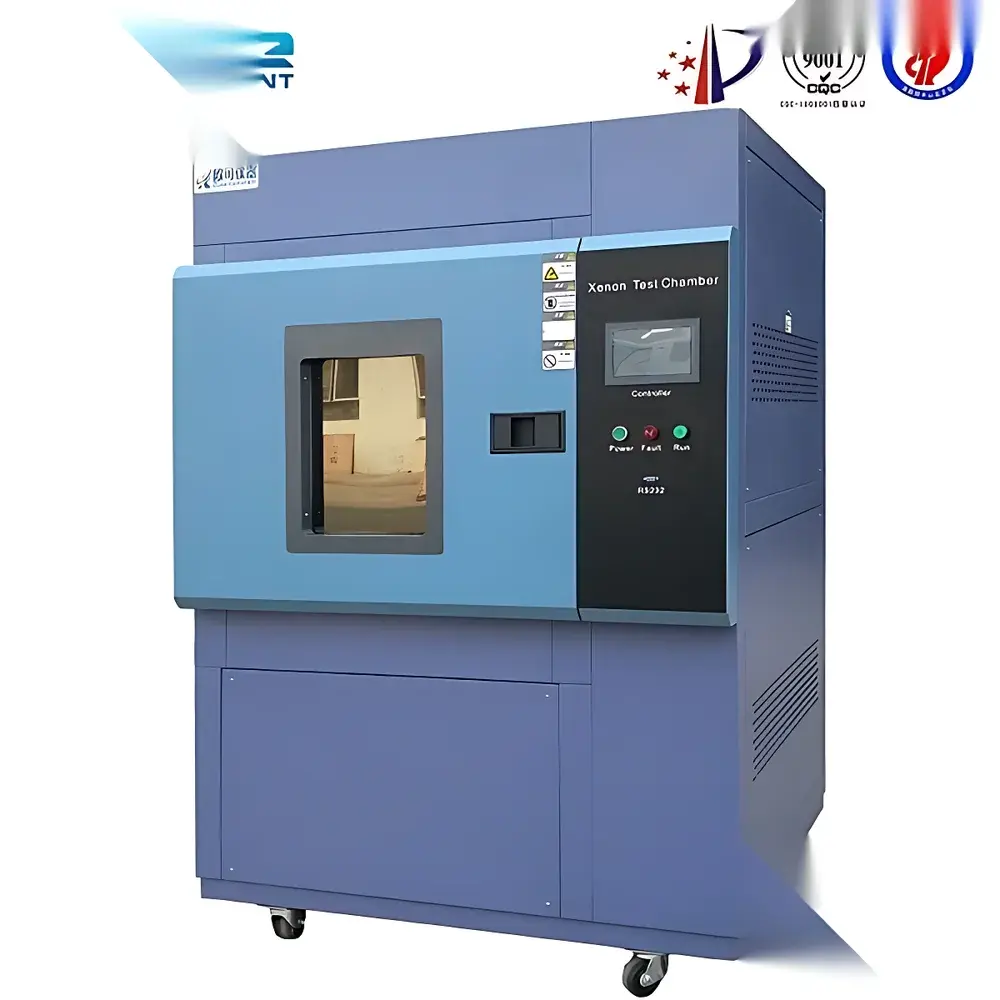
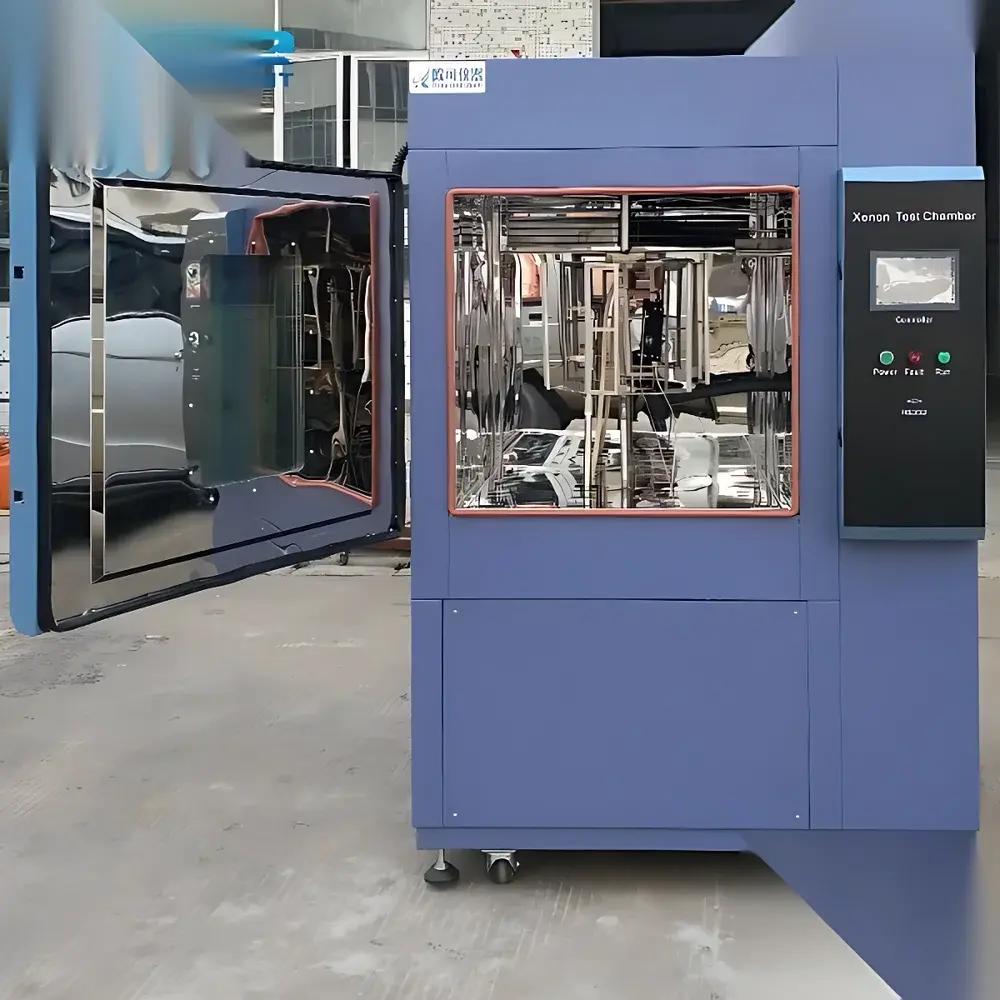
Xenon Arc Weathering Chamber XL-500 for Accelerated Solar Radiation Aging Testing
| Brand | OEM / Third-party Manufacturer |
|---|---|
| Origin | Imported |
| Supplier Type | Authorized Distributor |
| Price | USD 4,800 (FOB reference only |
| Chamber Dimensions (W×D×H) | 600 × 500 × 500 mm |
| Temperature Range | RT+10°C to 80°C |
| Humidity Range | 30–98% RH (30–65% RH during irradiation |
| Irradiance Spectrum | 290–800 nm |
| Irradiance Level | 550 W/m² (broadband, calibrated at specimen plane) |
| Light Source | Air-cooled 1 kW or 6 kW full-spectrum xenon arc lamp (rated life: 1600 h) |
| Black Panel Temperature Range | 55–75°C |
| Rainfall Duration | 1–9999 min (adjustable) |
| Rain Cycle Interval | 1–240 min (adjustable) |
| Control System | Programmable microprocessor-based temperature/humidity/irradiance controller (±0.1°C setpoint accuracy |
| Heating | Independent Ni-Cr alloy resistive heaters |
| Humidification | External stainless steel shallow-pan evaporative system |
| Air Circulation | Low-noise centrifugal blower with multi-vane impeller |
| Construction | Exterior — powder-coated color steel or brushed SUS304 stainless steel |
| Safety Protections | Overtemperature, overcurrent, leakage current, dry-run, motor overload, water shortage, and power-loss memory function |
Overview
The Xenon Arc Weathering Chamber XL-500 is an engineered environmental simulation system designed to replicate the combined degradative effects of terrestrial solar radiation, thermal cycling, humidity, condensation, and periodic water exposure on non-metallic and organic materials. It operates on the principle of broadband xenon arc irradiation—calibrated to match the spectral power distribution (SPD) of natural sunlight at sea level (CIE No. 85, ISO 4892-2, ASTM G155)—while maintaining precise control over temperature, relative humidity, and wet/dry cycling parameters. Unlike UV fluorescent or metal halide systems, the XL-500 delivers a continuous spectrum from 290 nm (UV-B onset) through visible to near-infrared (up to 800 nm), enabling realistic photochemical degradation kinetics in polymers, coatings, elastomers, textiles, and automotive interior components. Its chamber architecture supports standardized specimen mounting per ISO 4892-2 and ASTM D4329, with real-time black panel temperature monitoring to correlate surface thermal load with photodegradation rate.
Key Features
- Air-cooled full-spectrum xenon arc lamp (1 kW or 6 kW options) with spectral output traceable to NIST-traceable radiometric calibration standards
- Programmable irradiance control (550 W/m² broadband, adjustable via optical filter sets for UV cutoff or IR attenuation)
- Dual-mode humidity regulation: 30–65% RH during irradiation phase; up to 90% RH during dark condensation cycles
- Independent platinum resistance (Pt100) temperature sensors and capacitive RH transducers with ±0.1°C / ±0.1% RH setpoint accuracy
- Dynamic specimen rack with 360° rotation and adjustable tilt angle (0°–25°) to ensure uniform irradiance distribution per ISO 4892-2 Annex B
- Automated rain simulation system with programmable duration (1–9999 min) and interval timing (1–240 min), compliant with IEC 60068-2-52 salt mist + rain testing protocols
- Stainless steel (SUS304) interior chamber and sample holder structure, resistant to ozone, chlorine byproducts, and hydrolytic degradation
- Integrated safety architecture including dry-run protection, lamp overheat cutoff, water-level monitoring, and EEPROM-based power-loss recovery
Sample Compatibility & Compliance
The XL-500 accommodates flat-panel specimens up to 200 mm × 300 mm (standard) or custom fixtures for automotive trim, roofing membranes, or cable jacketing. It meets core international test standard requirements for accelerated weathering validation, including ISO 4892-2 (xenon arc methods), ASTM G155 (Class A/B/C exposure cycles), SAE J2527 (automotive exterior materials), and GB/T 16422.2 (Chinese national standard). All control algorithms and data logging routines are structured to support GLP-compliant audit trails when integrated with optional 21 CFR Part 11–compliant software modules. The chamber’s irradiance uniformity across the specimen plane (±15% per ISO 4892-2 Clause 7.3) and spectral stability (±5% deviation over lamp lifetime) are verified during factory acceptance testing using calibrated spectroradiometers.
Software & Data Management
The integrated controller features a 7-inch TFT touchscreen HMI with multilingual interface (English, German, Japanese, Chinese), real-time graphing of irradiance, temperature, and RH profiles, and USB export of CSV-formatted test logs. Optional Ethernet connectivity enables remote monitoring via Modbus TCP or OPC UA protocols. For regulated environments, the optional DataLogger Pro Suite provides electronic signatures, user access levels (admin/operator/viewer), and immutable audit trails compliant with FDA 21 CFR Part 11 and EU Annex 11. All logged parameters—including lamp voltage/current, cooling fan RPM, and water conductivity—are timestamped with millisecond resolution and stored redundantly on internal flash memory and external SD card.
Applications
This chamber is routinely deployed in R&D laboratories and QC departments for predictive lifetime assessment of polymer-based products subjected to outdoor service conditions. Typical use cases include: evaluating UV stabilizer efficacy in polyolefin packaging films; quantifying gloss retention and chalking resistance in architectural coatings; validating colorfastness of textile dyes under cyclic wet/dry exposure; screening thermal oxidative stability of silicone rubber gaskets; and qualifying photovoltaic encapsulant materials per IEC 61215 damp heat + UV sequence tests. Its reproducible irradiance profile and tightly controlled humidity gradients enable direct correlation between accelerated test hours and real-world field exposure (e.g., 1000 h in XL-500 ≈ 12–18 months in subtropical coastal climates, per ASTM G147 guidance).
FAQ
What spectral filters are included with the standard configuration?
The base unit ships with Daylight-Q filter set (quartz inner + borosilicate outer) for CIE daylight simulation. Optional filters include Window Glass (WG) for indoor exposure modeling and Extended UV (XU) for enhanced UV-B output.
Is lamp alignment and spectral recalibration required after replacement?
Yes. Each xenon lamp installation requires optical centering using the built-in alignment jig and post-installation spectral verification with a calibrated spectroradiometer. Factory-recommended recalibration interval is every 500 operating hours or after 3 lamp changes.
Can the chamber operate without humidity control during irradiation cycles?
Yes. Humidity can be disabled independently while maintaining temperature and irradiance control, supporting dry-heat + UV protocols per ASTM D7869.
What is the minimum specimen thickness supported on the dynamic rack?
The rotating rack accepts specimens ≥0.5 mm thick and ≤10 mm maximum thickness to ensure mechanical stability and thermal equilibrium during exposure.
Does the system support external data acquisition via analog outputs?
Yes. Standard 4–20 mA analog outputs are provided for irradiance, black panel temperature, and chamber RH, compatible with third-party SCADA or PLC systems.



