
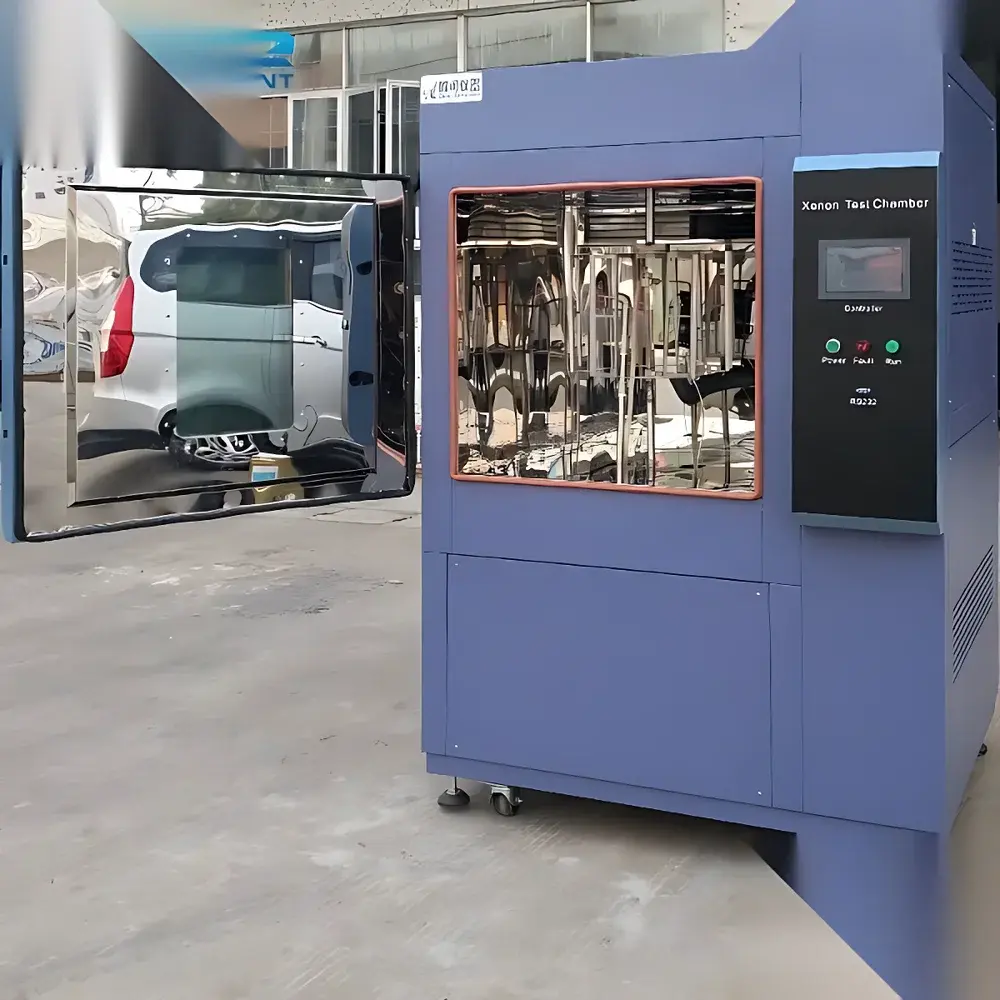
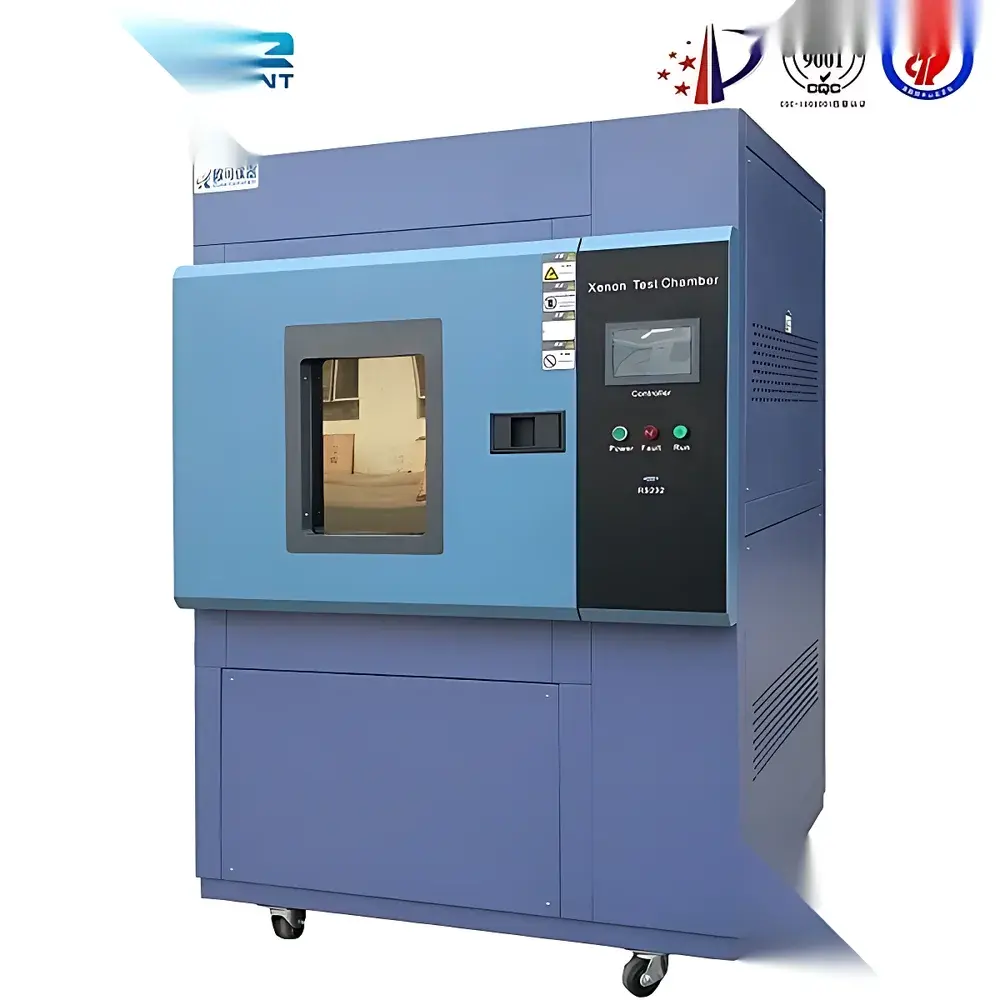
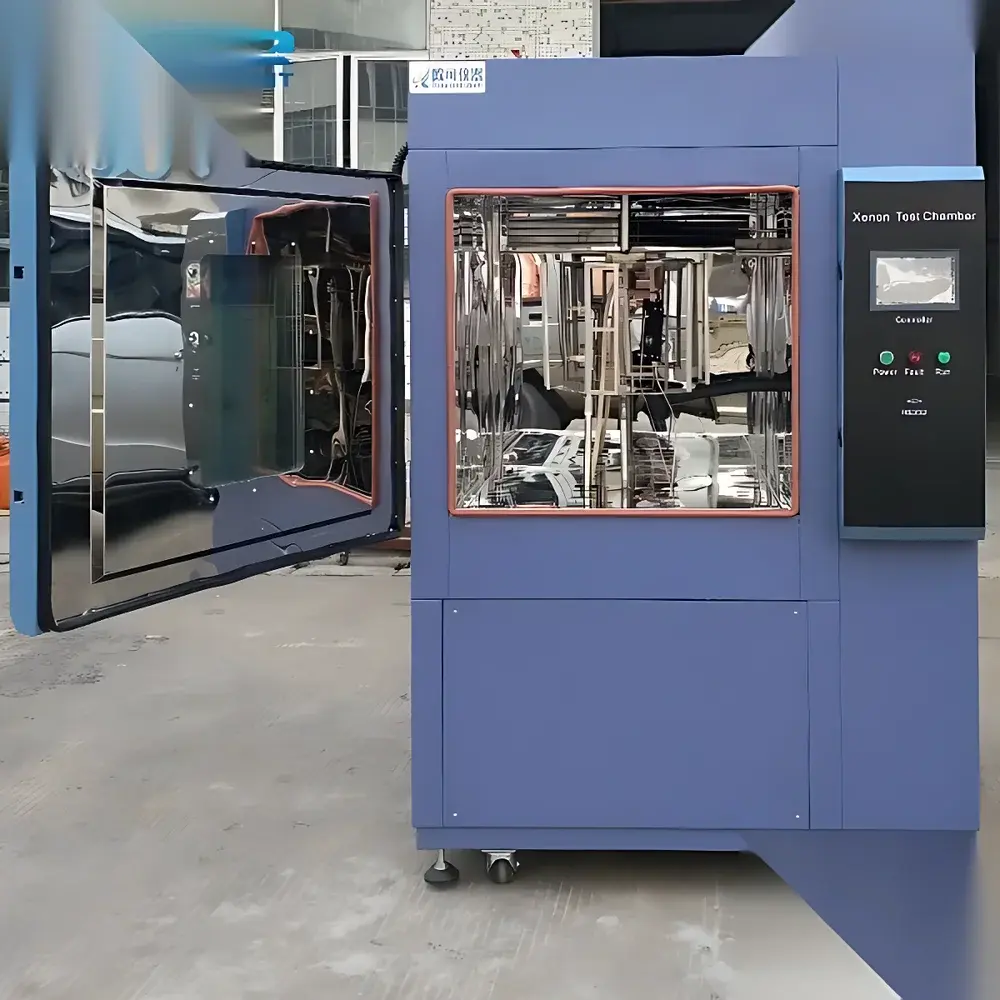
Xenon Arc Weathering Test Chamber
| Key Features | 500L or 700L chamber volume |
|---|---|
| Xenon lamp power | 4.5 kW / 6.0 kW (long-arc, full-spectrum solar simulation) |
| Irradiance control | 550 W/m² (at 340 nm or 420 nm band, adjustable) |
| Black panel temperature range | 50–90 °C |
| Temperature uniformity | ≤ ±3 °C |
| Relative humidity range | 55–90 %RH |
| Sample-to-lamp distance | 250–300 mm |
| Effective exposure area | 1600 cm² |
| Lamp service life | ≈1200 h |
| Spray cycle | programmable on/off duration up to 999 min each |
| Power supply | 380 VAC / 50 Hz, total rated power 12 kW / 15 kW |
| Controller | programmable touchscreen with xenon-specific algorithm and real-time irradiance feedback via fiber-optic sensor |
| Cooling | forced-air convection with axial fan and PID-controlled thermal management |
| Safety | interlocked door switch (lamp auto-off), overtemperature protection, dry-run prevention for spray system |
Overview
The Xenon Arc Weathering Test Chamber is an engineered environmental simulation system designed to replicate the damaging effects of sunlight, heat, and moisture on materials—mimicking natural outdoor exposure under accelerated, controlled laboratory conditions. It employs a long-arc xenon lamp as its radiation source, delivering a spectral power distribution closely aligned with terrestrial solar irradiance (CIE No. 85, ISO 4892-2). Unlike UV fluorescent or metal halide sources, xenon arc lamps provide continuous spectrum coverage from 290 nm to 800 nm, enabling accurate simulation of photodegradation mechanisms including polymer chain scission, pigment fading, coating chalking, and substrate embrittlement. This chamber supports both cyclic and continuous exposure protocols, integrating precise black panel temperature (BPT) or black standard temperature (BST) monitoring, programmable humidity control, and synchronized water spray sequences—all essential for evaluating material durability in accordance with international weathering standards.
Key Features
- Full-spectrum xenon illumination: Single 4.5 kW or 6.0 kW long-arc xenon lamp with quartz envelope and integrated IR/UV filtering optics ensures stable, spectrally relevant irradiance output at 550 W/m² (typically measured at 340 nm or 420 nm band); calibrated using NIST-traceable radiometers.
- Precision thermal management: PID-controlled forced-air convection system maintains black panel temperature within ±3 °C uniformity across the exposure plane; BPT/BST sensors mounted directly on sample holders provide localized surface temperature feedback.
- Fiber-optic irradiance sensing: Immune to thermal drift, the fiber-coupled radiometric sensor delivers real-time, closed-loop irradiance regulation without interference from chamber ambient temperature fluctuations.
- Programmable environmental cycling: Independent control of irradiance intensity, black panel temperature (50–90 °C), relative humidity (55–90 %RH), and spray timing (on/off durations up to 999 minutes) enables execution of complex test profiles per ISO 4892-2, ASTM G155, and SAE J2527.
- Robust mechanical architecture: Interior constructed from electropolished SUS304 stainless steel; outer enclosure fabricated from cold-rolled steel with epoxy-polyester powder coating; dual-layer silicone gasket sealing ensures long-term integrity under thermal and humidity stress.
- Comprehensive safety infrastructure: Door interlock circuit disables lamp power immediately upon opening; overtemperature cutoff, dry-run protection for spray pump, and automatic shutdown after user-defined test duration prevent operational hazards and equipment damage.
Sample Compatibility & Compliance
This chamber accommodates flat-panel specimens up to 1600 cm² effective exposure area, with adjustable stainless-steel sample racks compatible with standardized specimen holders (e.g., ASTM D7869 fixtures, ISO 11341 frames). It meets the core requirements of multiple international weathering standards, including ISO 4892-2 (Plastics — Methods of exposure to laboratory light sources — Part 2: Xenon-arc lamps), ASTM D4459 (Standard Practice for Determining Resistance of Plastics to Exposure to Fluorescent Light), ASTM G155 (Standard Practice for Operating Xenon Arc Equipment for Exposure of Non-Metallic Materials), GB/T 16422.1 and GB/T 16422.3 (Chinese national standards equivalent to ISO 4892), and AATCC TM16 (Colorfastness to Light). Optional filter configurations allow compliance with specific spectral cut-offs required by automotive (SAE J2412), aerospace (ASTM D7869), or textile (ISO 105-B02) applications.
Software & Data Management
The integrated programmable touchscreen controller features a dedicated xenon weathering firmware suite supporting up to 100 user-defined test programs, each with multi-step irradiance/temperature/humidity/spray sequencing. All operational parameters—including real-time irradiance (W/m²), BPT/BST (°C), RH (%), elapsed time, and lamp operating hours—are logged at user-selectable intervals (1–60 sec) and exportable via USB to CSV format. Audit trail functionality records operator login, parameter changes, alarm events, and calibration timestamps—supporting GLP-compliant documentation and FDA 21 CFR Part 11 readiness when paired with optional networked authentication modules.
Applications
Used extensively in R&D, quality assurance, and regulatory testing labs, this chamber evaluates photostability and weather resistance across diverse material classes: automotive interior and exterior trim (PP, TPO, PU, PVC), architectural coatings and sealants, textile dyes and functional finishes, packaging films (PET, PE, laminates), outdoor signage substrates, and medical device polymers subject to ISO 10993-12 biocompatibility aging protocols. Its reproducible exposure conditions support comparative benchmarking against reference materials, formulation optimization, shelf-life prediction modeling, and failure mode analysis under simulated climatic stressors.
FAQ
What spectral filters are included with the standard configuration?
The base unit includes a borosilicate inner filter (Boro) and a quartz outer filter (Quartz), producing a daylight-filtered spectrum compliant with ISO 4892-2 Cycle 1. Additional filter sets (e.g., Window Glass Q/B, Extended UV) are available as options.
Is the irradiance level adjustable during a test cycle?
Yes—the controller supports dynamic irradiance ramping and step changes within a single program, enabling simulation of diurnal intensity variation or dose-controlled exposure protocols.
How often does the xenon lamp require replacement?
Lamp lifetime is rated at approximately 1200 hours under nominal operating conditions; actual service life depends on irradiance setpoint, cooling efficiency, and voltage stability. The system logs cumulative lamp hours and triggers maintenance alerts.
Can humidity be maintained independently of temperature?
Yes—humidity is regulated via steam generator and condensation control, decoupled from heating/cooling cycles, allowing stable RH hold at any black panel temperature between 50 °C and 90 °C.
Does the chamber support remote monitoring or integration with LIMS?
Via optional Ethernet interface and Modbus TCP protocol, real-time data streaming and command control are supported; raw log files are compatible with common LIMS import formats (CSV, XML).



