
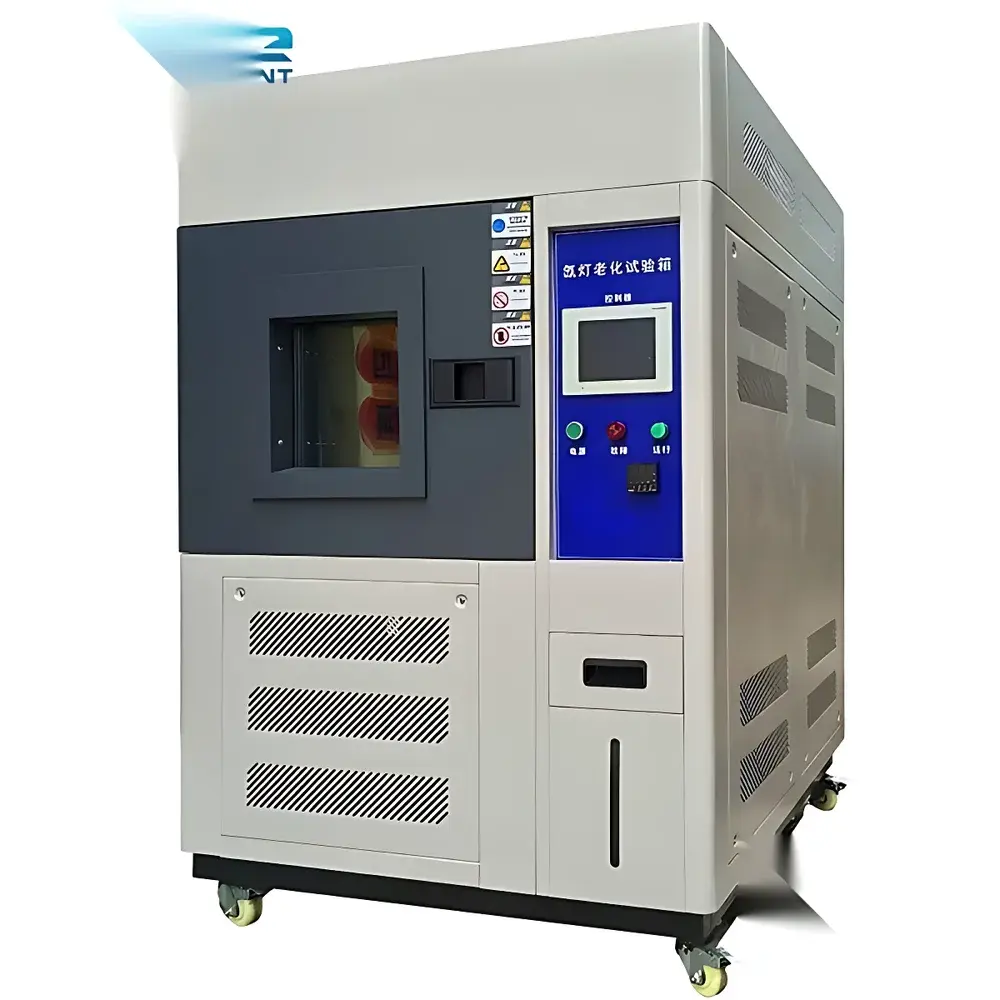
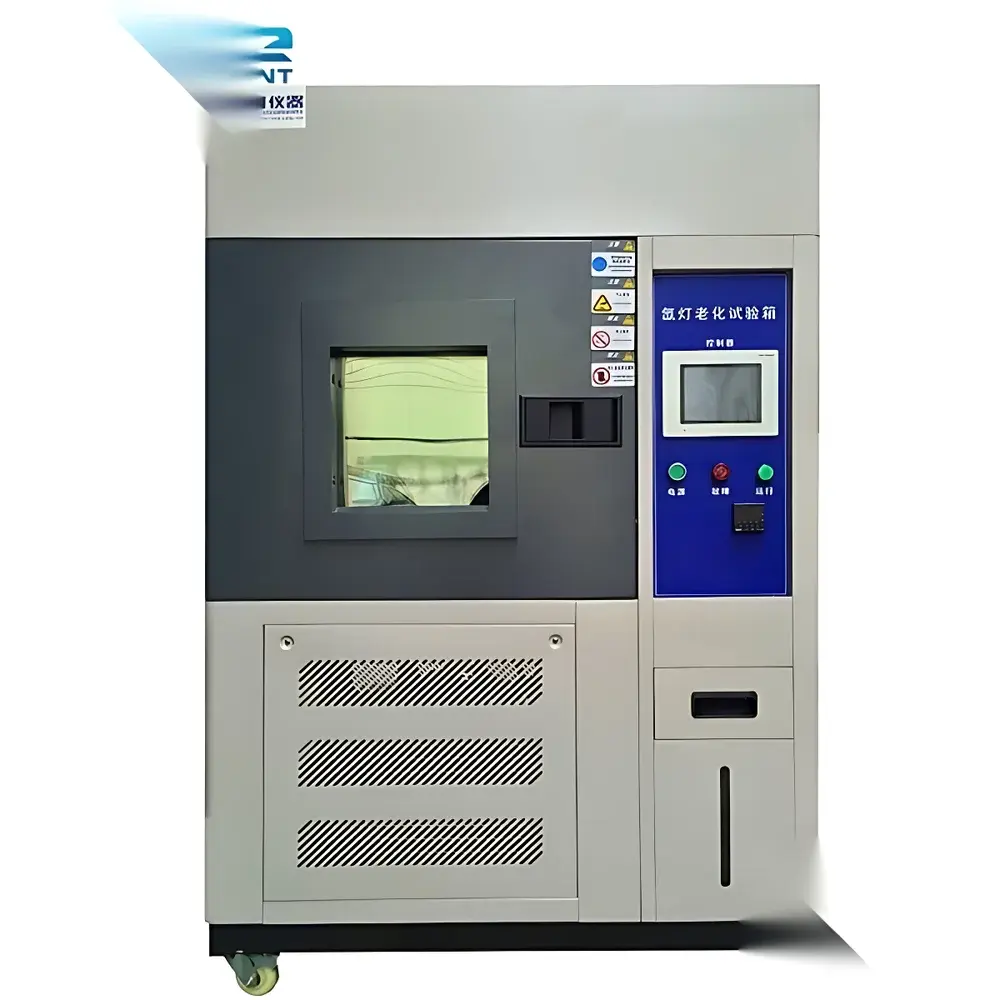
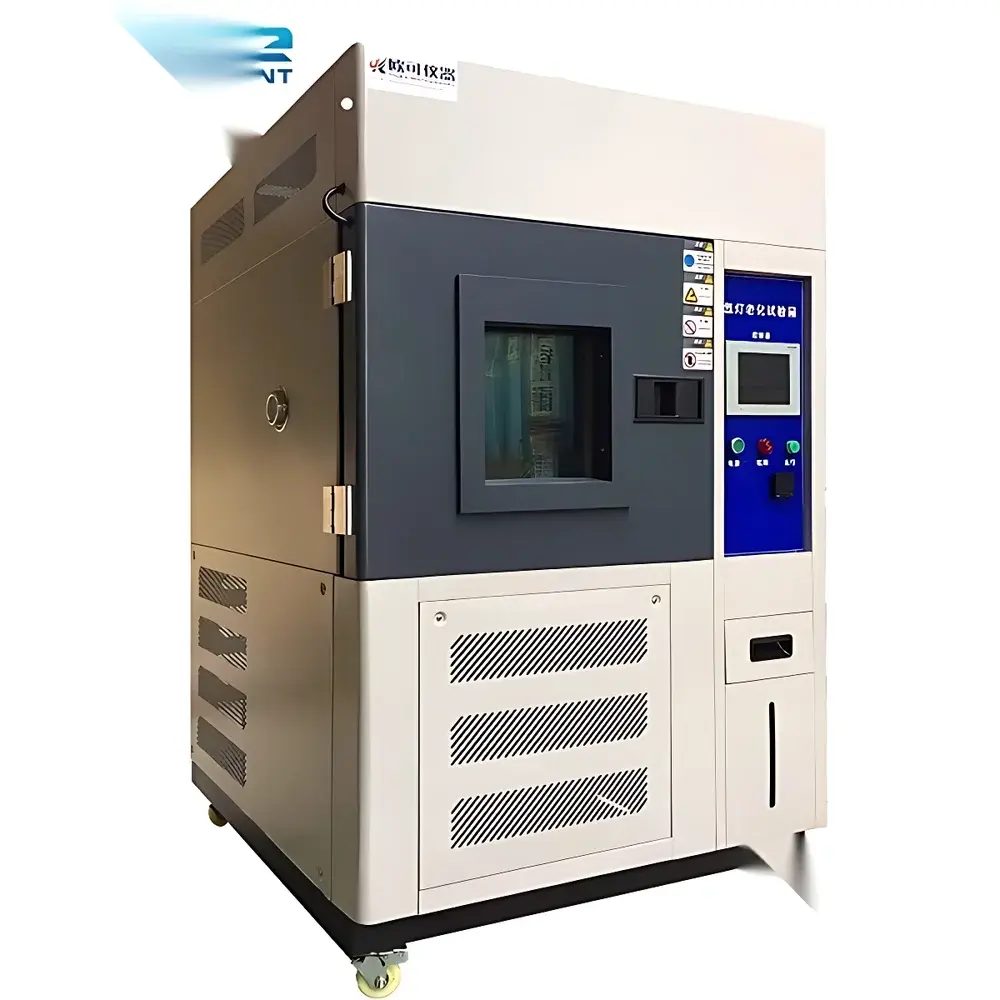
Xenon Arc Weathering Test Chamber – Full-Spectrum Environmental Exposure System
| Brand | OEM |
|---|---|
| Origin | Imported |
| Manufacturer Type | Authorized Distributor |
| Price | USD 5,200 (Reference Only) |
| Inner Chamber Material | SUS304 Stainless Steel |
| External Casing | Brushed SUS304 Stainless Steel |
| Xenon Lamps | 8 × 40 W, L = 1200 mm |
| Water Consumption | 8 L/day (Deionized or Distilled Water) |
| Temperature Controller | Fuji Electric Digital PID Controller (Japan) |
| Timer | Programmable Digital Time Relay |
| Temp. Range | RT+10°C to 70°C |
| Humidity Range | 65–98% RH |
| Rainfall Duration | 1–9999 h 59 min (adjustable) |
| Rainfall Cycle | 1–240 min interval (adjustable) |
| Spectral Range | 290–800 nm |
| Total Lamp Power | 9.9 kW |
| Lamp Lifetime | ≈1600 h |
| Sample Rack | SUS304 Stainless Steel Bars |
| Door Seal | High/Low-Temp Resistant Silicone Rubber |
| Standard Accessories | Radiation-Resistant Viewing Window (1 set), 4 Xenon Lamps |
| Safety Protections | Leakage Current Protection, Short-Circuit Protection, Overtemperature Cut-off, Low-Water Alarm, Motor Overheat & Overcurrent Protection |
| Power Supply | AC 380 V ±10%, 50 ±0.5 Hz, 5-Wire 3-Phase |
| Ambient Operating Conditions | 5–30°C, ≤85% RH |
| Compliance Standards | GB/T 8427, GB/T 8430, GB/T 14576, GB/T 15102, GB/T 15104, GB/T 2014, ISO 105-B02, ISO 105-B04, AATCC TM16-2003 |
Overview
The Xenon Arc Weathering Test Chamber – Full-Spectrum Environmental Exposure System is an engineered solution for accelerated simulation of outdoor solar radiation, temperature, humidity, and precipitation effects on materials. Based on the principle of xenon arc irradiation, it replicates the full solar spectrum (290–800 nm), including critical UV-A, UV-B, visible, and near-infrared wavelengths—enabling realistic photochemical degradation assessment under controlled laboratory conditions. Unlike narrow-band UV fluorescent systems, this chamber delivers spectral power distribution closely aligned with terrestrial sunlight (CIE No. 85, ISO 4892-2), making it suitable for evaluating colorfastness, gloss retention, polymer embrittlement, coating delamination, and substrate oxidation in accordance with international weathering test protocols.
Key Features
- Eight high-output 40 W xenon lamps (L = 1200 mm) arranged for uniform irradiance distribution across the test area; total system power output of 9.9 kW ensures stable spectral irradiance at standardized intensities (e.g., 0.35–0.55 W/m² @ 340 nm).
- Double-walled construction with inner chamber fabricated from electropolished SUS304 stainless steel and exterior casing finished in brushed SUS304—resistant to corrosion, thermal cycling, and chemical exposure during long-term operation.
- Precision Fuji Electric digital PID temperature controller (Japan-sourced) provides ±0.5°C stability within the operating range of RT+10°C to 70°C; integrated humidity control maintains 65–98% RH with ±3% RH accuracy.
- Programmable rainfall system supports both continuous and cyclic modes: rainfall duration adjustable from 1 minute to 9999 hours 59 minutes; inter-rainfall intervals configurable between 1 and 240 minutes—enabling simulation of diurnal wet/dry cycles.
- Radiation-resistant borosilicate glass viewport allows real-time visual monitoring without compromising spectral integrity or operator safety.
- Comprehensive safety architecture includes independent overtemperature cutoff, low-water level detection, motor overheat protection, leakage current interruption, and short-circuit tripping—fully compliant with IEC 61000-4 EMC requirements and Class I electrical safety standards.
Sample Compatibility & Compliance
This chamber accommodates flat-panel specimens up to 600 mm × 600 mm (standard rack dimensions), with optional custom racks available for irregular geometries. It supports testing of textiles, automotive interior trims, architectural coatings, plastic housings, elastomeric seals, and composite laminates. The system meets mandatory test condition requirements for multiple international standards, including ISO 105-B02 (colorfastness to artificial light), ISO 105-B04 (xenon arc fading), AATCC TM16-2003 (lightfastness of textiles), and GB/T 8427–2013 (Chinese national standard for textile colorfastness). Its operational parameters are traceable to NIST-calibrated radiometers and validated per ASTM G155 Annex A1 for spectral irradiance uniformity and temporal stability.
Software & Data Management
While hardware-based control remains primary for regulatory robustness, the chamber integrates RS485/Modbus RTU interface for third-party SCADA or LIMS integration. All operational parameters—including lamp voltage/current, chamber temperature/humidity, irradiance setpoints, rainfall timing, and alarm logs—are timestamped and stored locally for ≥30 days. Audit trails support GLP-compliant documentation, and data export via USB port enables traceable reporting aligned with FDA 21 CFR Part 11 requirements (when paired with validated electronic signature software). Calibration records for temperature, humidity, and irradiance sensors are retained per ISO/IEC 17025 guidelines.
Applications
- Accelerated aging of automotive interior materials (dashboard polymers, seat fabrics, trim adhesives) per SAE J2412 and ISO 16322-1.
- Evaluation of UV stabilizers and pigment systems in architectural paints and façade cladding.
- Validation of photostability for medical device packaging (ISO 11607-1) and pharmaceutical secondary packaging (ICH Q1B).
- Correlation studies between laboratory exposure and real-world service life using Arrhenius-type acceleration models and spectral weighting functions (e.g., CIE S 014).
- Qualification of outdoor signage substrates, solar panel encapsulants, and agricultural film materials under combined thermal, hygric, and photolytic stress.
FAQ
What spectral irradiance levels does this chamber achieve at 340 nm?
Typical calibrated output is 0.35–0.55 W/m² @ 340 nm, adjustable via lamp power modulation and optical filtering—consistent with ISO 4892-2 Category 1 and AATCC TM16 Option 3.
Is lamp spectral output certified against CIE 85:1989?
Yes—each lamp batch undergoes spectral verification using a NIST-traceable spectroradiometer prior to installation; spectral match factor ≥0.98 per CIE 85:1989 is documented in the factory calibration report.
Can the chamber operate unattended for extended cycles?
Yes—integrated safety interlocks, redundant temperature sensors, and automatic lamp shutdown upon water depletion enable fully autonomous operation for up to 30-day exposure sequences.
How often must xenon lamps be replaced?
Lamp replacement is recommended every 1600 hours of cumulative operation; output degradation beyond ±10% of initial irradiance triggers automatic maintenance alert.
Does the system support user-defined test profiles?
Yes—up to 16 programmable profiles can be stored internally, each defining independent ramp rates, dwell times, humidity setpoints, and rainfall scheduling—compatible with ISO 4892-2 Step 3 and Step 4 protocols.



