
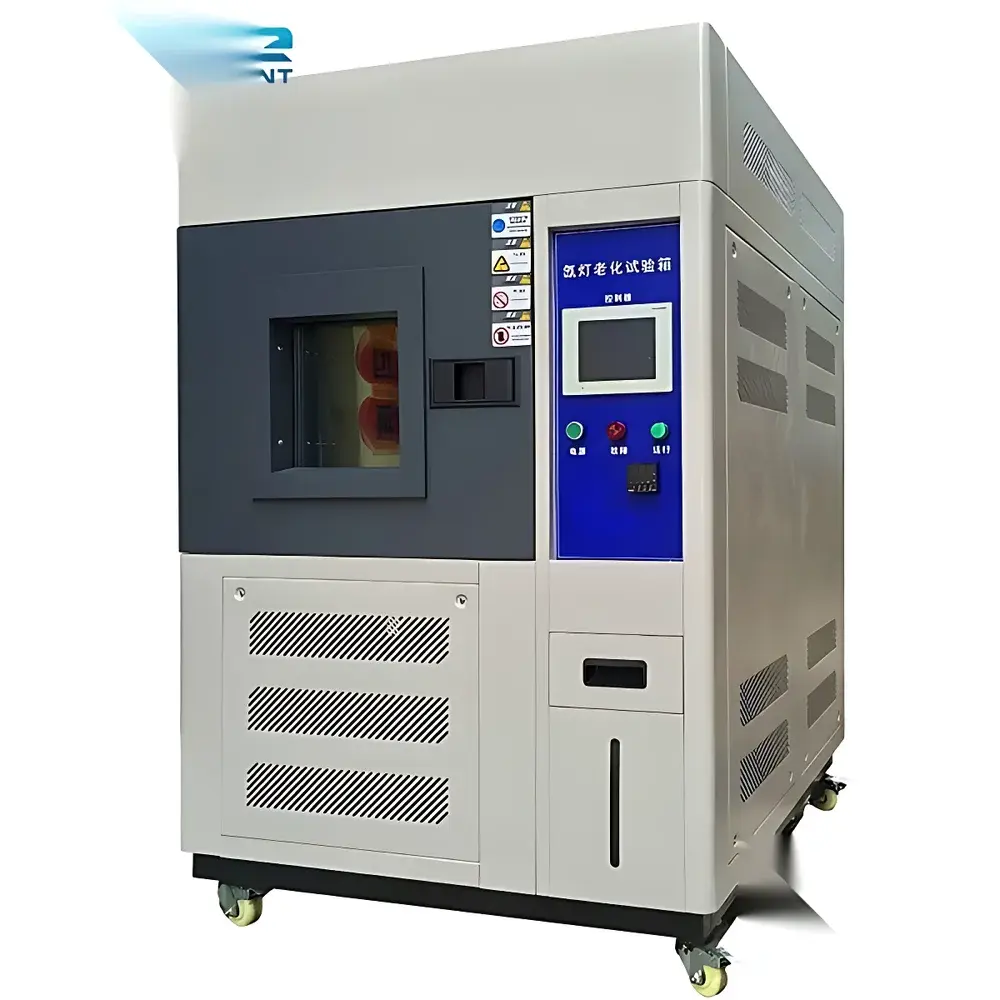
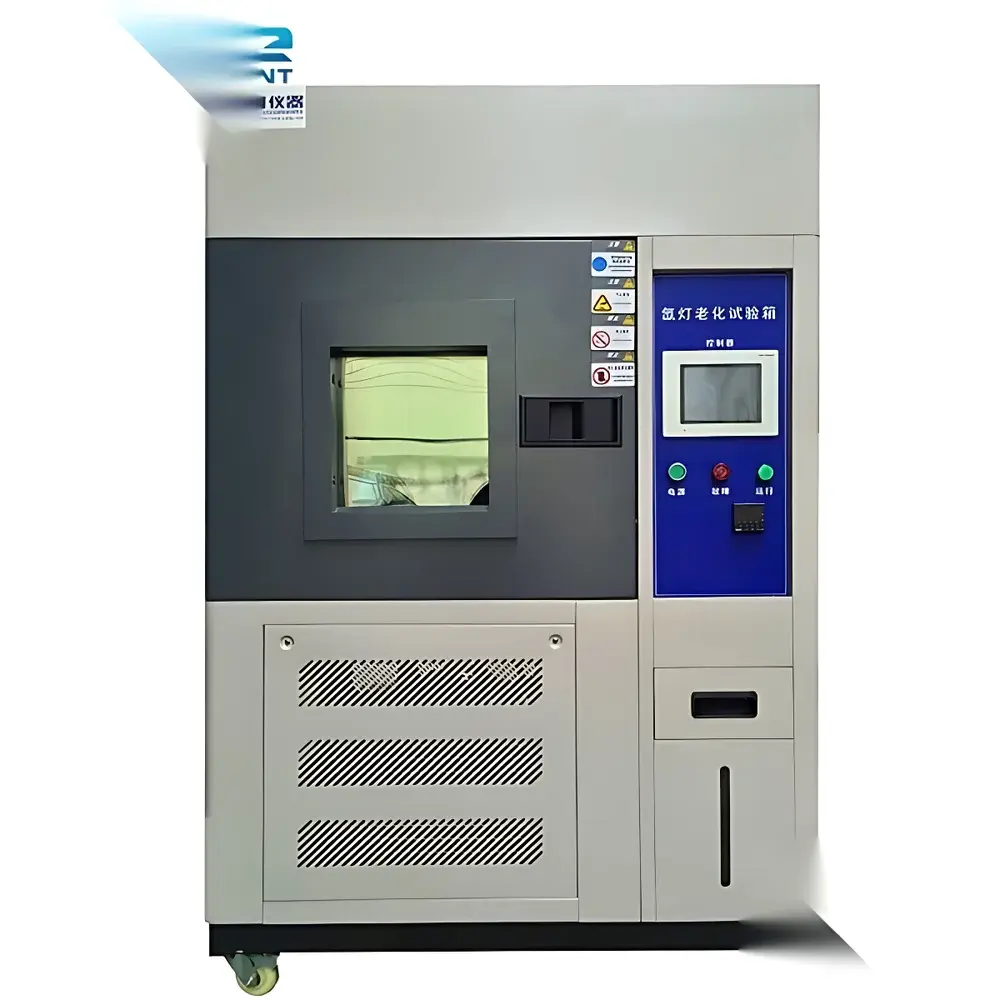
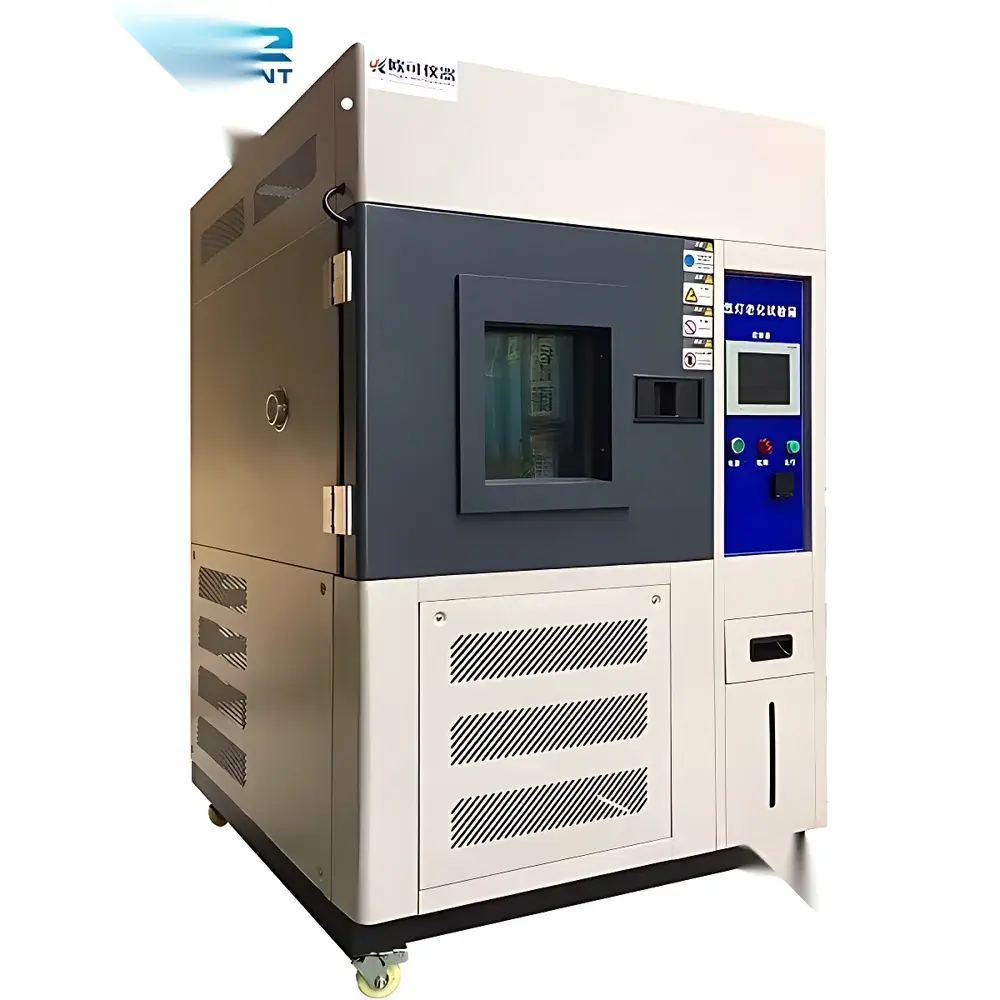
Xenon Arc Weathering Test Chamber – Model XW-6000 Series
| Brand | OEM / Custom-Built |
|---|---|
| Origin | Imported |
| Manufacturer Type | Authorized Distributor |
| Price | USD 5,300 (FOB Shanghai, ex-factory reference only) |
| Illumination Source | 6 kW Water-Cooled Xenon Arc Lamp (Optional 3 kW Air-Cooled) |
| Spectral Range | 290–800 nm |
| Irradiance Control | (550 ± 5) W/m² @ 340 nm equivalent |
| Black Panel Temperature | 53 °C ± 3 °C |
| Temperature Range | RT to +80 °C |
| Temp. Uniformity | ±2.5 °C |
| Temp. Stability | ±1 °C |
| Humidity Range (C-type) | 30–90 %RH |
| Spray Pressure | 78–127 kPa |
| Spray Nozzle Orifice | 0.4 mm |
| Rotation Speed | 1 rpm (360° continuous) |
| Chamber Interior Dimensions (C-type) | 1000 × 1000 × 1000 mm (W×H×D) |
| Compliance | ASTM G155, ISO 4892-2, SAE J2527, GB/T 16422.2 |
Overview
The Xenon Arc Weathering Test Chamber – Model XW-6000 Series is an engineered environmental simulation system designed to replicate full-spectrum solar radiation, thermal stress, and moisture exposure in controlled laboratory conditions. Based on the principles of xenon arc irradiation, it delivers photometrically calibrated broadband output (290–800 nm), closely matching terrestrial sunlight—particularly critical UV-B and visible regions—to accelerate material degradation mechanisms including photooxidation, chalking, color fading, gloss loss, and polymer chain scission. Unlike UV fluorescent or metal halide alternatives, this chamber employs a high-intensity water-cooled 6 kW xenon lamp (with optional 3 kW air-cooled configuration), enabling precise irradiance regulation at (550 ± 5) W/m² (typically referenced at 340 nm). Integrated black panel temperature sensors (PT100, ±3 °C tolerance) and programmable thermal control (RT to +80 °C, ±1 °C stability) ensure thermally coupled photochemical aging consistent with real-world outdoor exposure profiles.
Key Features
- High-fidelity xenon arc illumination system with spectral filtering: External quartz and borosilicate glass filters standard; optional IR-cut and daylight filters available for specific test protocols (e.g., ISO 4892-2 Cycle 1 vs. Cycle 2).
- Dual-lamp configuration support: Horizontal 3 kW (A/B variants) and vertical 6 kW (C variant) mounting options accommodate diverse specimen geometries and industry-standard rack configurations.
- Real-time irradiance monitoring via calibrated broadband radiometer with auto-compensation for lamp aging; electronic trigger system achieves ignition in <2 seconds and enforces ≥10 min inter-start delay for thermal management.
- Robust temperature control architecture: Nickel-chromium heating elements, PT100 Class A sensors, and PID-driven logic maintain chamber uniformity within ±2.5 °C across the working volume.
- Programmable spray subsystem: Stainless-steel (SUS304) reservoir with level-sensing float switch; high-pressure pump delivering 78–127 kPa through precision 0.4 mm nozzles; spray duration adjustable from 1 minute to 99 hours per cycle.
- Continuous 360° rotation mechanism (1 rpm) ensures homogeneous irradiation exposure for standard 75 × 150 mm test specimens; optional rotating sample table compatible with ASTM D4329 and ISO 4892-2 requirements.
Sample Compatibility & Compliance
The XW-6000 Series accommodates flat-panel, molded, and coated substrates up to 1000 mm × 1000 mm × 1000 mm internal volume (C-type). Specimen holders are configurable for automotive trim, architectural coatings, textile swatches, plastic housings, and aerospace composites. The system meets core regulatory and industry-standard test method requirements including ASTM G155 (Cycle 1–4), ISO 4892-2 (Method A & B), SAE J2527, GB/T 16422.2, and IEC 60068-2-9. All firmware and control logic are structured to support GLP-compliant audit trails when paired with optional data logging modules—fully traceable timestamps, parameter setpoints, and operator IDs are retained for FDA 21 CFR Part 11 readiness upon validation.
Software & Data Management
Equipped with a 7-inch capacitive touchscreen HMI running embedded Linux-based controller firmware, the chamber supports multi-segment programmable cycles (light/dark, spray/no-spray, temp/humidity ramps) with up to 100 user-defined profiles. Real-time graphs display irradiance (W/m²), black panel temperature (°C), chamber ambient temperature (°C), and relative humidity (%RH). Data export is supported via USB 2.0 (CSV format) or optional Ethernet interface (Modbus TCP/RTU). For enterprise integration, optional PC software provides remote monitoring, alarm notification (email/SNMP), historical trend analysis, and PDF report generation compliant with ISO/IEC 17025 documentation standards.
Applications
This chamber is routinely deployed in R&D laboratories and quality assurance departments for accelerated weathering validation of exterior automotive components (bumpers, headlights, seals), architectural cladding systems (aluminum composite panels, silicone sealants), consumer electronics enclosures (UV-stabilized polycarbonate), textile dye fastness (AATCC TM16), and medical device packaging (ISO 11607-1). It serves as a critical tool during material qualification, supplier screening, and failure root-cause analysis—especially where correlation to Florida or Arizona outdoor exposure data is required per ASTM G154 or ISO 4892-2 correlation matrices.
FAQ
What lamp life expectancy can be expected under standard operating conditions?
Typical operational lifetime exceeds 1,000 hours at rated power; lamp output decay is monitored continuously and compensated automatically via closed-loop irradiance control.
Is calibration certification included with shipment?
Yes—each unit ships with NIST-traceable irradiance and temperature calibration certificates valid for 12 months; annual recalibration services are available under extended support contracts.
Can the chamber operate unattended for extended cycles (e.g., 1,000-hour tests)?
Yes—the system includes hardware-level safety interlocks (overtemperature, low water level, lamp arc fault), redundant thermal cutoffs, and automatic shutdown with event logging for fully autonomous long-term operation.
Does the controller support custom test sequences beyond preloaded standards?
Yes—users may define arbitrary time-based sequences combining irradiance levels, temperature ramps, humidity steps, spray intervals, and dark periods using intuitive drag-and-drop logic blocks.
What maintenance is required between test cycles?
Routine tasks include quartz filter cleaning (weekly), lamp alignment verification (quarterly), spray nozzle inspection (bi-weekly), and distilled water replenishment in the reservoir; full preventive maintenance kits and service manuals are provided.



