
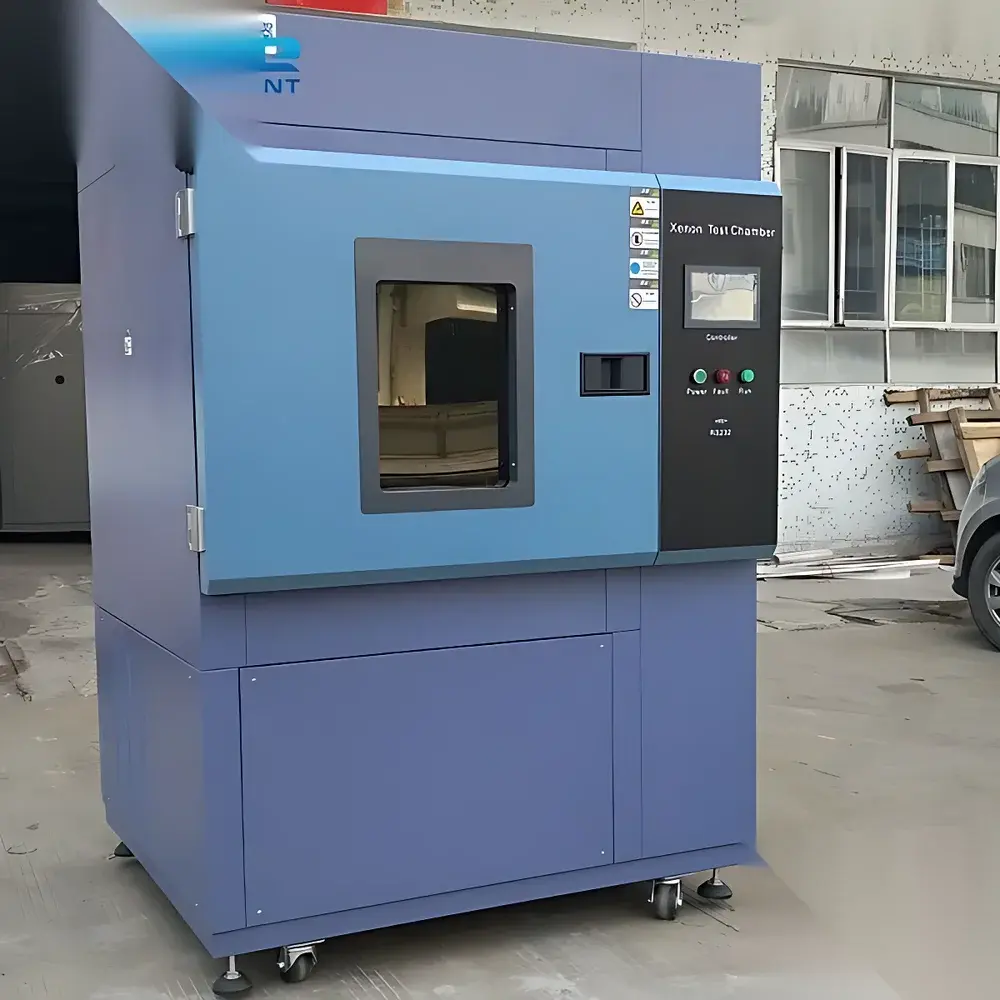
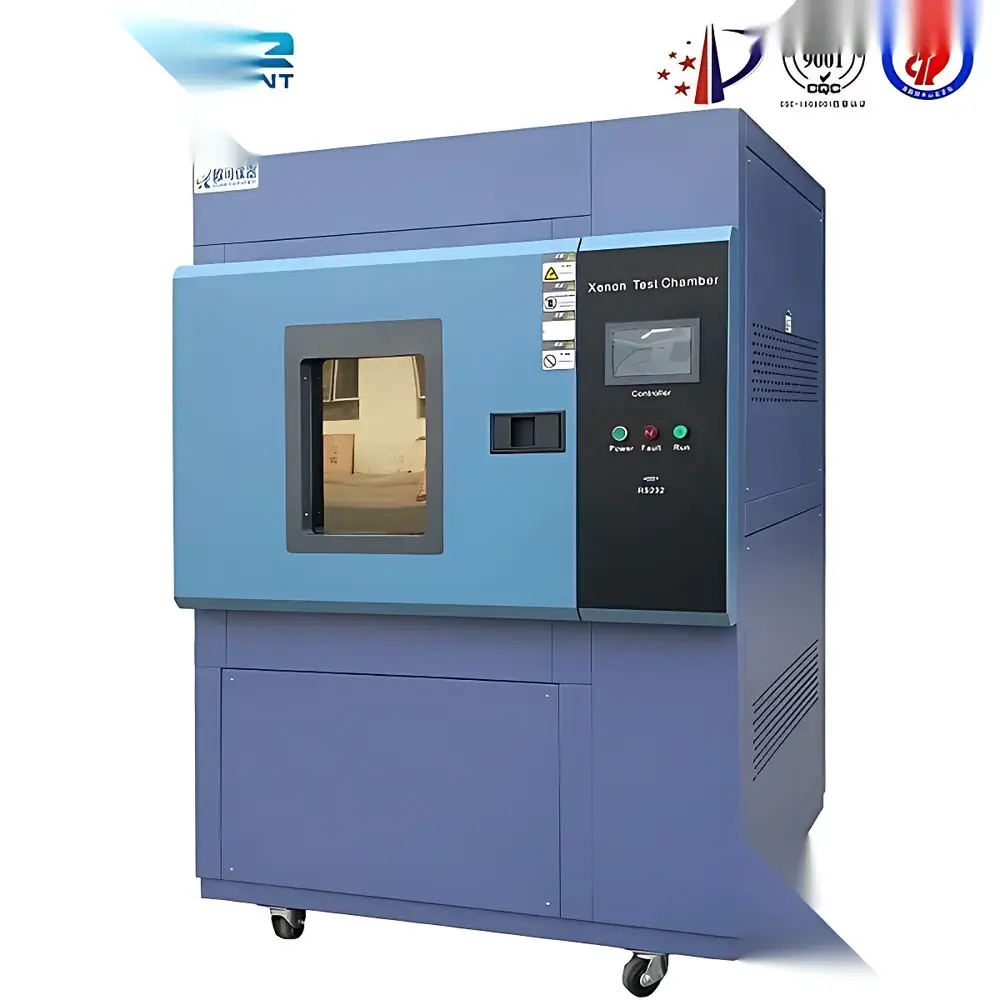
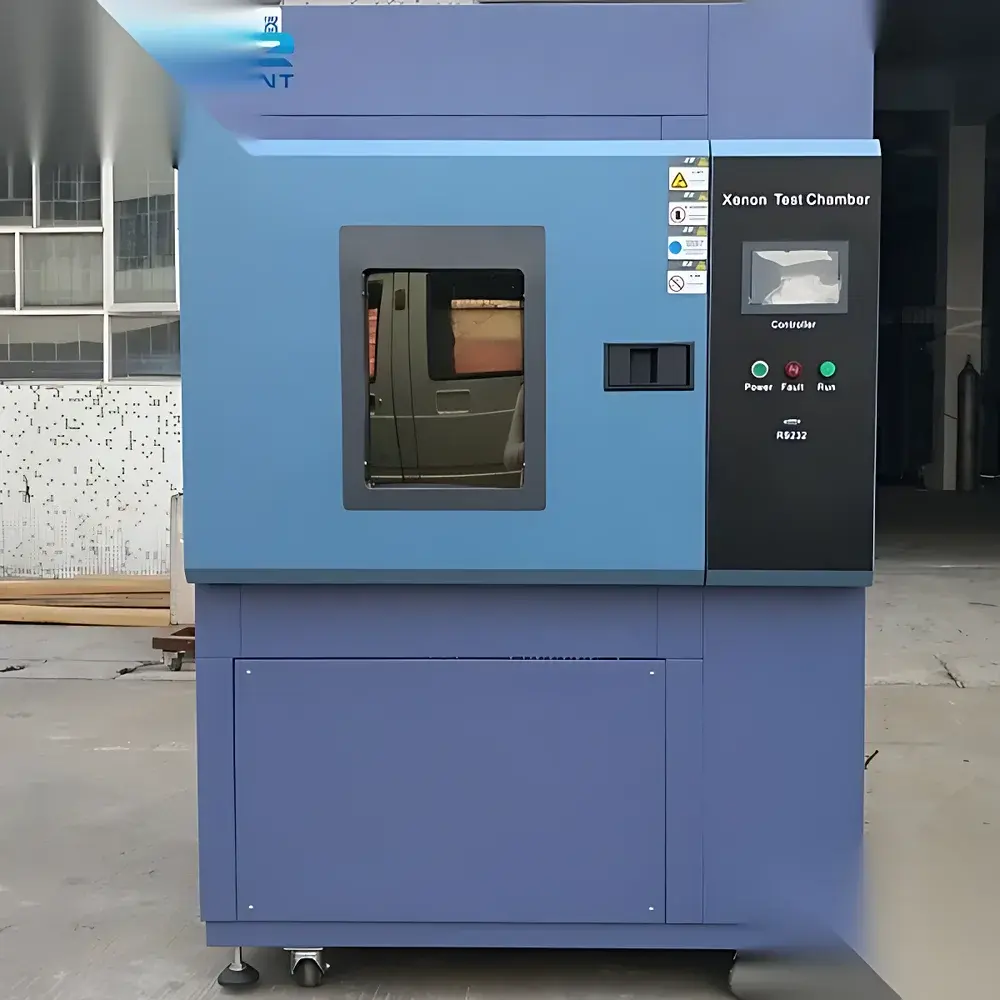
Xenon Arc Weathering Test Chamber – Model XW-7000 Series
| Temperature Range | RT+10°C to 70°C |
|---|---|
| Humidity Range | 65–98% RH |
| Rainfall Duration | 1–9999 h 59 min (adjustable) |
| Rainfall Cycle | 1–240 min (interval adjustable) |
| Irradiance | ≤300 W/m² (at specimen plane, 300–800 nm) |
| Xenon Lamp Total Power | 12.0 kW (rated lifetime: ≥1600 h) |
| Control Accuracy | Temperature ±0.1°C (set/indicated), Humidity ±1% RH |
| Black Panel Temperature Sensor | Dual-metal thermometric type |
| Heating System | Independent Ni-Cr alloy resistive heaters |
| Humidification System | External stainless steel shallow-surface evaporative humidifier |
| Air Circulation | Low-noise, high-temp-resistant centrifugal blower with multi-blade impeller |
| Power Supply | AC 380 V ±10%, 50 ±0.5 Hz, 3-phase 4-wire |
| Ambient Operating Conditions | 5–30°C, ≤85% RH |
Overview
The Xenon Arc Weathering Test Chamber – Model XW-7000 Series is an engineered environmental simulation system designed to replicate the full solar spectrum (290–2500 nm) using calibrated xenon arc lamps. It operates on the principle of accelerated photochemical degradation, enabling laboratories to assess material durability under controlled UV, visible, and near-infrared irradiation—combined with regulated temperature, relative humidity, and cyclic water exposure. Unlike UV fluorescent or metal halide systems, xenon arc technology delivers spectral energy distribution closely matching natural sunlight, making it the internationally preferred method for ISO 4892-2, ASTM G155, SAE J2527, and AATCC TM16-compliant weathering validation. This chamber supports both open-frame and filtered irradiance configurations, allowing users to simulate equatorial, subtropical, or temperate outdoor exposure conditions with metrological traceability.
Key Features
- Full-spectrum xenon arc lamp source (12.0 kW total power) with spectral output fidelity verified per CIE No. 85 and ISO 4892-2 Annex A;
- Configurable optical filtering systems—including Daylight-Q/B, Window Glass-Q, and Extended UV filters—to match application-specific irradiance profiles;
- Precise black panel temperature control (dual-metal sensor) and chamber air temperature regulation via PID-controlled Ni-Cr heating elements and low-noise centrifugal airflow;
- Independent stainless steel evaporative humidification system with external isolation design, ensuring stable RH control from 65–98% RH without mineral deposition;
- Programmable rainfall simulation: duration (1–9999 h 59 min) and interval (1–240 min) fully adjustable to emulate tropical downbursts, dew formation, or intermittent wetting cycles;
- Robust chamber construction: SUS304 stainless steel interior, high-temperature silicone door gasket, radiation-resistant borosilicate viewing window, and modular sample rack system accommodating irregular geometries;
- Industrial-grade control architecture featuring a Weintek color touchscreen HMI paired with Siemens SIMATIC S7-1200 PLC for deterministic real-time loop execution and audit-ready event logging.
Sample Compatibility & Compliance
The XW-7000 accommodates flat panels, molded parts, textiles, coatings, polymers, automotive trim, and architectural sealants up to 600 mm × 600 mm × 100 mm (W×D×H). Sample mounting utilizes corrosion-resistant SUS304 slotted rails and adjustable clamps, permitting variable tilt angles (0°–25°) to replicate real-world exposure geometry. The system meets essential safety and electromagnetic compatibility requirements per IEC 61000-6-2/-4 and EN 61000-6-3. All operational parameters—including irradiance, chamber temperature, black panel temperature, and RH—are continuously monitored and logged in accordance with GLP and ISO/IEC 17025 documentation practices. Optional calibration certificates traceable to NIST or PTB standards are available upon request.
Software & Data Management
Embedded firmware supports user-defined test protocols with up to 99 program steps, each configurable for irradiance setpoint (W/m²), temperature (°C), RH (%), rain-on/off timing, and dark cycle duration. Real-time data acquisition records all sensor inputs at 1-second intervals, stored internally for ≥30 days or streamed via Ethernet to a networked PC running optional LabView-based analysis software. Audit trail functionality complies with FDA 21 CFR Part 11 requirements when enabled: electronic signatures, user-level access control, and immutable event logs (start/stop, parameter changes, alarm triggers, maintenance alerts) are retained with timestamps and operator IDs. Export formats include CSV, PDF reports, and XML for LIMS integration.
Applications
- Automotive OEMs validating exterior trim, headlamp lenses, and interior fabrics per SAE J2412 and GMW14124;
- Polymer manufacturers assessing photostabilizer efficacy and yellowing index (ASTM D1148) in polyolefins and PVC compounds;
- Architectural coating developers evaluating chalk resistance, gloss retention, and color shift (ΔE*ab per ISO 11341) under simulated Florida or Arizona exposures;
- Textile labs conducting lightfastness testing per ISO 105-B02 and AATCC TM16-2021;
- Photovoltaic module encapsulant R&D requiring UV-induced EVA discoloration and adhesion loss quantification;
- Government metrology institutes performing interlaboratory round-robin studies on reference material aging kinetics.
FAQ
What spectral range does the xenon lamp cover, and how is it filtered?
The lamp emits continuous radiation from 290 nm to 2500 nm. Optical filters (Daylight-Q/B, Window Glass-Q) selectively attenuate short-wave UV or IR components to match specific exposure standards.
Is black panel temperature measurement included as standard?
Yes—dual-metal black panel thermometer is factory-installed and calibrated; optional digital black standard sensor (BS-1000) available for higher accuracy.
Can the system operate unattended for extended durations?
Yes—robust thermal management, redundant safety interlocks (overheat, dry-run, phase loss), and auto-recovery after power interruption ensure >1000-hour continuous operation.
How often must the xenon lamps be replaced?
Lamp life is rated ≥1600 hours at nominal irradiance; replacement interval depends on usage intensity and spectral stability requirements—typically every 1200–1500 hours for ISO-compliant testing.
Does the chamber support third-party calibration services?
Yes—full-service calibration packages (irradiance, temperature, RH) are available with accredited certificates traceable to national metrology institutes.



