
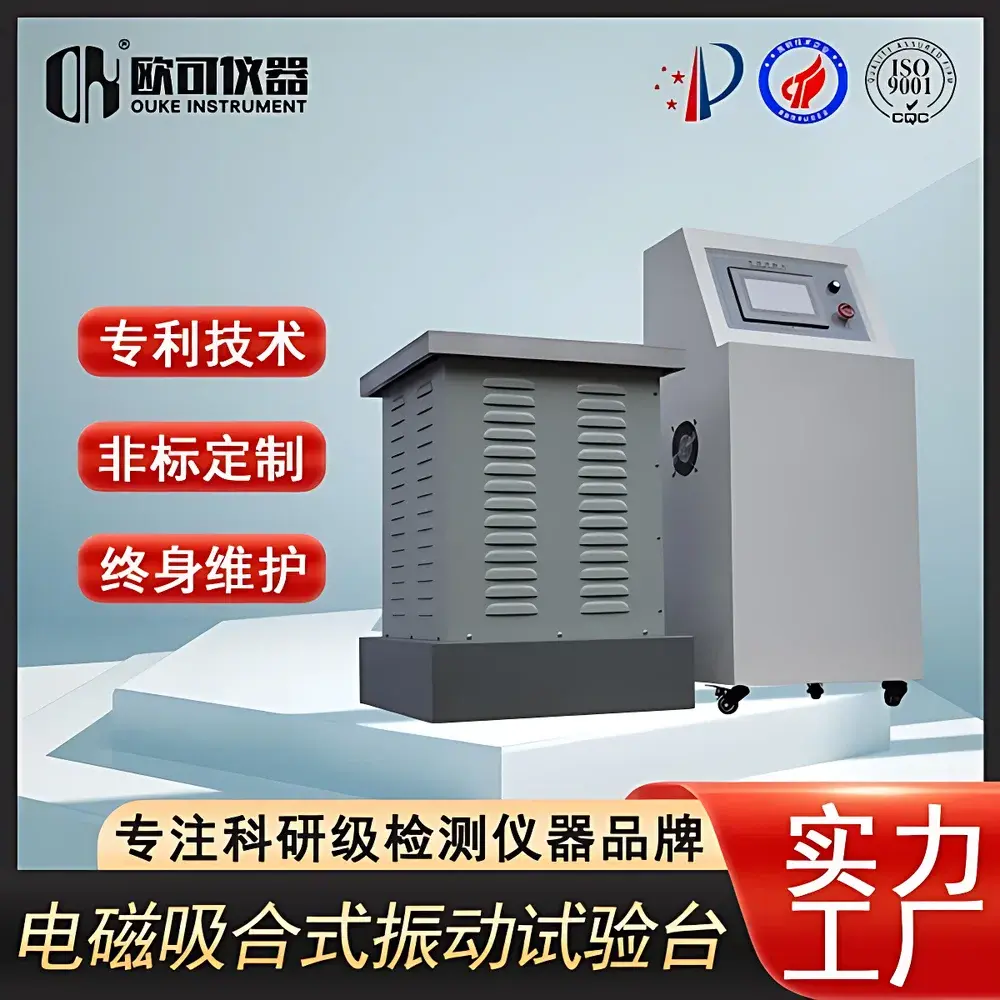
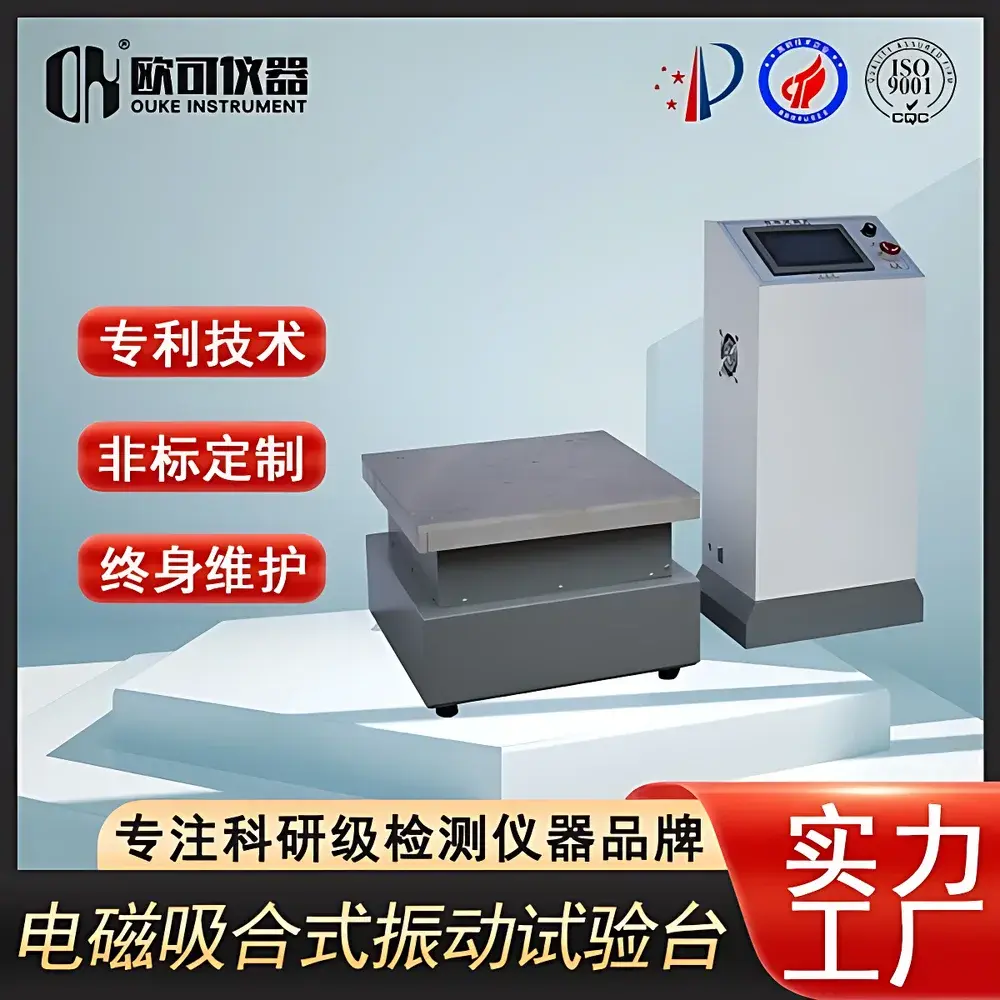
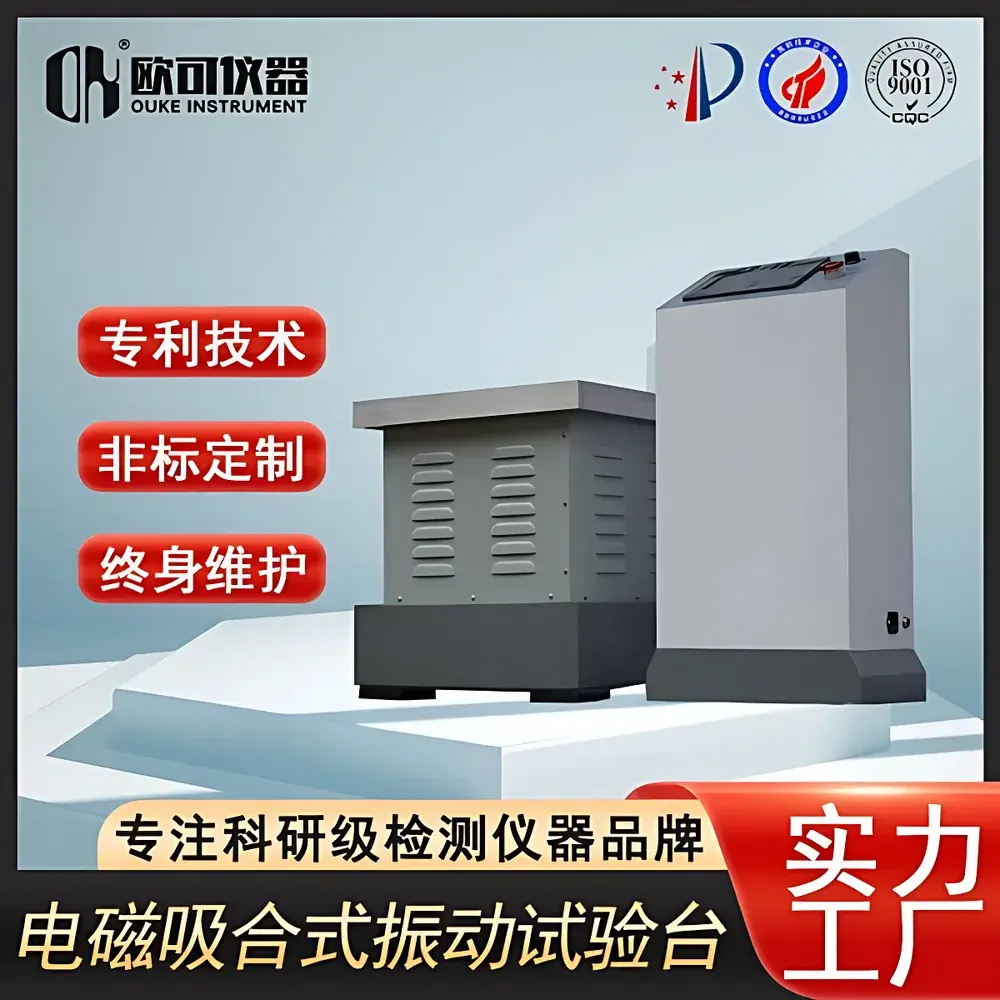
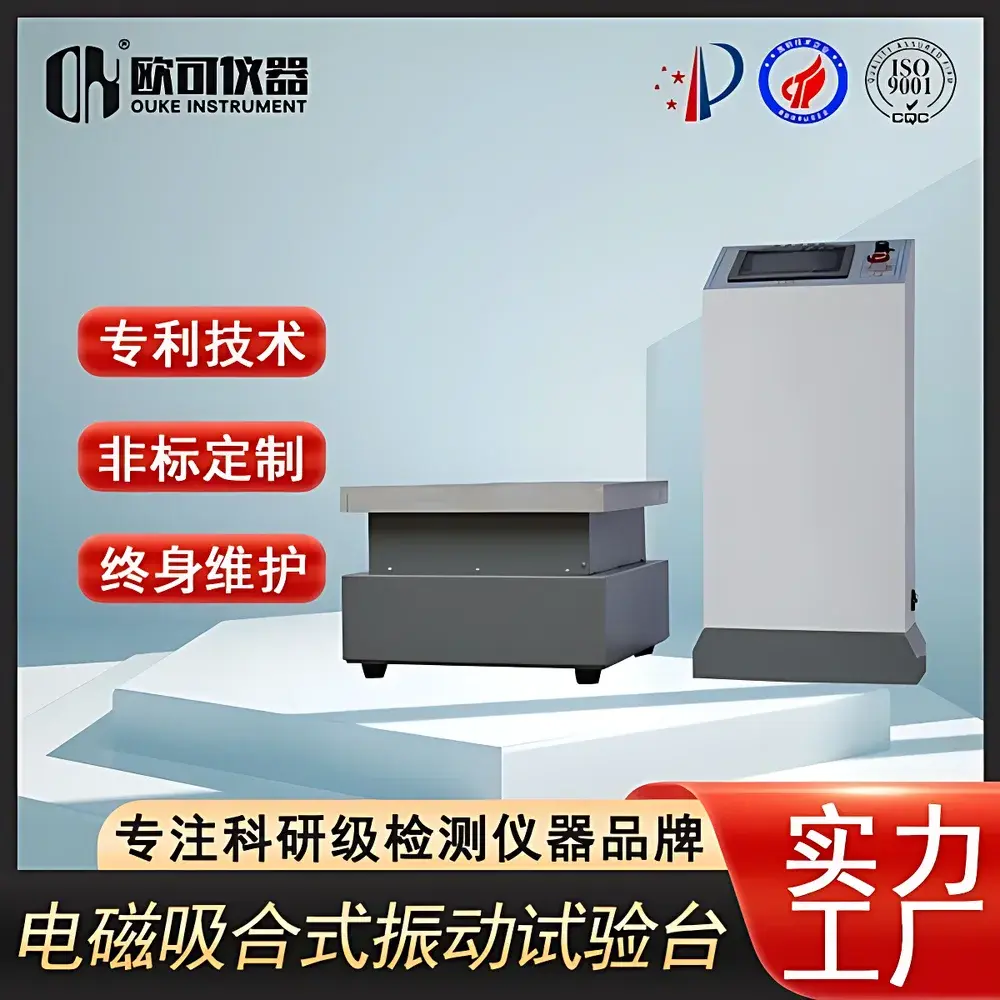
OK-XHS-50 Electromagnetic Snap-Actuated Vibration Shaker
| Brand | OK Instruments |
|---|---|
| Origin | Guangdong, China |
| Manufacturer Type | Direct Manufacturer |
| Instrument Type | Electromagnetic Vibration Shaker |
| Rated Thrust | 1.98 kN |
| Frequency Range | 5–5000 Hz |
| Max. Test Load | 70 kg |
| Table Surface | 500 × 500 mm |
| Peak Acceleration | 10 g |
| Operating Principle | Electromagnetic snap-actuation (bias-field + pulsed attraction) |
| Compliance | Designed for MIL-STD-810H, GJB 150A, IEC 60068-2-6, ISO 10816, and ASTM D999 test profiles |
Overview
The OK-XHS-50 Electromagnetic Snap-Actuated Vibration Shaker is a high-frequency, high-acceleration electrodynamic vibration testing system engineered for precision environmental stress screening (ESS) and qualification testing of lightweight, high-reliability components. Unlike conventional voice-coil electromagnetic shakers—where Lorentz force drives bidirectional motion—the OK-XHS-50 employs a specialized magnetic circuit architecture optimized for unidirectional electromagnetic attraction. In each half-cycle, a high-current pulse generates a transient magnetic field that strongly attracts the moving mass (table assembly) toward a fixed pole piece; mechanical restoration—via flexure-based suspension or inertial rebound—returns the mass to its neutral position before the next attraction pulse. This “snap-and-release” mechanism enables rapid acceleration onset, minimal phase lag, and exceptional fidelity in high-frequency sinusoidal sweep and narrowband random vibration up to 5 kHz. Its design prioritizes acceleration density (g/kg), not displacement amplitude, making it ideal for applications where test standards demand high-G, low-displacement excitation—such as aerospace avionics burn-in, MEMS device shock sensitivity assessment, and semiconductor packaging resonance analysis.
Key Features
- Electromagnetic snap-actuation architecture delivering peak acceleration of 10 g at full rated load (70 kg), with scalable performance up to >50 g under reduced-mass conditions
- Extended frequency bandwidth from 5 Hz to 5000 Hz—validated per ISO 5347-12 calibration protocols for high-frequency shaker characterization
- 500 × 500 mm aluminum table surface with 16 M8 threaded mounting holes (ISO 2041 pattern), compatible with standard fixture plates and seismic mass adapters
- Integrated high-efficiency Class-D power amplifier with real-time current limiting and thermal foldback protection
- Low-mass moving system (table + armature) with optimized magnetic flux path, minimizing eddy current losses and improving energy conversion efficiency above 1 kHz
- Front-panel interface with analog/digital I/O (±10 V, TTL sync), supporting external controller integration via IEEE-488 (GPIB) or Ethernet (LXI-compliant)
Sample Compatibility & Compliance
The OK-XHS-50 is validated for use with specimens requiring rigid mounting and minimal center-of-gravity offset—particularly printed circuit assemblies (PCBAs), inertial sensors, optical modules, and microelectromechanical systems (MEMS). Maximum payload assumes uniform mass distribution and compliance with ISO 5347-11 center-of-gravity height limits (<100 mm above table surface). The system meets mechanical safety requirements per EN 61000-6-2 (immunity) and EN 61000-6-4 (emission), and supports traceable calibration per ISO/IEC 17025 through accredited third-party laboratories. It is routinely deployed in GLP-compliant reliability labs conducting tests aligned with MIL-STD-810H Method 514.8 (vibration), GJB 150.16A (military equipment), and IEC 60068-2-64 (random vibration). Optional data logging packages provide audit-ready records compliant with FDA 21 CFR Part 11 when paired with validated control software.
Software & Data Management
The shaker operates with OK-VibControl Suite—a Windows-based application supporting real-time closed-loop control of sine, resonant dwell, swept-sine, and PSD-controlled random vibration profiles. The software implements dual-channel feedback (accelerometer + current monitor) for adaptive gain scheduling across the operational bandwidth. All test sessions generate timestamped binary data files (.okv) containing raw acceleration, drive current, and thermal sensor readings, exportable to MATLAB, Python (NumPy), or CSV for post-processing. Built-in FFT analyzers support on-the-fly resonance detection and modal damping estimation. For regulated environments, optional 21 CFR Part 11 add-ons include electronic signatures, role-based access control, and immutable audit trails covering parameter changes, calibration events, and test execution history.
Applications
- Aerospace: Qualification testing of flight-critical electronics (e.g., AHRS units, pitot-static sensors) per DO-160 Section 8
- Defense: Shock and vibration screening of fuzing mechanisms, RF transceivers, and seeker heads under GJB 150A-2009
- Automotive: High-frequency durability validation of engine control units (ECUs), knock sensors, and ADAS radar housings
- Semiconductor: Resonance mapping of wafer-level packaging, flip-chip interconnect fatigue under harmonic excitation
- Academic research: Material damping coefficient measurement at ultrasonic frequencies using forced vibration decay analysis
FAQ
What distinguishes snap-actuated shakers from conventional electrodynamic shakers?
Snap-actuated systems prioritize acceleration density and high-frequency response by exploiting unidirectional magnetic attraction rather than bidirectional Lorentz-force actuation—resulting in superior phase linearity above 1 kHz but limited peak-to-peak displacement (typically ≤ ±5 mm).
Can the OK-XHS-50 perform low-frequency, large-displacement tests?
No—it is not designed for displacements exceeding ±5 mm or frequencies below 5 Hz. For such requirements, a traditional electrodynamic shaker (e.g., OK-EDV series) or hydraulic shaker is recommended.
Is third-party calibration certification available?
Yes—OK Instruments provides NIST-traceable calibration certificates issued by CNAS-accredited laboratories, including sensitivity verification at 160 Hz, 1000 Hz, and 3000 Hz per ISO 5347-12 Annex B.
Does the system support multi-axis vibration testing?
The OK-XHS-50 is a single-axis (vertical) shaker. Horizontal or 6-DOF configurations require auxiliary slip tables or orthogonal shaker stacks—available as engineered integration solutions upon request.
What maintenance intervals are recommended?
Annual inspection of flexure suspension integrity, coil insulation resistance (>100 MΩ), and amplifier cooling fan performance is advised. No routine lubrication is required due to the non-contact electromagnetic drive principle.



