
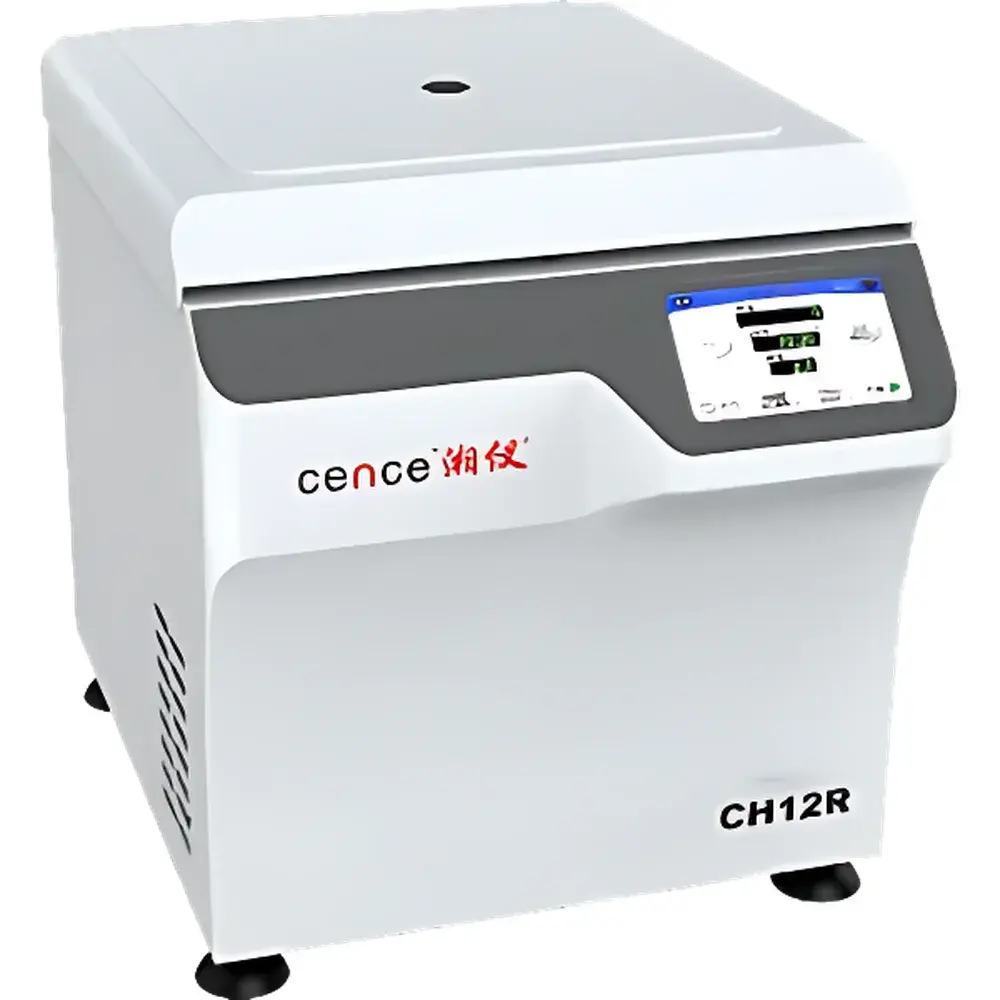
Xiangyi CH12R Blood Collection Vehicle-Specific Refrigerated Centrifuge
| Brand | Xiangyi |
|---|---|
| Origin | Hunan, China |
| Manufacturer Type | Direct Manufacturer |
| Product Category | Domestic |
| Model | CH12R |
| Instrument Type | Benchtop Centrifuge |
| Speed Class | Low-Speed Centrifuge (≤5000 rpm) |
| Function | General-Purpose Refrigerated Centrifuge |
| Configuration | Horizontal Rotor Centrifuge |
| Separation Target | Cells & Bacteria |
| Maximum Capacity | 8 × 10 mL |
| Maximum Speed | 5000 rpm |
| Maximum RCF | 3354 × g |
| Dimensions (W×D×H) | 400 × 470 × 350 mm |
| Cooling System | Hermetically Sealed Rotary Compressor |
| Control Interface | 5-inch HD Touchscreen |
| Safety Features | Overspeed Protection, Overtemperature Protection, Interlocked Lid Lock, Vacuum Suction Feet Mounting |
Overview
The Xiangyi CH12R is a purpose-engineered benchtop refrigerated centrifuge designed specifically for mobile blood collection environments—including mobile phlebotomy units, field diagnostic vans, and point-of-care laboratories operating from vehicles. It employs horizontal rotor architecture with fixed-angle or swing-out rotor configurations (depending on selected adapter set), delivering precise sedimentation forces governed by Newtonian fluid dynamics and sedimentation velocity principles (v = dr/dt = (ρp − ρm)·d²·RCF / (18·η)). Operating at a maximum rotational speed of 5000 rpm and generating up to 3354 × g, the CH12R achieves reliable separation of whole blood into serum/plasma layers, isolation of peripheral blood mononuclear cells (PBMCs), and stabilization of nucleic acid-containing samples in vacuum collection tubes (e.g., EDTA, SST, PST) and standard 8–10 mL nucleic acid extraction tubes. Its integrated hermetically sealed rotary compressor maintains temperature stability between −20 °C and +40 °C during operation—critical for preserving RNA integrity and preventing hemolysis during transit-induced vibration.
Key Features
- Mobile-optimized mechanical design featuring vacuum suction feet that provide stable adhesion to non-porous surfaces—even under dynamic vehicle acceleration, braking, or lateral movement.
- Benchtop footprint of only 400 × 470 × 350 mm, engineered for integration into confined cabin spaces without compromising accessibility or serviceability.
- 5-inch high-definition capacitive touchscreen interface with dual-parameter display: real-time simultaneous visualization of setpoint values (speed, time, temperature) and actual operational parameters (actual rpm, elapsed time, chamber temperature, RCF).
- Dual-layer insulated chamber housing constructed entirely from medical-grade stainless steel (AISI 304), ensuring corrosion resistance against repeated ethanol/wipe disinfection and compatibility with ISO 13485 cleanroom handling protocols.
- Comprehensive safety architecture including lid interlock verification, overspeed detection via Hall-effect rotor monitoring, thermal cutoff at compressor discharge, and automatic deceleration ramping to prevent sample disturbance upon stop.
Sample Compatibility & Compliance
The CH12R accommodates standardized clinical specimen containers without adapter modification: 2–5 mL vacuum blood collection tubes (including BD Vacutainer®, Greiner Bio-One, Sarstedt), 8–10 mL conical nucleic acid tubes (e.g., Eppendorf Safe-Lock™, Thermo Fisher Nunc™), and custom 10 mL polypropylene centrifuge tubes. All rotor assemblies are dynamically balanced per ISO 1585:2016 (Road vehicles — Centrifugal testing of components) and validated for sustained operation at 5000 rpm under simulated road vibration profiles (ISO 5073:2021). The unit complies with IEC 61010-1:2010 (Safety requirements for electrical equipment for measurement, control, and laboratory use) and meets electromagnetic compatibility (EMC) requirements per IEC 61326-1:2020 for mobile medical devices.
Software & Data Management
While the CH12R operates as a standalone instrument without network connectivity, its embedded firmware supports audit-trail-capable parameter logging (date/time stamp, user ID placeholder, run duration, final speed, end temperature) stored locally in non-volatile memory for up to 1000 cycles. Data export is enabled via USB 2.0 port (FAT32 formatted drive required) in CSV format, facilitating integration into LIMS workflows compliant with CLIA, CAP, and ISO/IEC 17025 documentation requirements. Firmware updates are performed offline using signed binary files, maintaining integrity per FDA 21 CFR Part 11 principles for electronic records in regulated environments.
Applications
- Routine serum/plasma separation from venous blood in mobile collection fleets, supporting downstream immunoassays (ELISA, CLIA), clinical chemistry analyzers, and coagulation testing.
- Pre-analytical processing of whole blood prior to DNA/RNA extraction—particularly critical for field-based molecular surveillance programs targeting infectious disease outbreaks.
- Stabilization of platelet-rich plasma (PRP) and buffy coat fractions in regenerative medicine transport protocols.
- Quality control centrifugation of reagent kits and calibrators during on-site deployment in resource-limited settings.
- Cell pellet formation for bacterial culture inoculation in mobile microbiology units serving rural health centers.
FAQ
Is the CH12R certified for use in moving vehicles?
Yes—the vacuum suction feet system has been tested per GB/T 28046.3-2019 (Road vehicles — Environmental conditions and testing for electrical and electronic equipment — Part 3: Mechanical loads) and demonstrates secure fixation under longitudinal accelerations up to ±0.5 g.
What temperature range is maintained during continuous operation?
The compressor sustains chamber temperatures from −20 °C to +40 °C, with ±1.5 °C uniformity across the rotor cavity at 4 °C setpoint (measured per ISO 13732-1:2006).
Can the CH12R be integrated into a hospital’s central LIMS system?
Direct network integration is not supported; however, exported CSV logs may be imported into third-party LIMS platforms supporting manual ingestion protocols.
Does the unit include rotor imbalance detection?
Yes—real-time vibration amplitude monitoring via piezoelectric sensors triggers immediate deceleration if imbalance exceeds 0.15 mm/s RMS, in accordance with ISO 1940-1:2003 balance quality grade G6.3.
Are rotors autoclavable?
No—rotors are precision-machined aluminum alloy (6061-T6) with anodized coating; cleaning must be performed with 70% isopropyl alcohol and soft lint-free cloths only.
Related Products



